
Not every trader is the same.
Most traders look for things like security, low fees, easy navigation, and a good range of assets.
But once traders gain experience, they do not choose a crypto exchange based on features alone.
Their choice depends on how well the platform fits their trading style.
For example, a scalper may leave if your platform has high spreads or slow execution. A day trader may look for reliable charts and tools to help them make quick decisions.
And it does not stop there.
There are many trading strategies in the crypto market, and some traders follow very specific strategies that need different tools and features.
For exchange owners, this creates a great opportunity.
Instead of building a platform that tries to serve everyone in the same way, you can build a crypto exchange around the needs of different trader groups.
So, let's look at the key trading strategies you should understand when building a crypto exchange and the features you can consider to attract today's traders.
Why Trading Strategies Matter For Exchanges?
Trading strategies influence how traders interact with a platform. Most traders follow a method to decide when to enter, hold, and exit trades. When a platform supports these approaches, it becomes easier for businesses to attract users and keep them active.
For businesses building a trading platform, supporting multiple strategies is not just a feature. It directly impacts how traders choose and continue using the platform.
Some reasons why this matters include:
- Traders prefer platforms that match their trading approach
- Different strategies help attract a wider user base
- More trading activity can increase platform usage
- Strategy-based features improve user experience
- Platforms with flexible tools are often chosen over basic ones
- Supporting common strategies helps retain both new and experienced users
This is especially important in cryptocurrency exchange development, where platform features directly influence trading volume and user engagement.
Now that we see how strategy support impacts platform growth, let’s look at the strategies traders commonly use.
Top 10 Trading Strategies That Help Exchanges Attract More Traders
Traders rely on specific strategies to plan their trades and respond to market movements. Below are 10 trading strategies that businesses should consider when building or improving a trading platform.
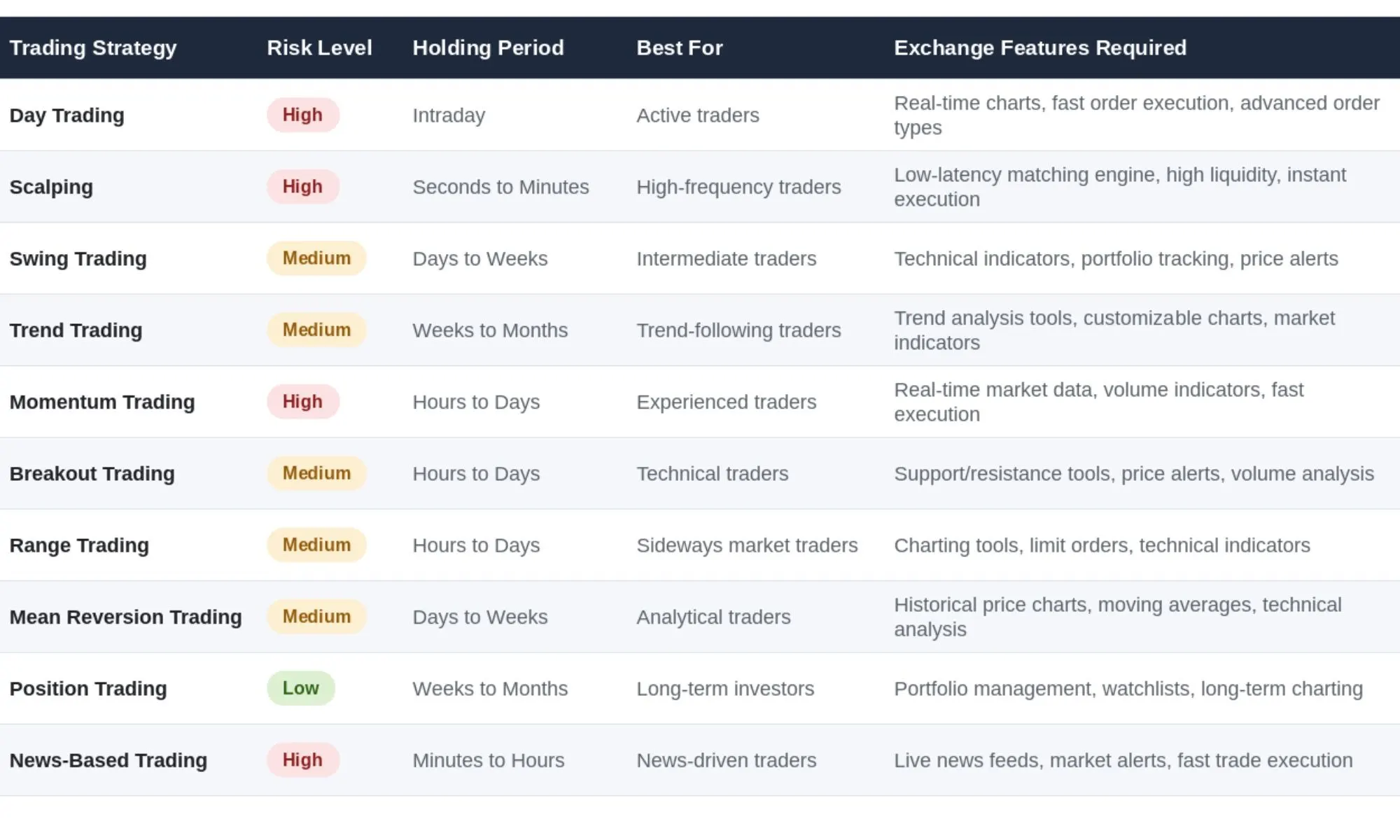
1. Day Trading
Day trading is a popular strategy where traders open and close positions within the same day. Instead of holding assets for long periods, they focus on small price movements during the day.
How It Works?
- Traders monitor price movements throughout the day
- Positions are opened and closed within a single trading session
- Traders rely on charts and market indicators to identify opportunities
- No positions are usually carried overnight
Why does it matter?
Platforms that support fast trade execution and real-time data are more suitable for day traders. This can increase user activity and encourage frequent trading.
2. Scalping
Scalping focuses on making many small trades within a short time. Traders aim to capture small price changes instead of waiting for large market moves.
How It Works?
- Traders place multiple trades within minutes or seconds
- Each trade targets small price changes
- The strategy relies on quick decision-making
- High trading activity is common with this approach
Why does it matter?
Scalping requires platforms to handle high trade volumes without delays. Systems that can process frequent orders are more likely to attract highly active traders.
3. Swing Trading
Swing trading focuses on holding positions for a longer period to benefit from medium term price movements. Traders aim to take advantage of market shifts that develop gradually.
How It Works?
- Traders hold positions for a few days or weeks
- They look for price swings between highs and lows
- Market trends and patterns guide entry and exit decisions
- Technical analysis often plays an important role
Why does it matter?
Swing traders look for platforms that offer clear charts and easy position tracking. Supporting this style can help attract users who trade less frequently but stay engaged over time.
4. Trend Trading
Trend trading involves identifying the direction of the market and trading in that direction. Traders attempt to benefit from upward or downward market trends.
How It Works?
-
Traders identify whether the market is moving upward or downward
- Trades are placed in the same direction as the trend
- Indicators and price patterns help confirm trends
- Positions are held while the trend continues
Why does it matter?
Trend traders rely on clear market direction and simple tools to follow it. Platforms that offer easy to read charts and trend indicators can better support this approach.
5. Momentum Trading
Momentum trading focuses on assets that show strong movement in a particular direction. Traders aim to enter the market while the momentum continues.
How It Works?
- Traders identify assets experiencing strong price movement
- Trades are placed in the direction of the momentum
- Volume and price changes help identify momentum
- Positions are often closed when the momentum slows down
Why does it matter?
Momentum trading depends on timely market signals and quick order placement. Platforms that reflect price changes accurately can better support this style and attract active traders.
6. Breakout Trading
Breakout trading occurs when the price of an asset moves beyond a level where it has previously stayed for some time. This movement often signals the start of a new trend.
How It Works?
- Traders identify support or resistance levels
- Trades are placed when the price breaks beyond these levels
- Breakouts often lead to strong price movement
- Traders monitor market volume to confirm the breakout
Why does it matter?
Breakout trading depends on accurate price levels and timely updates. Platforms that reflect these changes clearly can help users act quickly and stay confident in their trades.
7. Range Trading
Range trading is used when the market moves between a consistent high and low price level. Traders attempt to profit from repeated movements within this range.
How It Works?
- Traders identify support and resistance levels
- Buy orders are placed near the lower range
- Sell orders are placed near the upper range
- The strategy works best when the market moves sideways
Why does it matter?
Range trading relies on clearly defined price levels. Platforms that display these levels well and allow easy order placement can make this approach more practical for users.
8. Mean Reversion Trading
Mean reversion is based on the idea that prices tend to return to their average level over time. Traders look for situations where the price has moved far away from its typical range.
How It Works?
- Traders identify assets that have moved far from their average price
- Trades are placed expecting the price to move back toward the average
- Price history helps identify the average range
- The strategy focuses on temporary market extremes
Why does it matter?
This strategy depends on clear price history and comparison with past data. Platforms that present this information in a simple way can help users make better decisions.
9. Position Trading
Position trading focuses on long-term market movements. Traders hold assets for weeks, months, or sometimes longer based on broader market trends.
How It Works?
- Traders analyse long-term market trends
- Positions are held for extended periods
- Short-term price fluctuations are usually ignored
- Market fundamentals often influence decisions
Why does it matter?
Position traders need platforms that support long-term tracking and easy portfolio management. Providing these features can help retain users who stay invested over time.
10. News-Based Trading
News based trading involves making decisions based on important announcements or events that affect the market. These events can influence price movement quickly.
How It Works?
- Traders monitor economic or industry news
- Major announcements can trigger price movement
- Traders enter the market when news impacts sentiment
- Positions are adjusted as market reactions develop
Why does it matter?
This strategy depends on timely information and quick response. Platforms that provide fast updates and clear order execution can better support users during high impact events.
Why Businesses Are Building Strategy-Friendly Trading Platforms?
The trading industry has grown quickly, and many businesses are launching their own platforms.
Many startups prefer a white label to launch faster with built in trading features. This helps attract more traders and improve long-term engagement.
This shift is mainly driven by:
- Growing interest in online trading worldwide
- Demand for more practical trading tools
- Businesses launching their own branded platforms
- The need to stand out in a competitive market
As the industry continues to evolve, platforms built with the right strategy support are more likely to attract users and grow consistently.
We at Hashcodex, a trusted fintech software development company, build platforms designed around real trading strategies. By integrating commonly used methods into the system, we make it easier for platforms to support different trading styles and user needs.
Conclusion
Trading platforms today need to offer more than just basic features. Traders expect platforms that match how they trade and make it easy to apply their strategies. When a platform meets these expectations, it naturally becomes a place users return to.
The right combination of features, clarity, and usability can make a clear difference in how users engage and stay active over time.
If you are planning to build a trading platform that supports real trading strategies, having the right approach from the start matters.
Connect with us today to get started.









 NDA on Request
 Free Consultation – Let’s discuss your ideas