Finding the right binary options trading software development company can be difficult.
Why? Because many providers offer similar services.
Some offer ready-made platforms, while others build software around your business needs.
Based on my research across search engine results pages (SERPs), I found around 30+ companies offering binary options trading software development services.
There is no official global list of these companies, so this number is based on publicly available search results and company websites.
Among them, around 15 vendors are publicly identifiable and actively operating, including Hashcodex.
However, not every company will understand your business plans in the same way. Some may offer what you need, while others may not fit your project.
But how do you find the right fit? 🤔
Whether you're starting your first business or have had a disappointing experience with a previous vendor, this guide can help you make a more informed decision.
You'll learn what to consider when choosing the right partner and why Hashcodex could be a good fit for your project.
TL;DR
-
Hashcodex provides custom binary options trading platform development services to ensure the software is built around your business needs, with custom logic rules, payment methods, risk-management support, 100% source-code access, and external code audits.
-
Get complete trading infrastructure to run your business, including custom charts, a trading engine, wallets, payments, KYC and AML checks, CRM, risk controls, and an admin panel.
-
Binary trading platform includes data encryption, admin action logs, load testing, backups, and other security features to strengthen your binary options trading platform.
-
Basic custom builds cost approximately $15,000-$40,000 and take 2–4 weeks. Advanced builds cost $50,000- $100,000+ and take a few months. Licensing and legal costs are excluded.
What Is Binary Options Trading Software?
Binary option trading software is a type of system that allows users to predict whether the price of an asset will move upward or downward within a specific time period. If the prediction is correct, the trader receives a fixed payout based on the platform's trading rules. If the prediction is incorrect, the trader can lose the amount placed on the trade.
A binary trading platform can support different trading assets based on the business model, including currencies, cryptocurrencies, commodities, and stocks. The platform can include trading charts, asset selection, expiry times, trade execution, payout calculation, and trade history. The interface can also be designed to be simple enough for beginners to understand and use.
Developing a binary options trading platform involves creating a digital space where users can register, trade, deposit and withdraw money, and view their trading history. This platform must be fast, reliable, and secure because it deals with real money and sensitive user data. It also needs to provide accurate market data and allow users to trade with just a few clicks.
The development of such a platform requires collaboration between financial experts, software developers, UI designers, and cybersecurity specialists. The main goal is to create an intuitive experience for users while maintaining the safety and functionality of the platform.
Binary Options Trading Software Development Company
Hashcodex is a binary options trading software development company that builds jurisdiction-aware, audit-ready trading infrastructure. We help startups, fintech businesses, brokerages, financial institutions, and existing binary options brokers build platforms with strong settlement integrity, wallet reconciliation, risk controls, and post-launch reliability.
We provide 100% source-code access and all necessary credentials, so you have full control over your platform.
We build the core systems that run your business, including:
- Trading engine
- Custom trading charts
- Wallets and payments
- KYC and AML checks
- Risk controls
- CRM
- Admin panel
We also support web and mobile applications, strong data encryption, admin action logs, external code audits, load testing before launch, and backup and disaster recovery solutions.
Want proof of our work? See the real example below.
Binary options software can fit different types of businesses. You may be starting a new brokerage, adding binary options to an existing product, or looking for better software for your current business.
Forex and CFD Brokers
Already running a forex or CFD brokerage? You don't need to start everything from the beginning. You can add binary options to your existing business and connect it with your users, payments, CRM, and back-office system.
New Brokerage Businesses
Starting a new binary options brokerage? You can build the platform around your business from the start. This can include user accounts, trading, wallets, payments, KYC, CRM, admin tools, and reporting.
Fintech Startups
If you are building a fintech product and want to add trading services, a binary options platform can become part of your offering. It can connect with your existing payment, identity verification, wallet, and other financial systems.
Already running a trading platform but need more control? You can build your own software and decide how trading rules, payouts, users, payments, risk settings, and other platform functions should work.
Financial Technology Companies
If your company already provides financial technology services, you can add binary options to your existing product range. APIs can connect the new platform with your current users, payment systems, wallets, and other services.
White Label Providers
Want to offer your trading software to different businesses? A white-label or multi-tenant platform lets you support multiple brands from one software system. Each brand can have its own design, users, payment setup, and settings.
Businesses Replacing Existing Software
Is your current software becoming expensive or difficult to change? You can move to a custom platform if you need better control over the technology, business rules, integrations, or source code.
Already have a trading or financial platform that is working well? You can add binary options, new assets, mobile apps, payment methods, CRM features, or risk controls without rebuilding the whole platform.
Binary Options Trading Software Development Services
Looking to build your own binary options trading platform? We can build the complete software around your business model, including the trading engine, market data, payments, wallets, CRM, and admin panel.
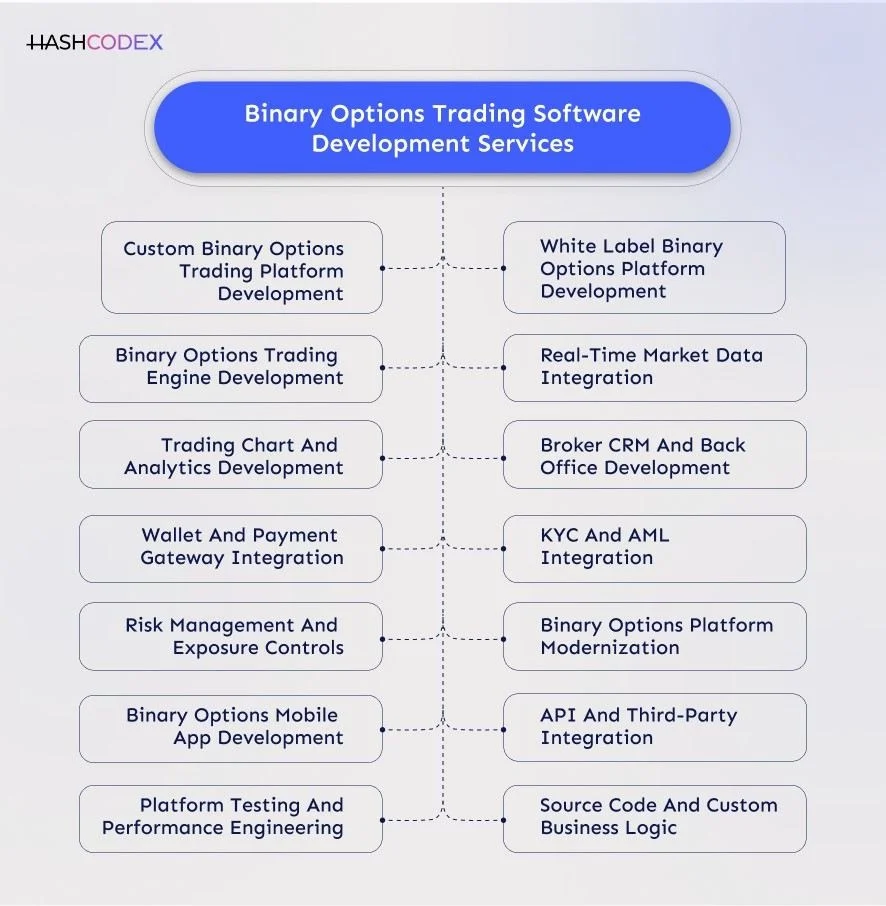
Build a platform around your trading rules, payout logic, user flow, and business requirements. We can customize the trading interface, asset management, expiry settings, user roles, risk controls, and backend business logic.
Launch a branded binary options platform using an existing software foundation. We can customize the branding, trading interface, payment setup, user management, admin panel, and other modules based on your requirements.
Binary Options Trading Engine Development
The trading engine is the core of the platform. We can build the logic that handles trade requests, call/put orders, expiry times, payout calculations, trade settlement, and trade history.
Real-Time Market Data Integration
Connect your platform with market data providers through APIs and WebSocket connections. The platform receives price updates and displays them across trading charts, asset pages, and the trading interface.
Trading Chart and Analytics Development
Build trading charts with live price updates, candlesticks, timeframes, indicators, and historical data. We can create a charting experience that fits your platform requirements instead of relying completely on third-party solutions.
Broker CRM and Back Office Development
Manage leads, traders, KYC status, deposits, withdrawals, support requests, campaigns, and user activity from one back-office system. CRM and trading operations can work together so your team can manage the complete customer journey.
Wallet and Payment Gateway Integration
Connect fiat payment gateways, cryptocurrency payments, wallets, and other payment services. The platform manages deposits, withdrawals, balance updates, transaction records, and payment status.
KYC and AML Integration
Connect identity verification and compliance services to your onboarding process. Verify users, collect required information, monitor account status, and maintain records based on your business and jurisdiction requirements.
Risk Management and Exposure Controls
Give administrators control over trading limits, payout settings, available assets, user limits, and other risk parameters. These controls can be connected directly to the trading engine and admin panel.
Binary Options Mobile App Development
Extend your platform to Android and iOS so users can access their accounts, view market data, place trades, manage wallets, and check trade history from mobile devices.
Already have a trading platform? We can update existing systems, replace difficult third-party dependencies, improve the frontend, connect new APIs, and rebuild selected modules without replacing the entire platform.
API and Third-Party Integration
Connect your platform with payment providers, market data services, KYC providers, CRM systems, notification services, analytics tools, and other third-party APIs required by your business.
Test key platform functions, including trade execution, expiry, settlement, payments, wallet updates, API failures, and real-time connections before launch. Performance testing can also help identify bottlenecks as platform activity increases.
Source Code and Custom Business Logic
If you need more control over your platform, we can build the software around your business logic and provide source code ownership based on the agreed project terms. This gives your team the flexibility to modify and extend the platform in the future.
Real Example: A Singapore Client
One of our Singapore-based clients came to us with high costs, slow performance, and a need for custom charts. We built a custom binary trading platform for them.
Results We Delivered:
- Yearly cost dropped by 70%
- Chart rendering became 2x faster
- The client gained full control over risk management, trading bots, market sentiment, analytics, and admin tools
Results are based on the client’s previous platform costs and performance benchmarks before migration.
Also Read
You can read the full story of our binary trading platform case study here
Many Will Leave. Few WillBuild Something Real.New plans. New projects. New results. Or just another scroll session. You choose the story.
Types of Binary Options Trading Models We Can Build
Binary options trading continues to grow in popularity, and different software solutions are available in the market. Below are the types of binary trading models we develop.
1. Cash-or-Nothing Binary Options
This is one of the most common binary options models. Your platform can let users predict whether an asset price will move up or down before a set expiry time.
- The platform checks the price at expiry.
- It applies your defined payout rules.
- The trade result and payout are recorded automatically.
2. One-Touch Binary Options
In this model, users predict whether an asset price will reach a specific level during the option period.
- Your platform monitors the price against the selected level.
- If the level is reached, the trade is settled based on your rules.
- You can configure the target price, expiry, and payout settings.
3. Boundary (Range) Options
Here, users predict whether an asset price will stay within a defined price range during the option period.
- You can set the upper and lower price levels.
- The platform tracks the price during the trade.
- The trade is settled based on whether the price stays within the defined range.
4. No-Touch Binary Options
This model works differently from One-Touch options. Users predict that the price will not reach a selected level before expiry.
- Your platform monitors the selected price level.
- The trade remains active until the expiry time or defined condition is reached.
- Settlement and payout are handled according to your configured rules.
These are the types of binary options trading models we develop for businesses based on their requirements.
We build custom binary options trading platforms with essential business protection features that help operators manage trades, payments, market data, security, and daily operations. Here is a list of the features we provide.
1. Trading Interface
Provides a clear trading screen with asset lists, live market prices, trade amounts, expiry times, and payout details. Operators can customise the layout and trading options to match their business needs.
2. Market Data Integration
Connects the platform with trusted market-data providers to receive and display asset prices. Operators can choose suitable data sources based on their trading needs and platform requirements.
3. Jurisdiction-Aware Product Catalog
Controls which products and trading features are available in each location. Helps operators follow local rules by managing access based on business-location requirements and verified account details.
4. Stale-Price Circuit Breaker
Automatically stops trades when market prices are delayed, incorrect, or unreliable. Helps operators prevent incorrect trade results, payout errors, and losses caused by poor market data.
5. Settlement Replay and Proof Pack
Creates a clear record of every completed trade, including entry price, expiry time, final result, and payout calculation. Helps operators check settlements and resolve payment disputes.
6. Payment Integration
Connects the platform with payment providers to manage deposits and withdrawals. Supports options such as bank transfers, cards, e-wallets, and cryptocurrencies based on business needs and provider availability.
7. Demo Trading
Provides a demo environment where operators can offer practice trading with virtual funds. Helps demonstrate platform features and allows new users to understand how trading works without using real money.
8. Security and Account Access
Includes security features such as two-factor authentication, role-based access, and data protection. Helps operators control staff access, protect important business information, and secure platform settings.
9. Responsible-Trading Control Center
Provides tools to manage deposit limits, cooling-off periods, self-exclusion, and trading-activity monitoring. Helps operators support safer trading practices and meet responsible-trading requirements.
10. Ledger-First Wallet Reconciliation
Records every wallet-balance change, including deposits, withdrawals, payments, and trade results. Helps operators track transactions, check account balances, and find payment or settlement errors.
11. Admin Panel
The admin panel gives your team control over platform operations.
It can include:
- Manage users and account access
- Add or manage trading assets
- Set trading conditions
- Monitor trades
- View deposits and withdrawals
- Check platform reports
- Manage affiliate and referral programs
These features help operators reduce payout disputes, improve financial control, manage risk, and run a more reliable trading platform.
Want to see how these features could work for your platform? Contact Hashcodex to discuss your binary options software requirements and request a demo.
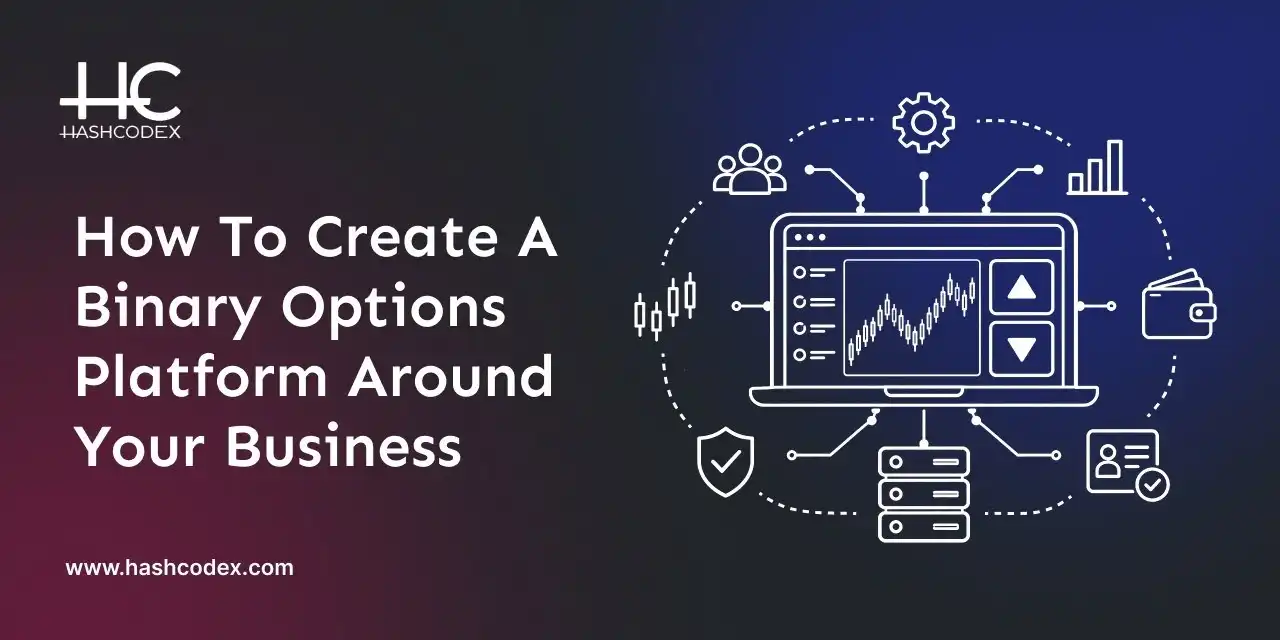
A binary options platform connects multiple systems to manage trading, market data, payments, and user accounts. Each component plays a specific role in processing trades from placement to final settlement. Below is the visual architecture of a binary options trading platform.
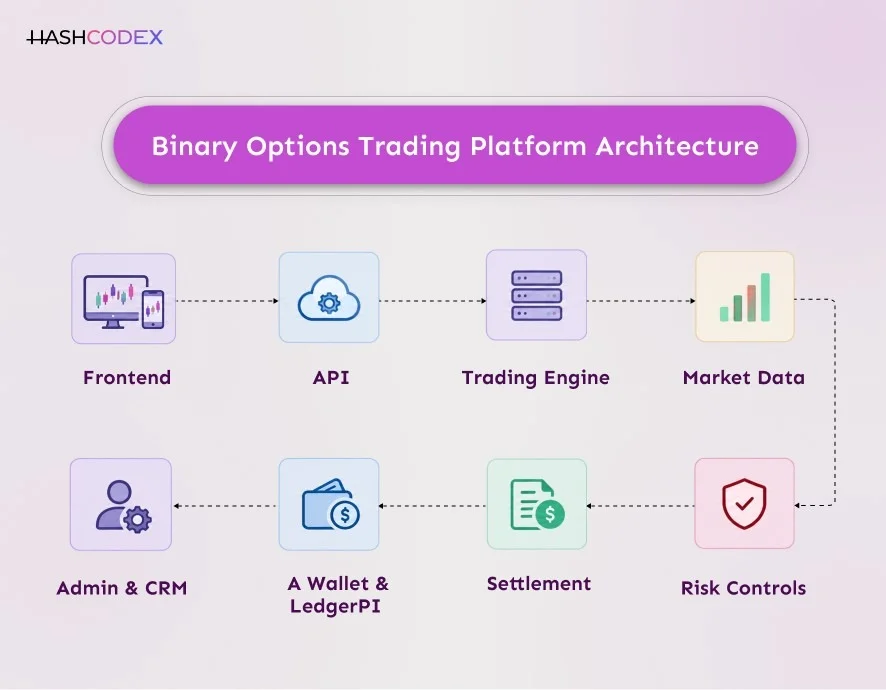
Before building a binary options platform, you need to decide how the business will make money. This decision also affects the trading rules, payment system, wallet, CRM, and admin panel.
The platform can charge fees for activities such as deposits, withdrawals, account services, or other selected transactions. The fee rules can be set according to the business model.
Subscription Plans
You can offer different plans for users based on the features and limits they need. For example, a basic plan can include standard features, while higher plans can offer additional tools or higher limits.
Referral Commissions
The platform can include a referral program where partners receive a commission for bringing new users. The CRM can track referrals, commissions, and payouts.
White-Label Licensing
A software provider can license the platform to other businesses. Each business can use its own brand, selected features, payment methods, and business settings.
Custom Revenue Models
Some businesses may have their own way of generating revenue. In that case, the trading engine, wallet, payment system, and admin panel can be developed around those requirements.
Plan the Revenue Model Before Development
Your revenue model should be decided before development because it can affect how the platform handles trades, payments, user accounts, commissions, and reports. This helps the development team build the required features from the beginning.
10 Questions to Ask Before Choosing a Binary Options Software Development Company
- Do you build the trading engine yourself or use a ready-made solution?
- Can I see a live demo before I decide to work with you?
- Will I own the full source code after the project is completed?
- Can you add new features if my business grows in the future?
- Which market data and price feed providers do you support?
- How do you keep the platform running during busy trading hours?
- Do you provide a white-label solution or a fully custom platform?
- How much experience do you have in building binary options trading platforms?
- What kind of support do you provide after the platform goes live?
- Can you share real project results or client success stories with me?
For a closer look at different providers and their offerings, read our binary options vendor comparison guide.
Why Choose Hashcodex as Your Binary Options Trading Software Development Company?
Hashcodex is a trading software development company that helps you build a binary options trading platform around your business needs. We build the core systems that manage trade execution, settlements, customer funds, and risk controls, so your platform operations can be independently verified.
Since these systems need to work together, we develop the binary options contract engine with a focus on settlement accuracy and the regulatory requirements of your target markets. We also follow milestone-based payments, so you can track project progress and know what is being delivered at each stage.
Once the project is complete, you receive full source code access under our perpetual licensing model, giving you greater control over your platform. We also plan for disaster recovery, data backups, and platform availability, with a 99% uptime commitment. As your business grows, the platform can be built to support an increasing number of users.
Beyond the core trading system, we can also include demo trading and educational simulations to help users understand the platform and interact with its features. Whether you want to launch your own binary options trading platform or offer subscription-based trading software to other brokers, We align our solutions with your business goals.
Ready to discuss your idea? Contact Hashcodex today to get a demo and explore how we can build a custom binary options trading platform for your business.
Here is the step-by-step process we follow to develop your binary options trading software project.
1. Understand Your Business
First, we learn how you want your platform to work, who will use it, and what you want to offer. This helps us plan the right software for your business.
We decide what your platform needs, such as trading, user accounts, payments, wallets, CRM, and an admin panel.
3. Choose Trading Assets and Rules
We set up the assets you want to offer, along with trade types, expiry times, payout rules, and trading limits.
4. Connect Live Market Data
Your platform needs current price information to run trades. We connect market data providers and bring those price updates into your trading platform.
5. Build the Trading Engine
The trading engine handles the main trading work. It receives trades, checks the details, manages expiry times, calculates payouts, and records the final result.
6. Build the Trading Screen
We create the main screen where users can choose an asset, view its price, select trade details, place a trade, and check their trade history.
7. Add Charts and Market Data
We can add live charts, candlesticks, timeframes, indicators, and past price data so users can view the market information provided by your platform.
8. Connect Payments and Wallets
We connect the payment methods and wallets your business needs for deposits, withdrawals, and account balances.
9. Add KYC and AML Checks
We connect KYC and AML services to verify users and collect the information required for your business and target market.
10. Set Up CRM and Back Office
Your team needs a place to manage the business. The CRM and back office can help manage users, leads, KYC status, deposits, withdrawals, support, and reports.
11. Add Risk Controls
We add controls for things such as trading limits, payout settings, available assets, and user limits. Your admin team can manage these settings from the platform.
12. Connect Other Services
If your business already uses other software, we can connect it with the platform. This can include payment systems, KYC providers, CRM tools, notifications, analytics, and other APIs.
13. Build Web and Mobile Apps
You can offer the platform through a web browser or mobile apps. Users can access their accounts, view prices, place trades, manage their wallets, and check their trade history.
14. Test Everything
Before launch, we test the important parts of the platform. This includes trades, expiry, payouts, price updates, payments, wallet balances, and API connections.
Once testing is complete, we deploy the platform and make it ready for real users. We can also monitor the main systems after launch.
16. Give You Control of the Software
If source code ownership is part of your project, we provide the source code based on the agreed terms. You can then make changes or add new features as your business grows.
This is not another blog. This is yourNext Move
You have done the research. You have seen the ideas. Now it is time to actually do it
Structured start.No rework later.
Here are the technologies we use to build a high-performance binary options trading platform with fast trade execution and live market updates.
| Platform Area |
Technology |
Purpose |
| Frontend |
React, Vue, Angular |
Trading screens, dashboards, charts, and admin panels |
| Backend |
Node.js, Python, Java, PHP, Go |
Business logic, APIs, user management, and platform operations |
| Trading Engine |
Node.js, Go, WebSocket |
Trade processing, expiry, settlement, and real-time updates |
| Market Data |
WebSocket, REST APIs |
Live prices, historical data, and market updates |
| Database |
PostgreSQL, MySQL, MongoDB |
Users, trades, wallets, transactions, and platform records |
| Mobile |
Flutter, React Native, Kotlin |
Android and iOS trading applications |
| Cloud Infrastructure |
AWS, Google Cloud |
Hosting, servers, storage, and platform deployment |
| DevOps |
Docker, Kubernetes |
Application deployment, containers, and infrastructure management |
| Security |
SSL, Encryption, RBAC, 2FA |
Deposits, withdrawals, payment status, and transaction updates |
| API Integration |
REST APIs, WebSocket APIs |
Connecting market data, KYC, payments, CRM, and other services |
| Payment Integration |
Payment APIs, or Creating a Custom System |
Deposits, withdrawals, payment status, and transaction updates |
A binary options platform connects users, market data, trading, payments, and settlement in one system. Here is how a typical trade moves through the platform.
1. User Registration
A user creates an account by providing the required personal and contact details.
2. KYC Verification
The platform verifies the user's identity through the connected KYC service before allowing access to required features.
3. Wallet Funding
After verification, the user can add funds through the available payment methods. The wallet balance is updated after a successful deposit.
4. Asset Selection
The user chooses an available asset, such as a currency, cryptocurrency, commodity, or stock.
5. Market Data
The platform receives price updates from the connected market data provider and displays them on the trading screen.
6. Trade Request
The user selects the trade direction, amount, and expiry time, then submits the trade.
7. Trade Validation
The trading engine checks the trade details, account balance, asset availability, trading limits, and other required rules.
8. Expiry
The trade stays active until the selected expiry time. The platform records the required market price at expiry.
9. Settlement
The trading engine compares the required prices and determines the trade result based on the platform's rules.
10. Payout
If the trade meets the defined winning conditions, the applicable payout is added to the user's balance. Otherwise, the amount is handled according to the platform rules.
11. Ledger Update
The system updates the user's wallet and transaction records so every balance change is recorded.
12. Reporting
The platform stores trade, payment, wallet, and user activity data for administrators and business reporting.
The cost to build a custom binary options trading platform usually starts from $15,000 and can go up to $40,000 for a basic version. This normally takes around 2 to 4 weeks to design, develop, and prepare an initial version.
If you need advanced features and enterprise-level infrastructure, the cost can range from $50,000 to $100,000+. Development may take a few months, depending on the complexity of the platform.
These prices cover design, frontend, and backend development. Licensing, legal, compliance, hosting, market-data, and third-party integration costs are separate. Ask for a documented quote with a clear scope of work so you can compare providers fairly.
Business Benefits of Binary Options Trading Software Development
Investing in the development of a binary option trading platform can offer several business advantages:
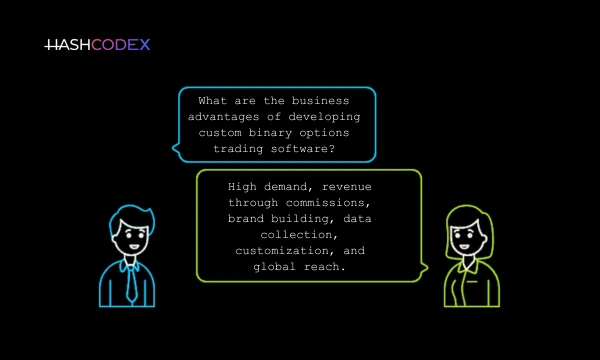
1. High Demand and Fast Growth
Binary options are popular among beginner traders due to their simplicity. A well-designed platform can attract a large user base and generate high trading volumes.
2. Revenue Through Commissions and Spreads
The platform owner can earn money through commissions on trades or by offering slightly different buy and sell prices. These small amounts add up quickly with high user activity.
3. Brand Building and Customer Loyalty
A secure, reliable, and easy-to-use platform builds trust. Satisfied users are more likely to return and even refer others to the platform.
4. Data Collection and Insights
By tracking user behavior, trading patterns, and market activity, businesses can collect valuable data that helps in decision-making and marketing.
5. Customization and White Label Options
Businesses can choose to develop their own unique platform or use white-label solutions that allow for quick customization and branding.
6. Global Reach
Binary option trading platforms can attract users from around the world, allowing businesses to expand their operations globally.
Yes, binary options trading is legal in some jurisdictions. However, regulations vary based on the country, regulator, product structure, and target customers. Before development begins, businesses should determine where the platform will operate, who it will serve, what products it will offer, and which licensing and compliance requirements apply.
In countries such as the USA and Canada, binary options trading is highly restricted, and platforms cannot freely offer services to retail users.
In Russia, only regulated firms are permitted to provide binary options trading services.
When it comes to Middle East countries, Israel does not allow binary options trading at all. Countries like Saudi Arabia, UAE, and Kuwait have strict rules. If someone wants to launch a platform, they must follow strong regulatory requirements.
Africa is one of the fastest-growing markets for binary options trading. Many platforms are targeting this region due to increasing user interest.
Here’s the important part. You may legally run your platform in one country, but you can still face restrictions when serving users from another country.
So before entering this business, you must choose the right jurisdiction and clearly understand the regulations. The same business model can be fully allowed, tightly controlled, or restricted depending on where you operate.
Also Read
For more information, read our article on whether binary options trading is legal.
Building the platform is only half of the work. So, what is most important?
The more important part is making sure your platform follows the required compliance and security standards.
PCI DSS (Payment Card Industry Data Security Standard)
We develop binary options trading platforms that are designed to support PCI DSS requirements when handling card payments.
We can provide payment gateways that are adapted to PCI DSS standards. This means the platform we develop will follow the required rules.
- If you are developing your own payment gateway while preparing your binary options trading platform, you need to complete the formal certification process with a qualified assessor.
- If you prefer a third‑party payment gateway, we can also integrate it into your platform. You do not need to focus on the third‑party provider’s PCI DSS requirements, because they usually handle most of them.
PCI DSS Level 1 is the highest level of this certification. It covers how payment data is stored, sent, and protected.
Our platform and payment gateway are designed to help you work towards PCI DSS compliance as part of your overall security setup.
ISO 27001
ISO 27001 is a well-known international standard for information security.
It covers:
- How data is encrypted
- Who is allowed to access data
- How the company reacts if there is a security problem or breach
This standard applies to the entire platform, not only the payment system.
GDPR (General Data Protection Regulation)
If your platform has users in the European Union, you must follow GDPR.
It controls:
- How user data is collected and stored
- How long you can keep it
- How users can ask to see, correct, and delete their data
If your prime focus is EU users, this is not optional.
KYC and AML (Know Your Customer / Anti-Money Laundering)
These rules are not basic formalities.
KYC checks who the trader really is before they can deposit and withdraw money.
AML makes sure the platform is not used for illegal money.
Regulators and banks always check for this first.
Why This Actually Matters
The CFTC, a US regulator, has warned traders about binary options platforms.
Many binary options platforms operate without being registered with a regulator.
So, traders who use these types of platforms may have no legal protections if something goes wrong.
The warning exists for real reasons. Many platforms launch without following these rules. As a result, you could lose real users, which means you could lose real money.
Building these security and compliance standards into your platform from day one can help you in the long run.
The binary options platform we develop is designed to support security, compliance, and legal requirements, so you can build a more secure and compliant trading business.
Building a binary options platform is not just about creating the trading screen. The system also needs to handle prices, trades, payments, timing, and user balances correctly. Here are some challenges you may face during development.
Expiry Synchronization
The countdown shown to the user and the backend must reach the expiry time together. Even a small difference can affect when a trade is closed.
Market Data Latency
Market prices may take some time to reach the platform. The system needs to handle these delays carefully so trades use the correct price data.
Payout Calculation
Different assets and trading rules may have different payout rates. The platform needs flexible rules to calculate the correct payout for each trade.
High Trading Activity
Many short-term trades can be placed within a few seconds. The platform needs to handle these requests correctly without losing or processing the same trade twice.
Wallet and Ledger Accuracy
Deposits, withdrawals, trades, and payouts all change the user's balance. Every transaction needs to be recorded correctly so the wallet shows the right balance.
Risk Exposure
The platform operator needs control over trade limits, available assets, payout settings, and other risk rules to manage trading activity.
Payment Failures
A payment may fail, take time to confirm, or send the same notification more than once. The system needs to handle these cases without changing the balance incorrectly.
WebSocket Disconnects
The real-time connection can sometimes stop working. The platform should reconnect and keep the trading screen updated with the latest information from the backend.
Market Data Failure
A price provider may stop sending updates or become unavailable. The platform needs clear rules for handling old or missing price data.
Conclusion
If you have reached the end of this blog, I hope you have found the information you were looking for.
As we discussed at the beginning, we covered why Hashcodex could be one of the companies on your list, the different services we offer, the types of business models, and the ways to develop binary options trading software.
To make your decision easier, we've also covered what questions to ask before choosing a provider, along with everything you need to know in detail.
Now, the choice is yours. You have the information you need to make an informed decision. Whether you choose Hashcodex or another partner, what matters most is finding the right fit for your business.
Want to see how we develop your platform in real time? We are just one step away from showing you how we work. 😉
Frequently Asked Questions
Existing brokers, fintech startups, trading businesses, entrepreneurs, white-label providers, and companies replacing third-party trading software can build a binary options platform.
2. What does a binary options admin panel control?
It can manage users, KYC, assets, payouts, deposits, withdrawals, trade monitoring, risk rules, reports, and platform settings.
Yes. The platform can be designed to handle high trading activity with the right backend architecture, database setup, and real-time systems.
The platform can use defined rules for stale or missing price data, such as stopping new trades until reliable market data is available.
5. How much does binary options trading software development cost?
The cost depends on the platform type, features, integrations, trading engine requirements, mobile apps, security needs, and level of customization. Development can start at $15,000, with some platforms ready within 4 weeks.












 NDA on Request

 Free Consultation – Let’s discuss your ideas