
No matter what business you start, understanding it deeply gives you an edge.
Why? Because deep knowledge helps you spot opportunities others overlook, opportunities that can lead to significant profits.
Now, let’s talk about crypto trading bot strategies.
Many businesses depend on generic trading bot strategies, but that means entering a highly competitive market.
Instead, focus on unique approaches that can set you apart.
In this blog, we’ll explore different automation strategies, why they matter, and how they can help your business grow.
👉 Keep reading. Everything you need to know is right here!
What are Crypto Trading Bots and How Do They Work?
Let me explain.
A crypto trading bot is basically a computer program. It buys and sells cryptocurrencies automatically based on rules or strategies.
Now you may be thinking, How does it really work?
Here’s the thing. Traders connect the bot to their exchange account. After that, the bot keeps watching the market all the time. It reacts faster than any human.
Think of this example. Suppose the Bitcoin price drops to a level fixed in the bot. The bot will buy it immediately.
Later, when the price goes up, the bot will sell it. Traders don’t need to sit in front of the screen the whole day.
And here’s another point. Bots don’t have emotions. They will not panic if the price falls. They will not lose control when the market moves higher. They simply follow the rules or learn patterns and trade efficiently.
Now, let's understand the crypto trading bot types.
Top 15 Crypto Trading Bot Strategies For Business In 2026
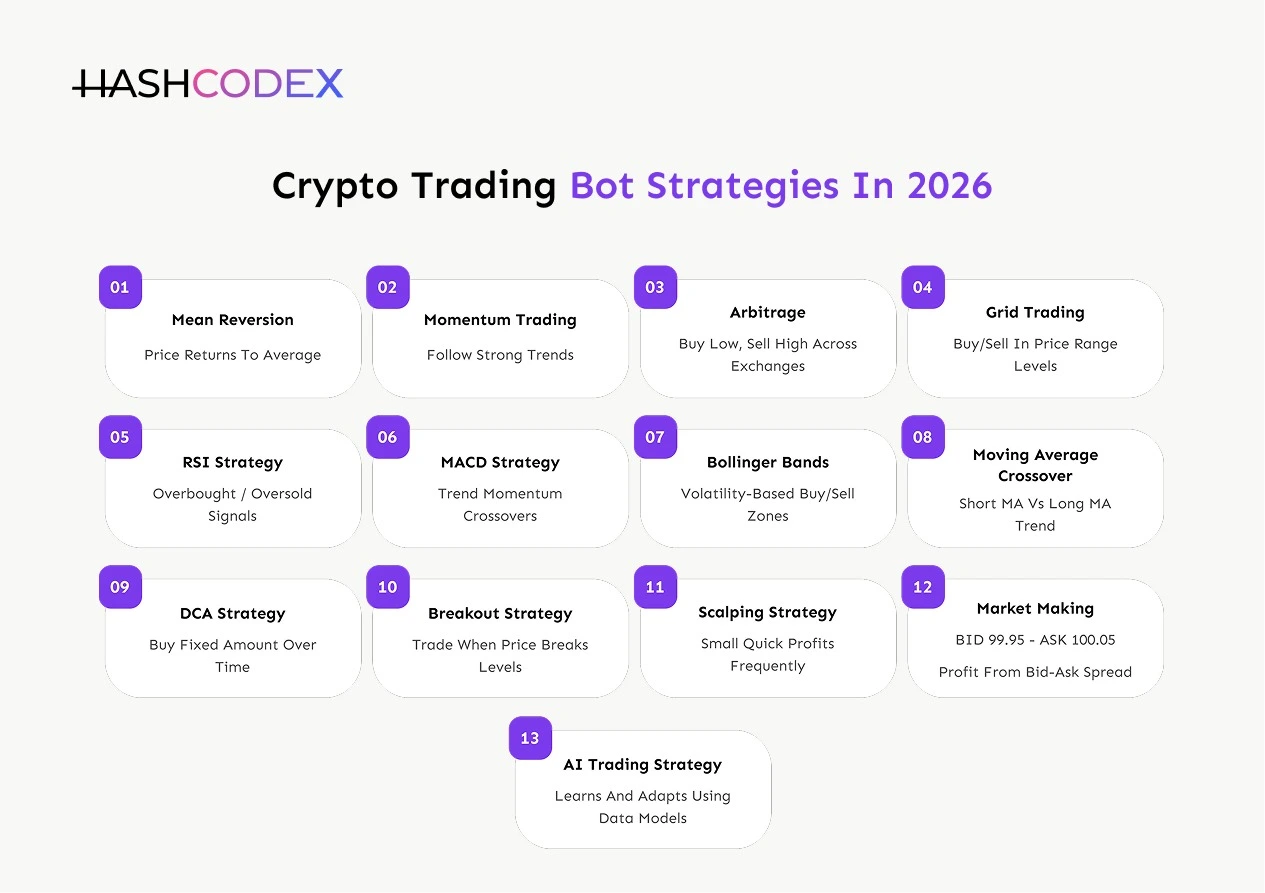
Mean Reversion
Mean reversion simply means that prices usually go back to their average after moving too high or too low.
Think of this like walking a dog. Sometimes the dog runs too far ahead, but the owner pulls it back. If the dog lags behind, it moves forward again.
Now imagine this. Bitcoin is usually around $100. Suddenly it jumps to $120. A mean reversion bot will sell at the high price. Later, when it drops near $80 compared to the normal average, the bot buys again.
Why does it work? Because prices often return to the average. This strategy can give steady profits if used properly.
Momentum Trading
Momentum trading is all about following the trend. If a coin is rising, the bot buys. If it is falling, the bot sells.
Think of a river or a runner. If someone is running fast, you expect them to keep running for some time.
If you had to bet on a winner, you would choose the fastest runner, not the slowest one. Same here. Suppose Bitcoin rises 3 percent continuously. The bot sees the trend and buys. Later, it sells for a profit.
Why does it work? Many coins continue their trend for some time. Momentum bots use this to make money.
Arbitrage Strategy
Here is the point. Arbitrage bots focus on price differences between exchanges. The goal is simple: buy low and sell high quickly.
Example. If Bitcoin is cheaper on one exchange, the bot buys there and sells on another exchange where the price is higher.
Arbitrage has many types.
- Cross exchange arbitrage,
- spatial arbitrage,
- triangular arbitrage,
- statistical arbitrage, and flash loan arbitrage.
👉 Before developing an arbitrage crypto trading bot, entrepreneurs must understand each of these types clearly.
MACD Trading
MACD is a trading indicator that uses lines to show market momentum. Bots buy when the MACD line crosses above the signal line and sell when it crosses below.
Think of it like this. Momentum trading bots tell you if the market is going fast or slow. But MACD is like a speedometer. It gives exact data about the movement.
Example. Bitcoin MACD crosses above the signal line. The bot buys. Later, when it crosses down, the bot sells.
Parabolic SAR Strategy
Here is the trick. Parabolic SAR predicts trend reversals. Bots use it to know when to enter or exit trades.
Example. Dots appear below the price, the bot buys. Dots appear above the price, the bot sells. Simple and useful for beginners.
Bollinger Band Strategy
Bollinger Bands are nothing but three lines on a chart. The middle line shows the average price. The upper and lower bands show volatility.
Simple logic: buy near the lower band, sell near the upper band. Lower band means price is looking low. Upper band means the price is looking costly.
Suppose Bitcoin is moving between $33,800 and $36,000. The bot buys near $33,800 when the price touches the lower band. Later, when the price climbs near $36,000 at the upper band, the bot sells.
Profit is around $2,200 per Bitcoin. But remember, in real life, fees and slippage reduce the profit.
Grid Trading Strategy
Grid trading works by placing multiple buy and sell orders at different price levels. The bot automatically buys when the price drops and sells when it rises.
Think of it like setting traps at different levels. Whenever the market moves up and down within a range, the bot captures small profits repeatedly.
Example. Bitcoin trades between $90,000 and $100,000. The bot places buy orders at $92,000, $94,000, and $96,000 while placing sell orders at $98,000 and $100,000. Every market swing creates profit opportunities.
Why does it work? Crypto markets often move sideways for long periods, making grid trading one of the most popular automated trading strategies.
DCA Trading Strategy
Dollar Cost Averaging allows a bot to buy cryptocurrency at fixed intervals regardless of price.
Instead of investing all funds at once, the bot spreads purchases over time.
Example. A bot buys $100 worth of Bitcoin every week. When prices fall, it buys more Bitcoin. When prices rise, it buys less.
Why does it work? DCA reduces the impact of market volatility and lowers emotional decision-making.
RSI Trading Strategy
RSI (Relative Strength Index) measures whether a cryptocurrency is overbought or oversold.
Most bots buy when RSI falls below 30 and sell when RSI rises above 70.
Example. Bitcoin RSI drops to 25. The bot detects oversold conditions and opens a buy position. When RSI reaches 75, the bot exits with profit.
Why does it work? RSI helps identify potential market reversals before they happen.
Moving Average Crossover Strategy
This strategy uses two moving averages to identify trend changes.
The bot buys when the short-term moving average crosses above the long-term moving average and sells when the opposite occurs.
Example. The 50-day moving average crosses above the 200-day moving average. The bot identifies a bullish signal and enters the market.
Why does it work? Moving averages filter market noise and help identify long-term trends.
Trend Following Strategy
Trend-following bots identify market direction and trade with the prevailing trend.
The strategy assumes that assets moving strongly in one direction are likely to continue moving that way.
Example. Bitcoin forms higher highs and higher lows for several weeks. The bot continues buying pullbacks until the trend weakens.
Why does it work? Strong trends can persist longer than expected in cryptocurrency markets.
Scalping Strategy
Scalping bots execute dozens or even hundreds of trades daily to capture small price movements.
The goal is not one large profit but many small profits throughout the day.
Example. A bot buys Bitcoin at $99,950 and sells at $100,020 seconds later. The profit per trade is small but accumulates over hundreds of trades.
Why does it work? Crypto markets operate 24/7 and provide constant short-term trading opportunities.
Market Making Strategy
Market-making bots continuously place buy and sell orders around the current market price.
The bot profits from the difference between the bid and ask prices.
Example. Bitcoin trades at $100,000. The bot places a buy order at $99,950 and a sell order at $100,050. The spread becomes a profit when both orders execute.
Why does it work? High trading volume creates frequent opportunities to capture spreads.
AI Powered Trading Strategy
AI trading bots use machine learning and historical market data to identify trading opportunities.
Unlike rule-based bots, AI systems continuously learn from market behavior.
Example. An AI bot analyzes thousands of market signals, news events, and trading patterns before opening a position.
Why does it work? AI can process large amounts of market data faster than human traders.
Breakout Trading Strategy
Breakout bots enter trades when prices move beyond important support or resistance levels.
The strategy attempts to capture large moves that often occur after consolidation periods.
Example. Bitcoin has remained below $100,000 for weeks. Once the price breaks above that level, the bot opens a buy position.
Why does it work? Breakouts often attract additional buyers and increase momentum.
Fibonacci Retracement Strategy
Fibonacci retracement uses mathematical levels to identify potential support and resistance zones.
Bots automatically place trades when prices reach key Fibonacci levels.
Example. Bitcoin rises from $80,000 to $100,000 and retraces to the 61.8% Fibonacci level. The bot enters a buy position, expecting the trend to continue.
Why does it work? Many traders monitor Fibonacci levels, creating self-fulfilling market reactions.
These are some of the popular strategies. There are many more, but right now these are the ones most people are expecting and using.

Common Mistakes When Using Crypto Trading Bot Strategies
Making a crypto trading bot looks exciting. But when people start, they face some common problems.
- Overfitting backtests
- Ignoring trading fees
- No stop loss management
- Poor risk allocation
- Trading illiquid assets
- Using one strategy in every market
👉 Tip: Start with a simple plan. Test it with small trades. Improve step by step. Keep the rules clear, keep the bot light. Slowly, as you learn more, the bot will work better and give reliable results.
Final Takeaway for New Entrepreneurs
Crypto trading bots can be powerful products, but they do not create themselves.
As entrepreneurs, you and I are the ones building it, so the success of the bot fully depends on how we design it, how we test it and how we plan its place in the market.
Before creating a crypto trading bot, you must do a few things:
- First, hire a knowledgeable and creative crypto trading bot development company.
- Next, make a proper plan for what you want to create.
- Start small, try different automation models, and understand how real users behave.
With time, you will learn which strategies your bot should support, how the system should react to market changes, and what features your customers really need. This way, you can build a bot product that lasts and stands out.
Always remember: keep checking how your bot performs, collect feedback from users, and upgrade the system regularly.
Finally, treat your trading bot as a smart digital product, not just a tool. The bot executes trades, but your vision, planning, and improvements make it valuable.
This is how entrepreneurs build successful crypto bot businesses: slow, steady, and strategic.











 NDA on Request
 Free Consultation – Let’s discuss your ideas