
Remember watching a football match with a friend and both of you reacting to a goal at the same time?
Neither of you planned it. You just saw the same moment and reacted.
But what if you kept reacting in exactly the same way again and again? At some point, you might start wondering how it keeps happening.
Prop firms face a similar situation when they notice matching activity across different trading accounts.
Two traders making similar trades is normal, as they may be reacting to the same market movement. But when these patterns keep appearing across several accounts, it can raise questions.
So, how do prop firms tell the difference between coincidence and possible rule violations? Let’s explore how they detect multi-account abuse and trader collusion.
What Are Multi-Account Abuse and Trader Collusion in Prop Firms?
Multi-account abuse happens when a trader uses multiple prop firm accounts to gain an unfair advantage or bypass the firm's rules, such as copying trades across accounts when not allowed.
Trader collusion happens when two or more traders work together by coordinating trades, sharing account access, or taking positions that benefit each other.
But here is the important part: similar trading does not automatically mean abuse or collusion.
Two traders can make the same trade because they are watching the same market, news, or price movement. What matters is the wider pattern and whether the activity goes against the firm's rules.
This is why prop firms need to look beyond individual trades and monitor patterns across accounts to identify suspicious activity.
Why Multi-Account Abuse and Trader Collusion Are a Problem for Prop Firms
Multi-account abuse and trader collusion can create unfair advantages and make it harder for prop firms to enforce their trading rules.
Here are the main problems they can cause:
- Rule violations: Traders may use multiple accounts to bypass account limits or trading restrictions.
- Unfair advantages: Coordinated trading can give traders benefits that others do not have.
- Risk management issues: Placing the same trades across multiple accounts can affect how risk is managed.
- Harder account reviews: Firms must spend more time investigating unusual trading patterns across accounts.
- Impact on genuine traders: More rule violations can lead to stricter checks for everyone.
The challenge is identifying these activities without wrongly flagging genuine traders. So, how do prop firms detect multi-account abuse and trader collusion? Let’s look at the methods they use.
How Prop Firms Spot Multi-Account Abuse and Trader Collusion
Prop firms usually look at more than one trade when checking for multi-account abuse or trader collusion. They compare account details, trading times, order sizes, instruments, entry and exit points, and other account activity to find repeated patterns.
A single matching trade does not tell the whole story. The real picture often appears when the same behavior happens across many trades or accounts.
Let’s look at the main checks firms can use.
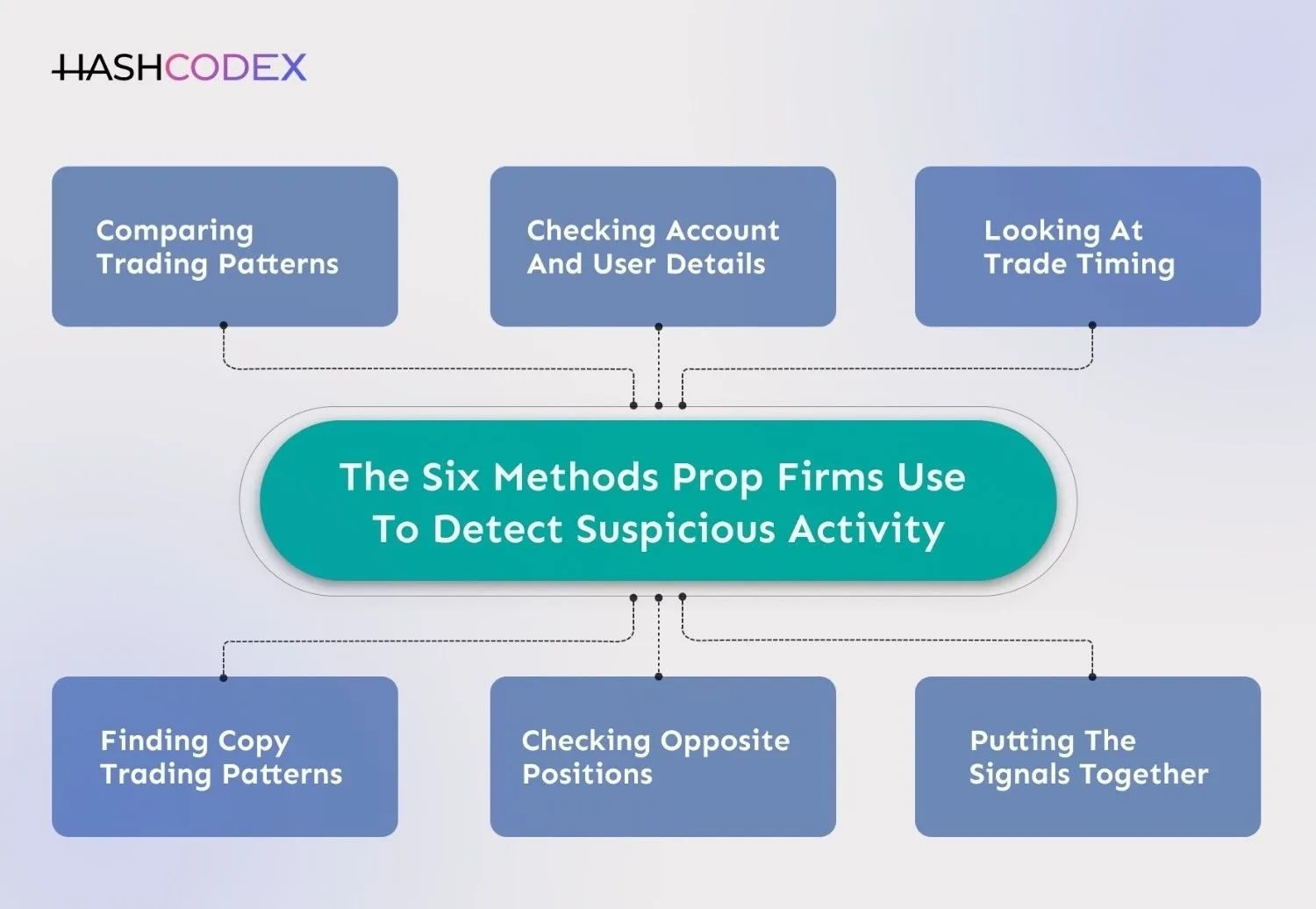
1. Comparing Trading Patterns
The way a trader uses an account can reveal a lot.
A firm may compare accounts based on factors such as:
- Entry and exit times
- Trade direction
- Position size
- Instruments traded
- Stop loss and take profit levels
- Holding time
- Trading frequency
For example, if several accounts repeatedly trade the same instruments, use similar position sizes, and enter and exit around the same time, the firm may compare those accounts more closely.
2. Checking Account and User Details
Trading activity is only one part of the review.
Firms can also check information connected to how accounts are created and accessed. This may include device details, network information, payment details, and other account data.
If several accounts share unusual details, the firm may check whether they are connected.
However, shared information does not automatically mean abuse. For example, people living in the same house may use the same network.
That is why account details usually need to be considered along with trading activity.
3. Looking at Trade Timing
Timing can also help firms compare accounts.
Suppose several accounts repeatedly enter the same instrument within a very short time and close their positions around the same time.
That timing may be worth checking, especially if it happens across many trades rather than just once.
Firms can also pay attention to activity around major market events, when many traders may naturally enter trades at similar times.
4. Finding Copy Trading Patterns
Copy trading detection can help firms identify when separate accounts behave in almost the same way.
If multiple accounts repeatedly show similar trades, entry prices, position sizes, and exit points, a firm may check whether the trades are being copied from one account to another.
This is different from simply following the same strategy. Two traders can use the same strategy while still making independent decisions.
The key question is whether the accounts are actually being traded independently.
5. Checking Opposite Positions
Firms may also look for accounts that repeatedly take opposite positions.
For instance, one account may buy an instrument while another sells it at almost the same time. A single example does not prove anything because traders can have different views of the market.
But if the same accounts repeatedly take opposite positions in a coordinated pattern, the firm may review the activity more closely.
This can help firms spot cases where traders may be using separate accounts to handle different sides of a trade.
6. Putting the Signals Together
This is where the different checks become more useful.
A firm may find that several accounts have matching trade times, similar order sizes, related account details, and similar trading behavior.
None of these points alone may be enough to reach a conclusion.
But when several signals appear together, they can give the firm a clearer reason to review the accounts.
“The goal is not to flag every trader who makes a similar trade. It is to look at the full account activity and understand whether the trading appears independent or connected.”
If you want to learn more about managing trading risks and keeping your prop firm protected, check out our Prop Firm Risk Management guide.
How Technology Automates Multi-Account and Collusion Detection
When a prop firm has thousands of accounts, manually checking every trade is not really practical. This is where trade monitoring software can take over the heavy lifting of prop firm fraud detection.
It can track details such as:
- Trade timing and order size
- Instruments, entry and exit prices
- Device and IP information
- Account activity and trading patterns
The software can then compare this information across accounts and use pattern matching, account linking, rule-based checks, and alerts to surface activity that may need a closer look.
For example, if several accounts repeatedly place similar trades within seconds of each other, or different accounts keep showing the same device or login details, the system can bring those connections to your team's attention.
But as your prop firm grows, the technology behind these checks needs to grow with it. So you need a system that can handle large volumes of account activity without leaving your team buried in manual checks.
How the Right Software Helps Prop Firms Stay on Top of Account Activity
Once you start dealing with hundreds or thousands of accounts, keeping track of all this activity becomes a lot harder. This is where having the right prop firm software setup can make things much easier.
A prop firm may need to monitor things like:
- Multiple accounts: See activity across accounts and identify possible connections.
- Trading activity: Track trade timing, order sizes, instruments, and other patterns.
- Device and IP activity: Spot accounts that may be sharing access details.
- Rule-based alerts: Get notified when activity matches a rule that needs attention.
- Account history: Look back at previous activity when reviewing an account.
- Reports and records: Keep the information needed for internal reviews.
Having these capabilities in one place means your team does not have to jump between different tools or manually piece together information from different sources.
And for that the provider you work with should be able to give you the monitoring, risk controls, and infrastructure you need today while supporting the scale you are aiming for tomorrow.
So for prop firms looking to simplify account monitoring and abuse detection, choosing the right prop firm software provider can make it easier to bring these capabilities together in one system.
Conclusion
Multi account abuse and trader collusion are not always easy to spot. Similar trades can happen naturally, so looking at one trade alone may not tell us much.
What matters is the bigger picture, including account activity, trading patterns, and other signals that may connect different accounts.
So, if you are running a prop firm, having the right prop firm software can make prop firm risk management and these checks much easier to manage as your trading operation grows.
At Hashcodex, we help prop firms bring account monitoring and abuse detection into one system. From comparing trading patterns and tracking device or IP activity to setting alerts, our software helps your team spot unusual connections faster.
Building a prop firm and want the right monitoring and risk controls in place from the start?
Book a consultation with our experts and explore how Hashcodex can help you build the software infrastructure your prop firm needs.









 NDA on Request

 Free Consultation – Let’s discuss your ideas