You already know what real estate tokenization is.
So, you are probably here because you are comparing companies that can build your real estate tokenization platform.
Maybe you are a real estate developer, property owner, asset manager, or investment company looking to start a business in this space.
You have already thought about your business model and decided what you want your company to offer.
Now, you need to turn that idea into a platform that can support your business from the start.
It should do more than create property tokens. Your platform also needs property listings, investor accounts, KYC, payments, smart contracts, ownership records, security, and compliance to work together.
So, where should you start?
In this guide, we will walk you through the real estate tokenization platform development process, the features you need, the expected cost, and the key things to plan before development begins.
We will also show you what to look for in a development company and why Hashcodex could be the right technology partner for your project.
Key Takeaways
- Choosing the right development company can determine whether your legal structure and smart contracts are built correctly together, helping you avoid rework later.
- Hashcodex is a real estate tokenization development company with an experienced team that can work on the SPV structure and smart contract logic together from the start.
- The cost of building a real estate tokenization platform can range from around $20,000 to over $100,000 for complete infrastructure from start to finish. The cost may change based on your specific needs.
- According to Forbes, less than 1% of global real estate value has been tokenized so far, which means the market is still wide open for early movers.
Real Estate Tokenization Development Company
Hashcodex is a real estate tokenization development company that helps businesses build blockchain platforms for real estate tokenization. We can build the full platform around your business needs, including smart contracts, property setup, investor portals, and compliance features.
The platform can bring properties and investors together in one place. It can manage property details, digital tokens, investor verification, ownership records, payments, and token transfers. We can also add wallets, income sharing, and a secondary market based on your business model and local rules.

Why Work With a Focused Real Estate Asset Tokenization Development Company Instead of a Large Vendor?
If you have been researching this space, you may have already seen many vendors offering enterprise pricing, pre built solutions, and different use cases.
So, why could a focused development company be a better choice for your project?
Direct Access to the Team
When you work with a focused development team, you can directly communicate with the developers working on your project.
You do not have to wait in a long support queue every time you need to discuss something about the platform.
More Flexibility
Not every idea comes to you before development starts.
Sometimes, after the project begins, you may want to add a new feature or change the workflow.
A focused development partner like Hashcodex can make those changes based on your actual business needs.
Better Understanding of the Full Platform
Real estate tokenization is not only about creating tokens.
It is about connecting property owners and investors, managing investor onboarding, handling KYC and payments, and making sure smart contracts and ownership records work together.
So, if you are looking for more customization, dedicated resources, and a platform that can support your future needs, Hashcodex could be worth considering.
A Short Note From Our Management Team
Chandru Murugan, CEO:
“Businesses that succeed in this space are not always the ones with the biggest budget. RealT is one example of a company that started with an MVP and built its business around a clear tokenization model. The right technology partner should understand your business plan, not just your budget.”
Vinoth Kumar, CTA:
“I have seen teams build a token contract first and then bring in legal experts later. When the legal structure changes, they may have to change parts of the technical setup as well.
Before writing the code, we need to understand the SPV structure, who can hold the tokens, which jurisdictions are involved, and how the legal and technical parts should work together. The coding itself is not always the hardest part. Making the right legal and technical decisions before development starts is.”
Who Can Launch a Real Estate Tokenization Platform
Different businesses can build a tokenization platform depending on the type of property they own and how they want investors to join.
Individual Property Owners
If you own one or a few rental or income-generating properties, tokenization lets you raise money from investors without selling the property. Your platform can manage property details, investor accounts, ownership records, and income payouts.
Real Estate Developers
Developers can raise funds for new construction projects by inviting a wider group of investors. The platform can manage project details, token issuance, investments, and updates during the building phase.
Real Estate Funds and Fund Managers
If you manage multiple properties, tokenization helps you keep everything digital. You can track investor shares, ownership records, income payments, and provide clear reports in one system.
Brokerages and Real Estate Agencies
Agencies can offer tokenized investment opportunities to their existing clients. This creates a new revenue stream while giving clients modern investment options. The platform can manage property listings, token sales, and investor reports.
Fintech and PropTech Startups
Startups can build tokenization into their main product. Your platform can include property listings, investor onboarding (KYC), wallets, token issuance, and portfolio tracking.
Tokenization Platform Operators
Operators can launch a marketplace where property owners list eligible assets. Investors can browse, buy, and trade tokens across different projects. The platform manages listings, ownership, and investor accounts.
Family Offices and Private Investment Groups
Wealthy families or small investor groups can use tokenization to manage holdings across different properties. It makes ownership tracking, income distribution, and portfolio management simple and digital.
Institutional Investors
Large organizations such as pension funds or insurance companies can use tokenization to manage real estate investments more efficiently. It helps with compliance, reporting, and diversification.
Real Estate Tokenization Development: What We Plan Before Building
A real estate tokenization project should not begin with coding smart contracts. First, it is important to define what the platform will represent and how it will work.
1. What is being tokenized
Is it a single property, a portfolio, a fund interest, a revenue right, a debt instrument, or another eligible investment structure?
2. Who can invest
Will it be retail investors, accredited investors, institutions, or another defined group?
3. What does the token represent
Does it represent ownership, income rights, debt exposure, or another type of interest?
4. How will investors be verified
Which KYC, AML, and eligibility checks are required?
5. How will ownership be managed
Will records be kept on-chain, off-chain, or a mix of both?
6. How will income be distributed
Will it be manual approval, automated calculation, smart contract distribution, or another workflow?
7. Can investors transfer tokens
If yes, what restrictions will apply?
8. Is a secondary market required
If yes, what type of venue and investor eligibility model will be used?
9. What needs to remain off-chain
Not all property, investor, or compliance data should be stored directly on the blockchain.
10. Who owns and operates the platform
This affects hosting, source code, deployment, integrations, and long-term maintenance.
Real Estate Tokenization Development: Step-by-Step Process
You do not need deep technical knowledge to tokenize real estate. The process follows a clear set of steps.
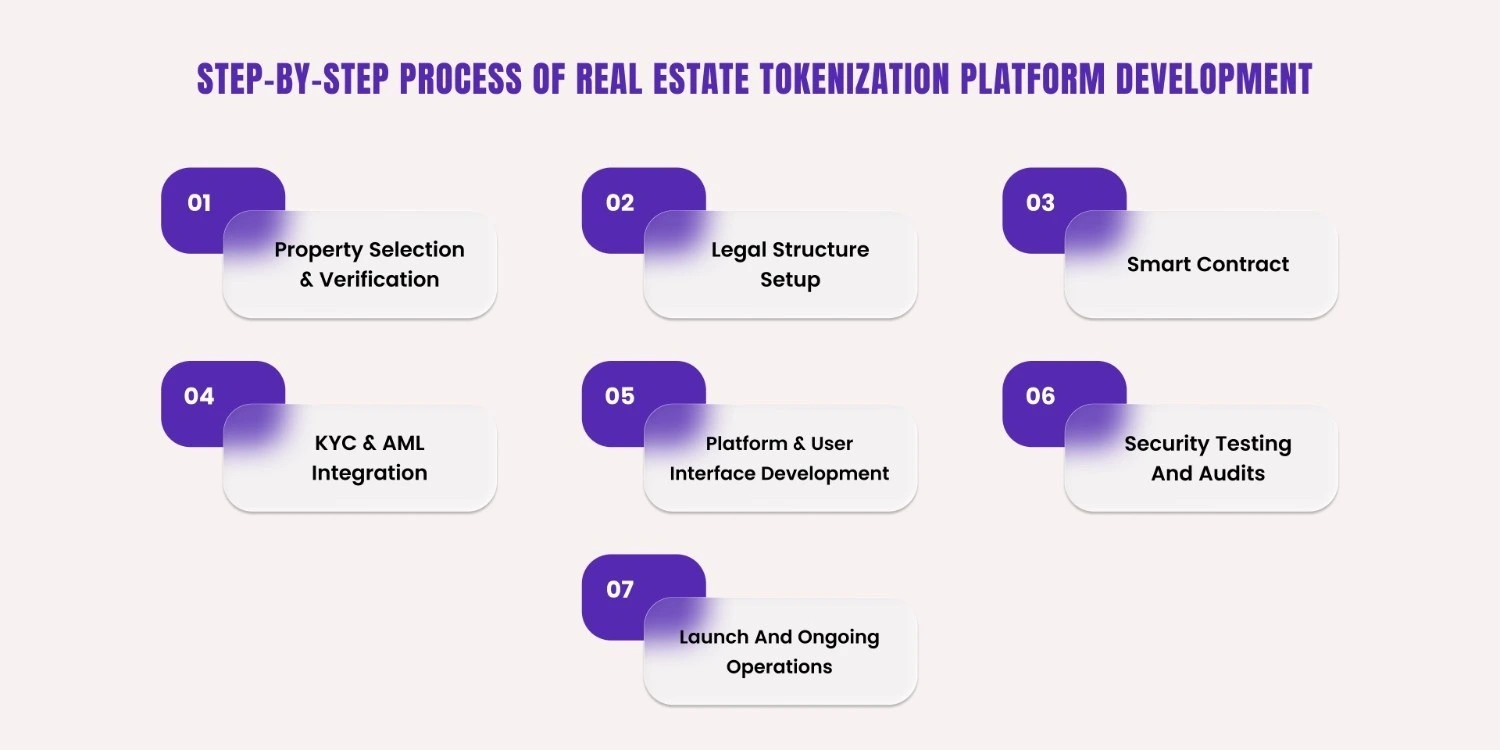
Step 1: Property selection and verification
The process begins with choosing a property that is suitable for tokenization. This step decides the quality of everything that follows.
The team checks:
- Property value and current market condition
- Ownership documents and legal clarity
- Rental income history if it is an income property
- Title verification
- Basic safety and structure condition
Once the property is verified, it becomes ready for legal structuring and platform integration.
Step 2: Legal structure setup
After the property is verified, the next step is to build the legal structure that connects the real asset with digital tokens.
This is usually done using a Special Purpose Vehicle (SPV):
- A separate legal company is created for each property
- That company holds full ownership of the asset
- Digital tokens represent shares in that company
This structure is important because it clearly defines ownership and separates each property from others in the platform.
Once the legal setup is complete, the system is ready for blockchain development.
Step 3: Smart contract development
Now the technical foundation of the platform is built using smart contracts.
These contracts handle all core actions inside the system, including:
- Creating and managing tokens
- Recording ownership on blockchain
- Distributing rental income to investors
- Controlling transfer rules
- Applying compliance conditions
Different contracts are used for different functions, such as token management, income distribution, compliance, and governance.
After development, these contracts must be carefully reviewed because they directly control financial operations.
Once the smart layer is ready, user verification is added.
Step 4: KYC and AML integration
Since real estate tokens are treated as regulated assets, user verification is required before investment.
The platform adds:
- Identity verification (KYC)
- Anti-money laundering checks (AML)
- Investor eligibility validation
These checks are usually done using tools like Sumsub, Jumio, or Onfido.
After verification, user data is linked to wallet addresses so the system can automatically enforce rules during transactions.
With compliance in place, the focus moves to building the user platform.
Step 5: Platform and user interface development
This is the part users interact with every day.
The platform is designed to make complex investment data simple and easy to use. It usually includes:
- Property listing pages with complete details
- Investor dashboard showing holdings and earnings
- Token buying and selling system
- Income reports and history
- Document storage section
- Notifications for updates and payouts
This step connects the blockchain system with a clean and usable interface.
After the platform is ready, it moves into testing.
Step 6: Security testing and audits
Before launch, the entire system is tested to avoid risks.
This includes:
- Smart contract audits
- Security testing of the platform
- KYC and AML system validation
- Legal document review
Most platforms go through two audit rounds:
- First round identifies problems and gaps
- Second round confirms fixes and stability
Once testing is complete, the platform is ready for launch.
Step 7: Launch and ongoing operations
After launch, the system continues running and needs regular management.
Ongoing work includes:
- Monitoring smart contracts
- Distributing rental income to investors
- Handling user support
- Regulatory reporting
- System maintenance and updates
A real estate tokenization platform is not a one-time build. It needs continuous attention to stay stable and grow over time.
What We Build for Your Real Estate Tokenization Business
1. Investor Platform
Property search, investor registration, KYC, investment, portfolio tracking, and document management.
2. Property Management System
Property onboarding, valuation, ownership documents, property details, and performance tracking.
3. Tokenization Engine
Token creation, issuance, allocation, supply management, redemption and transfer restrictions.
4. Smart Contract Layer
Ownership rules, compliance conditions, distributions, transfers and administrative controls.
5. Admin & Compliance Panel
Investor approvals, property verification, transaction review, reporting and role-based access.
6. Secondary Market
Eligible investors can transfer or trade tokens through an integrated marketplace where legally permitted.
7. Payment & Wallet Infrastructure
Wallet connection, payment processing, supported currencies and transaction records.
Key Features We Offer in Real Estate Asset Tokenization Platform Development Service
Here are the core features we provide based on our project experience, your business requirements, and current market needs.
Investor-Facing Features
Fractional Ownership
Investors can buy a portion of a property instead of purchasing the entire asset. This allows your platform to support fractional real estate ownership based on your business model.
Investor Dashboard
Investors can view their property holdings, income earned, investment documents, and other account details in one place.
Investment Tracking
Investors can track their investment value, property performance, income, and ownership details whenever they need them.
Secondary Market Access
If permitted by local laws and your business rules, investors can sell or transfer their property tokens to other eligible buyers through a secondary market.
Multicurrency Support
The platform can support multiple currencies, allowing investors from different markets to view property prices and make investments using supported currencies.
Property & Asset Management
Property Onboarding
Property owners or your internal team can add a new property with its basic details, ownership information, and other required data before verification and tokenization.
Property Verification & Documents
Your team can verify ownership documents, complete required paperwork, and store property records such as inspection reports and legal documents in one central location.
Property Valuation & Management
Your team can update the assessed value of each property. These values can be used for token pricing, investment records, and investor reporting across the platform.
Token Management
Token Creation & Issuance
Once a property is verified and ready for tokenization, the platform can create digital tokens that represent defined ownership or economic rights connected to the asset.
Token Allocation & Transfer
Tokens can be allocated to investors based on their investment amount. Once approved, the tokens can be transferred to the investor's supported wallet.
Token Burning & Redemption
Tokens can be removed from circulation when they are no longer required. This may happen when a property is sold, an investment is redeemed, or an investor exits based on your rules.
Token Supply Management & Transfer Restrictions
The platform can track the total token supply and the tokens held by investors. Transfer rules can also be built into the token system to restrict transfers to unsupported countries, wallets, or users when required.
Admin Features
Property Management
Your admin team can add, edit, verify, and manage every property listed on the platform from a central dashboard.
Property & Investor Management
The platform can provide separate controls for managing property listings and investor accounts. Your team can review, approve, restrict, or update accounts based on your business and compliance requirements.
Token Management
Admins can oversee token issuance, allocations, transfers, and total supply across different properties listed on the platform.
Compliance Review
Your compliance team can review flagged transactions, investor applications, verification records, and other activities that require manual review.
Role-Based Access & Reporting
You can control what each internal team member can view or manage based on their role. The platform can also provide reports for income, ownership, compliance activity, and overall platform performance.
The RWA platform we develop is made to cover everything from investor tools to property management, token control, and admin oversight. It is designed so real estate tokenization can stay simple, transparent, and effective for business.
The main features listed above are included, but they are only the highlights. Other important functions such as dividend distribution, secondary market integration, wallet management, and more are also part of the platform, based on your needs.
The final set of features is planned around how funds are raised, how real estate assets are managed, how property tokens are issued, and how investors are served.
Real Estate Tokenization Platforms We Develop for Different Property Types
The real estate tokenization platform we develop can support different property types and investment structures. You can choose what you want to tokenize based on your business, property type, and investment plan.
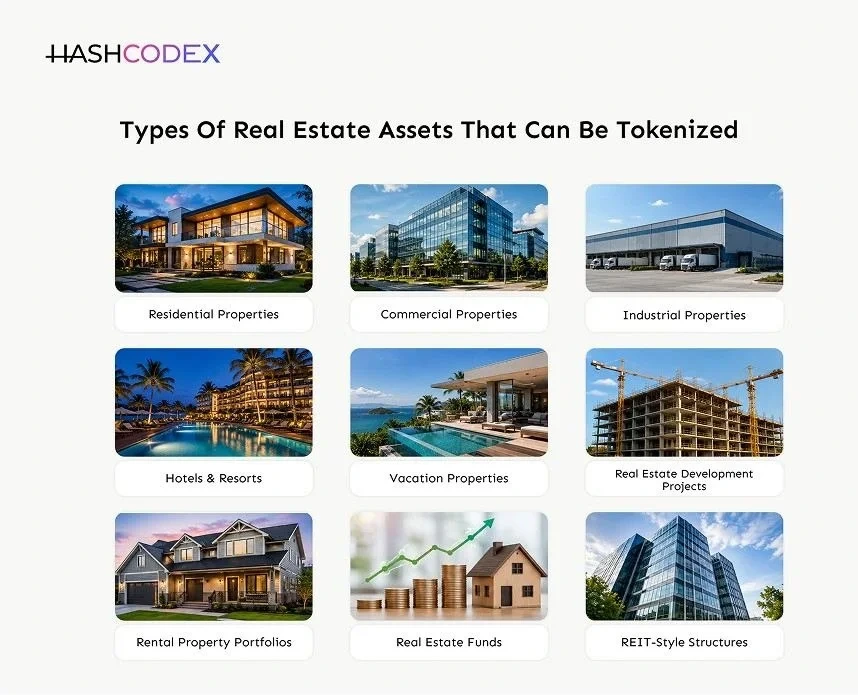
Residential Properties
You can tokenize apartments, villas, housing projects, and other residential properties. The platform can let multiple investors own a smaller share of a property.
Commercial Properties
The platform can support offices, shops, shopping centres, and other commercial properties. You can manage property details, investor ownership, and income in one place.
Hotels and Resorts
You can tokenize hotels, resorts, and other hospitality properties. The platform can manage investor shares, income payments, property records, and token transfers.
Industrial Properties
The platform can support warehouses, factories, logistics centres, and other industrial properties. Your team can manage property details and investor holdings from one system.
Real Estate Development Projects
You can use the platform to raise funds for eligible property development projects. Investors can take part through the investment structure you choose.
Rental Property Portfolios
You can bring multiple rental properties into one platform and manage investor shares and rental income from a single system.
REITs and Real Estate Funds
We can develop a platform to support eligible REITs and real estate funds. You can manage investors, token ownership, income distribution, and reports based on your business model and legal requirements.
Real Estate Tokenization Models You Can Build
The right model depends on your property, business plan, and how you want investors to take part. We can build your platform around one model or support multiple models.
Equity-Based Real Estate Tokenization
Build a platform where tokens represent ownership or rights in a property. Investors may earn from rental income, property value growth, or the sale of the property.
Fractional Ownership Tokenization
Divide a property into smaller digital units so multiple investors can own a share. This model is useful when you want to offer fractional real estate investment.
Rental Income Tokenization
Create tokens linked to rental income from a property or group of properties. Your platform can track each investor's share and manage income payments based on your rules.
Real Estate Debt Tokenization
Create tokens that represent a share in a real estate loan instead of property ownership. Investors can receive interest payments while the property owner keeps the property.
Real Estate Portfolio Tokenization
Combine multiple properties into one tokenized portfolio. Your platform can help investors access different properties and income sources through one investment structure.
Key Benefits of Real Estate Tokenization Platform Development
Reach More Investors
Your platform can help you reach more eligible investors by letting them invest in smaller parts of a property.
Raise Money in New Ways
You can divide a property into digital tokens and raise money from multiple investors instead of depending on one buyer or funding source.
Manage Everything in One Place
You can manage properties, investors, token ownership, transfers, and investment records from one platform.
Reduce Manual Work
Smart contracts can handle tasks such as issuing tokens, checking transfers, and distributing income based on the rules you set.
Offer Fractional Investment
Your platform can let investors buy a smaller share of a property instead of buying the whole property.
Support Token Transfers
If local laws allow it, your platform can let eligible investors transfer or trade their property tokens through a secondary market.
White-Label Real Estate Tokenization: An Alternative Way to Get Your Platform
If your priority is launching a branded RWA tokenization platform without developing everything from scratch, a white-label architecture gives you the technical foundation you need to get started.
It already includes the core systems needed for tokenization, including a tested tokenization engine, compliance layer, and other platform features that have been tested across multiple use cases.
When Does White Label Make Sense?
White label makes sense if you want to:
- Launch and validate demand before committing to a fully custom build.
- Offer a fairly standard structure, such as a single SPV with straightforward rental income distribution.
- Follow common investor eligibility and compliance rules.
- Get to market faster instead of spending months building every system from the ground up.
When Does Custom Development Make Sense?
A custom platform may make more sense when:
- Your property structure, revenue model, or investor rights don't fit the pre-built solution.
- You are managing a complex multi-property portfolio with different rules for each asset.
- You need deep integrations with existing systems, fund administration platforms, or other business software.
- Your business model requires workflows and features that cannot be handled through standard configurations.
We build both options, and during the call, the right fit for your situation is explained honestly. The choice is guided by your business needs, not by which option is more profitable for us.
Tokenized Real Estate vs Traditional REIT
| Factor | Tokenized Real Estate | Traditional REIT |
| Investment Focus | Exposure to a specific property or project | Usually exposure to a portfolio |
| Ownership Format | Digital tokens linked to defined legal and economic rights | Shares in a trust or company |
| Minimum Investment | Can be divided into smaller investment units | Depends on the REIT and market price |
| Transfer Process | May use blockchain based transfer workflows | Uses conventional market infrastructure |
| Compliance | Requires investor verification and transfer controls | Follows established securities and fund regulations |
| Liquidity | Depends on eligible buyers and marketplace availability | Public REITs generally offer exchange based liquidity |
Compliance-Ready Smart Contract Development
Real estate tokenization often involves regulated financial activity. Smart contracts should support the legal and compliance rules governing token issuance and transfers.
So Hashcodex develops smart contracts that can support:
- Token creation, issuance, and burning
- KYC and AML-based investor whitelisting
- Transfer and jurisdiction restrictions
- Lock-up periods
- Rental income or dividend distributions
- Token holder voting and governance
- Transaction records and reporting
- Emergency pause and administrative controls
For regulated offerings, standards such as ERC 3643 can support identity-based transfer restrictions and compliance controls. The appropriate standard depends on the legal structure, blockchain, and business requirements.
Technology Stack Used in Real Estate Tokenization Platform Development
| Layer | What We Use & Why |
| Blockchain | Ethereum and similar networks like Polygon or BSC. They are safe, widely used, and help keep costs low. |
| Smart Contract Language | Solidity is used to write contracts. Every contract is audited before deployment to ensure safety. |
| KYC/AML Integration | Services like Sumsub, Jumio, or Onfido verify investor identity. This ensures only eligible investors can participate. |
| Backend | Built with Node.js and cloud servers, the platform can scale as more investors, properties, and transactions are added. |
| Frontend | Investor dashboards and admin panels are built with React. They are simple, clear, and easy to use. |
| Payment Processing | Supports fiat currency and stablecoins. Payment options are set up according to local laws and business needs. |
| Custody | Tokens can be stored with trusted third‑party providers or directly in investor wallets, depending on the setup. |
✅ This technology stack has been reviewed by the Hashcodex development team to meet the required standards for security, compliance, scalability, and RWA tokenization platform development.
Real Estate Tokenization Development: Legal and Operational Challenges
When it comes to tokenizing real estate, one question usually comes up first.
Is this even legal?
The answer is yes, but only when the right structure is in place. Real estate tokenization operates within existing legal systems, but it requires careful planning from the start.
These challenges are not barriers. They are part of building a reliable and compliant platform.
Here are a few key areas to consider:
- Legal Ownership Structure
A property cannot be directly divided into digital shares without a proper setup.
To address this, the asset is placed under a legal entity that links ownership to tokens in a clear and accepted way.
- Regulatory Compliance
Rules for digital assets and investments vary across regions.
This is handled by structuring the token offering to follow local regulations and investor requirements.
- Market Adoption and Trust
Since this is still a growing space, some investors may take time to feel confident.
Clear communication and consistent operations help build trust over time.
- Technical Integration and Platform Reliability
The platform that manages tokens, investors, and transactions needs to work without issues.
Working with an experienced real estate tokenization development company helps ensure a stable and well-structured setup.
In most cases, these challenges are not roadblocks. They are part of building a strong foundation.
With the right setup, real estate tokenization can operate in a clear and structured way.
How Much Does It Cost to Develop a Real Estate Tokenization Platform?
The cost to develop an RWA tokenization platform can start from $15,000 and go beyond $100,000. The price depends on whether you need a basic platform for your business or an enterprise-grade platform with advanced features, compliance, and integrations.
Other factors include the asset type, token model, blockchain, smart contracts, KYC/AML, investor dashboard, admin panel, wallet integration, payment processing, and secondary market. We can build the platform based on your business model, requirements, and budget.
Key Mistakes Businesses Should Avoid During Real Estate Tokenization Development
1. Ignoring Legal Structure
Define the SPV, property ownership, investor rights, and token structure before development begins.
2. Poor Token Economics
Clearly define token supply, pricing, rental income, voting rights, and redemption terms.
3. Choosing the Wrong Token Standard
Standards such as ERC 3643 can support investor whitelisting, identity based transfers, and compliance controls.
4. Overlooking Secondary Markets
Plan token transfer rules, eligible wallets, approved marketplaces, and investor exit mechanisms during development.
5. Skipping Smart Contract Audits
Audit contracts handling token issuance, transfers, income distributions, and administrative controls before deployment.
6. Choosing Blockchain Too Early
Select the blockchain based on token standards, compliance requirements, transaction costs, wallet support, and the real estate investment model.
Conclusion
Real estate ownership is changing through tokenization. By converting property assets into digital tokens, businesses can create new investment opportunities and make ownership more accessible.
A successful tokenization platform requires proper asset structuring, smart contract integration, and compliance management. Each component plays an important role in the platform's operation.
Hashcodex supports businesses by providing RWA tokenization development solutions for real estate tokenization platforms in the USA, UAE, and Singapore, helping organizations digitize property assets and broaden investor participation.
For businesses considering property tokenization, this can be a valuable way to explore modern real estate investment models.
Interested in property tokenization? Contact our team to discuss your project.
Frequently Asked Questions
Is real estate tokenization legal?
Real estate tokenization can be legally structured, but requirements vary by country and token type. Legal professionals should determine the entity structure, investor eligibility, disclosures, and offering requirements.
Does a real estate token give direct ownership of a property?
Not always. A token may represent ownership in an SPV holding the property or provide economic rights such as rental income, debt repayment, or other defined benefits.
What is an SPV in real estate tokenization?
An SPV, or Special Purpose Vehicle, is a separate legal entity created to hold a property or project. Tokens can represent ownership interests or defined rights connected to that entity.
Which blockchain is best for real estate tokenization?
The right blockchain depends on compliance requirements, transaction costs, privacy, smart contract capabilities, wallet support, and integrations. Ethereum compatible networks are commonly considered for real estate tokenization.
What is ERC 3643?
ERC 3643 is a token standard designed for regulated digital assets. It supports identity verification, wallet whitelisting, transfer restrictions, and compliance controls for eligible token holders.
Can tokenized real estate be traded on a secondary market?
Tokenized real estate can be traded through eligible secondary markets when the legal structure, investor eligibility, transfer restrictions, and marketplace requirements permit token transfers.
How long does it take to develop a real estate tokenization platform?
A basic MVP can take around 4 to 5 months. Platforms requiring compliance automation, income distribution, multiple assets, and secondary market features may take 5 to 8 months.
How much does real estate tokenization platform development cost?
Real estate tokenization platform development starts from $15,000. The final cost depends on the token model, blockchain, compliance integrations, smart contracts, investor portal, and platform features.
How do you ensure RWA tokenization platforms comply with USA and other local regulations?
The platform is built around USA and other local regulatory requirements, including investor eligibility, KYC/AML checks, asset documentation, and transaction records. Compliance rules are configured based on the target jurisdiction, asset type, and business model.








 NDA on Request
 Free Consultation – Let’s discuss your ideas