
You’re looking for a Prop Firm CRM.
So, let’s skip the basics and get straight to what matters.
Whether you’re building from scratch or migrating from your existing system, our Prop Firm CRM Software Solutions support both.
Planning a migration?
We help you move your existing setup while protecting your data and minimizing disruption.
Building from scratch?
We build a custom CRM around your business logic, integrations, and operational needs, with security and accurate risk calculations at its core.
Curious to know how we approach it? Read the blog till the end!
Key Takeaways
- A Prop Firm CRM is a specialized platform designed to manage the daily operations of a prop trading firm, unlike regular sales CRMs or traditional forex broker management systems.
- The right Prop CRM should include all the essential features needed to manage traders, challenges, trading accounts, payments, payouts, and risk rules in one place.
- Hashcodex provides Prop Firm CRM software solutions that help firms manage traders, automate daily operations, and grow their business successfully.
Prop Firm CRM Software: Manage Traders, Challenges, Risk & Payouts
A Prop Firm CRM is specialized software designed to manage the complete operational lifecycle of traders, from registration and KYC verification to challenge management, trading account monitoring, risk management, funded accounts, and payouts.
Hashcodex provides CRM for Prop Trading Firms designed for founders, CEOs, and operations teams who need a better way to manage traders, evaluations, and daily business activities. It brings trader onboarding, challenge configuration, account administration, payment workflows, and performance reporting into one centralized platform.
With integrations for trading platforms like MT4, MT5, cTrader, X9Trader, etc., our CRM connects trader management with your trading operations. Teams can track evaluation stages, organize trader accounts, track progress, and coordinate essential workflows from one centralized dashboard.
From managing multiple challenge programs to overseeing funded traders, affiliate relationships, and payout workflows, Hashcodex’s CRM solutions help teams stay organized throughout the trader lifecycle. By bringing these functions together, it reduces repetitive administrative work, improves operational visibility, and gives prop firms greater control as their businesses grow.
site.bannercta
How Hashcodex Helps You Migrate Your Prop Firm CRM
You might consider migrating to a new CRM if your current system has stability issues, integration limitations, or increasing costs. At Hashcodex, we help you make the migration process easier by
1. Audit and Map Your Data
First, we identify all the important data that needs to be moved, including trader details, KYC records, challenge statuses, funded account history, payouts, and affiliate commissions. Then, we map everything to the new CRM to make sure no important information is missed.
2. Connect and Test
Next, we connect the new CRM with your trading platforms and test everything to make sure trader details and account information sync properly before going live.
3. Run Both Systems in Parallel
Where possible, we run both the old and new CRMs side by side for a planned period. This helps us compare account data, payouts, and challenge statuses to catch and fix any issues before the full switch.
4. Switch to the New CRM
Once everything is tested and verified, we move your team and trader dashboards to the new CRM according to the migration plan, ensuring a smooth transition.
Typical Migration Timeline
- Duration: A CRM migration usually takes around 4–8 weeks, depending on the amount of data, integrations, and workflow complexity.
- Trader Downtime: Our goal is to keep disruption to a minimum. The actual downtime depends on how your CRM is connected to the trading platforms and how well the migration is planned.
Ready to migrate your Prop Firm CRM? Let’s discuss your requirements.
How does Prop Firm CRM Software work?
Prop trading management software works by connecting different stages of the trader lifecycle through centralized data, configurable rules, and automated workflows.
When a trader performs an action or an event occurs within the trading infrastructure, the CRM can receive the relevant information, update the trader or account record, and trigger the next operational step according to predefined conditions.
For example, when a trader purchases an evaluation, the CRM can record the order, associate the trader with the selected challenge, initiate the required account setup process and display the account status within the trader and admin interfaces.
As the trader progresses, the CRM can track evaluation status, trading activity, rule conditions, account milestones, and payout eligibility.
A typical workflow is:
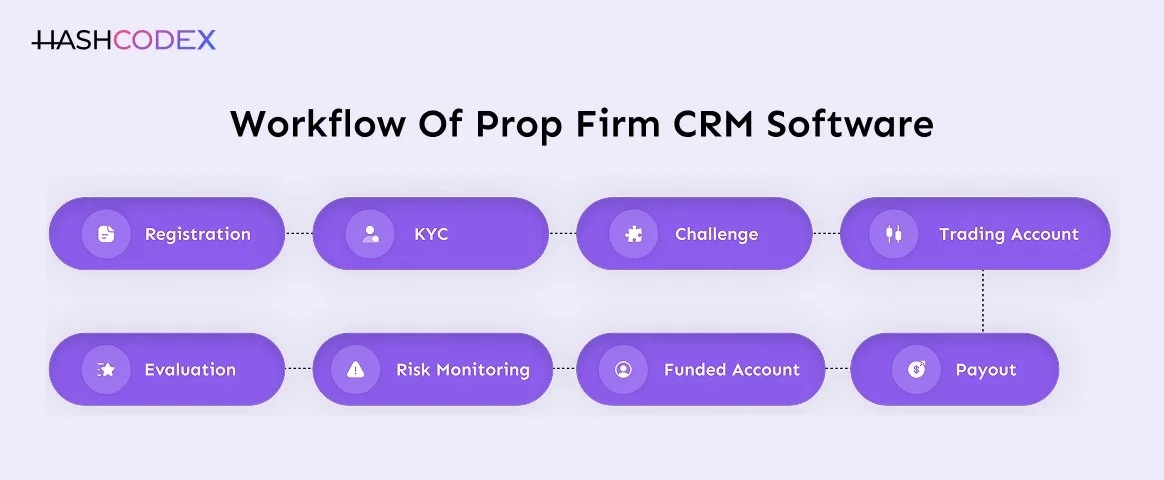
This workflow allows different teams to work from the same operational information instead of maintaining separate records for each stage.
Example of an Automated Prop Firm CRM Workflow
Consider a trader purchasing a two-phase evaluation.
The Proprietary trading CRM records the trader and payment details, assigns the right challenge configuration, and connects with the trading infrastructure to create the account.
During the evaluation, the system receives account and trading data and checks key metrics against configured rules, such as profit targets, daily loss limits, and maximum drawdown.
Once the required conditions are met, the account status can be updated and the next stage can begin.
When the trader becomes eligible for a payout, the trading firm CRM records the request, applies the firm's payout rules, sends it for review, and keeps a record of the outcome.
The level of automation depends on the CRM setup, trading platform integrations, and rules configured by the prop firm.
How Does Prop Firm Management Software Handles the Complete Trader Lifecycle?
A prop firm does not manage a trader through one isolated transaction. The trader moves through multiple operational stages, and each stage can require different data, rules, and actions.
A specialized CRM connects these stages into one continuous workflow.
1. Trader Registration
The process begins when a trader creates an account with the prop firm. The CRM stores registration details and creates a centralized trader profile connected to challenges, trading accounts, payments, support requests, and future activity.
2. KYC and Verification
The CRM tracks the trader’s verification status, submitted information, and required actions. It can also integrate with an external KYC provider and sync verification results with the trader record.
3. Challenge Management
The trader is assigned to the appropriate evaluation program. The CRM stores challenge details such as account size, profit target, drawdown rules, minimum trading requirements, and evaluation stages.
4. Trading Account Provisioning
The CRM can connect with trading infrastructure to support account creation, account assignment, and account status updates.
5. Evaluation Monitoring
During the evaluation, the CRM displays account status and relevant performance data. Operations teams can identify accounts that are progressing, nearing key thresholds, or requiring review.
6. Risk and Rule Monitoring
The CRM can work with a risk engine or trading platform data to monitor configured trading conditions. Events such as drawdown breaches, loss limits, or restricted activities can be flagged for review or trigger automated actions where supported.
7. Funded Account Management
After completing the required evaluation stages, the CRM can update the trader’s status and support the transition to the funded account stage.
8. Payout Management
When a funded trader becomes eligible for a payout, the CRM can manage the request, eligibility details, approval status, payment information, and payout history according to the firm’s process.
9. Trader Support and Retention
Throughout the lifecycle, support teams can use the centralized trader profile to view account status, previous requests, and relevant activity. This helps teams provide informed responses without repeatedly requesting information from the trader.
Why Do Prop Trading Firms Need CRM Software?
A prop firm's operational complexity increases as its trader base grows. Managing more traders means handling more evaluations, accounts, payments, support requests, risk events, and payout requests.
Without a centralized system, teams may rely on spreadsheets, emails, chat applications, and separate dashboards to track different parts of the business.
A CRM for Prop Firms brings these workflows together so that teams can work from centralized trader and account information.
The value is not simply having all information in one place. A specialized CRM can also connect information between systems and automate actions that would otherwise require manual intervention.
For example, an evaluation result can update a trader's status, a risk event can generate an internal notification, and a payout request can move through an approval workflow.
This becomes increasingly important as trader volume increases because operational processes need to remain consistent even when the number of accounts and transactions grows.
Key Benefits of Prop Firm Management Software
Centralized Trader Management
Maintain a single record for each trader with registration, verification, challenge, account, support, and payout information.
Reduced Manual Administration
Automate repetitive tasks where integrations and business rules allow, reducing the need to update multiple systems manually.
Better Risk Visibility
Give risk and operations teams access to account information, rule events, and trading metrics from a centralized interface.
Faster Payout Operations
Manage payout requests, eligibility, approvals, payment details, and completed transactions through a structured workflow.
Improved Trader Support
Give support teams access to trader and account context to help them respond to requests more efficiently.
Better Operational Reporting
Bring trader, account, risk, payment, and support data together for a clearer view of business activity.
Common Operational Challenges Faced by Prop Trading Firms
Prop firms have special challenges as they get bigger, especially in handling traders, tracking challenges, and keeping everything organized.
Some of them are:
- Managing Large Numbers of Trader Accounts
As trader volume grows, manually tracking account status, challenge stages, verification details, and support requests becomes difficult. A centralized CRM provides a structured view of each trader and their current status.
- Managing Complex Challenge Rules
Different evaluation programs may have different account sizes, profit targets, drawdown limits, trading restrictions, and progression rules. Managing these conditions manually can increase operational workload.
- Monitoring Risk Events
Prop firms need visibility into account performance and trading conditions. A CRM connected to trading and risk systems can help teams identify important events and manage rule-related workflows.
- Handling Payout Requests
As more traders become eligible for payouts, managing requests can create additional operational work. A structured workflow helps teams track eligibility, reviews, approvals, and payment status.
- Coordinating Internal Teams
Sales, operations, compliance, risk, and support teams may all work with the same trader. Centralized information and role-based access can help teams coordinate their responsibilities.
- Managing Multiple Systems
Prop firms may use separate systems for trading, payments, KYC, communication, and analytics. Connecting these systems with a central CRM can reduce fragmented workflows.
Core Features of Prop Trading CRM Software
Prop Trading CRM software includes a range of features for managing trading challenges, risk rules, trader accounts, payments, integrations, and internal operations. These are the key features:
- Challenge & Evaluation Engine: Set up one-phase or multi-phase challenges with profit targets, drawdown, and loss limits.
- Risk Monitoring & Breach Detection: Track trading activity and automatically detect rule violations.
- Trading Platform Integrations: Connect with MetaTrader 5, cTrader, DXtrade, Rithmic, and other trading platforms.
- KYC & Onboarding: Manage trader registration, identity verification, and account creation.
- Trader Dashboards: Display live performance, profit targets, drawdown, trading statistics, and account status.
- Payout Management: Manage profit splits, payout requests, and payment methods such as crypto, Wise, and Stripe.
- Affiliate Management: Track referrals, commissions, and multi-tier affiliate programs.
- Account & Rule Management: Configure account types, trading conditions, and risk parameters.
- Automation & Notifications: Automate actions and alerts for breaches, evaluations, account changes, and payouts.
- Reporting & Analytics: Monitor trader activity, performance, risk events, payouts, and affiliate data.
- Admin & Permissions: Manage team access, roles, and permissions across the CRM.
- API & Integrations: Connect external tools, payment providers, KYC services, and trading infrastructure.
Prop Firm CRM Risk Management
Risk management is one of the key differences between a Prop trading management software and a conventional CRM.
A CRM connected to the firm's trading and risk infrastructure can monitor conditions such as daily loss, maximum drawdown, profit targets and other custom trading rules.
When a relevant event occurs, the system can record the event and trigger an appropriate workflow, such as updating the account status, notifying the risk team or flagging the account for review.
The exact capabilities depend on the trading platforms, risk engine, and integrations used by the prop firm.
Choosing a Prop Firm CRM Solution: SaaS or Custom Build
Prop firms generally have two main options for their operational technology: use an existing SaaS CRM or build a custom CRM internally.
A SaaS CRM provides ready-made features, integrations, and workflows, which can reduce development work and implementation time. However, customization may depend on the features and options provided by the CRM vendor.
A custom CRM gives the firm greater control over workflows, user interfaces, integrations, and business logic. It can be built around specific operational requirements, but it also requires development resources, infrastructure, testing, maintenance, and ongoing product work.
Another approach is to customize an existing CRM by configuring or extending its features to match the firm's workflows and requirements. This can provide a balance between ready-made functionality and customization.
The right option depends on the firm's budget, technical resources, required integrations, workflow requirements, and level of customization needed.
Hashcodex offers both SaaS and one-time purchase options for its Prop Firm CRM. The SaaS model provides a ready-to-use platform, while the custom-built option allows firms to have the system tailored to their specific workflows, integrations, and operational needs.
| Factor | Custom CRM for Prop Firm | Existing Prop Firm CRM |
| Customization | High | Provider dependent |
| Deployment | Usually slower | Usually faster |
| Development | Internal investment | Lower initial effort |
| Maintenance | Internal | Provider dependent |
| Integrations | Custom | Existing + custom options |
| Control | High | Provider dependent |
How Much Does Prop Firm CRM Software Cost?
The cost of prop firm management software depends on factors such as trader volume, number of brands, trading integrations, challenge complexity, risk requirements, payment systems, customization, and support.
For a standard SaaS or white-label setup, Prop Firm CRM software typically costs $499–$2,000 per month, with a one-time setup fee of around $10,000–$15,000. Custom-built and enterprise solutions may cost more depending on the firm's specific requirements.
CRM for prop trading are generally more expensive than standard corporate CRMs because they may need to support real-time trading data, challenge evaluations, drawdown monitoring, account actions, payout workflows, and integrations with multiple systems.
When comparing prices, consider the total implementation cost along with the features, integrations, customization, and support included in the package.
Why Do Prop Trading Firms Choose Hashcodex for Prop Firm CRM Solution?
As a trading firm grows, managing traders with generic tools can become difficult. Prop firms have specific workflows and requirements that standard CRM systems may not be designed to handle.
We at Hashcodex, a top prop firm software provider, build prop firm CRM around the way trading firms actually operate. From trader management and evaluations to account activity, affiliate programs, and operational workflows, our solutions are designed with the prop firm model in mind.
With us, your team can get a better view of what is happening across the business. Trader information, account activity, assessments, affiliate records, and other operational data can be accessed from a central dashboard.
The bigger advantage is flexibility. Every prop firm has its own rules, workflows, programs, and ways of working. Hashcodex provides solutions that can be configured around those requirements, giving firms more control over how their CRM operates.
For a growing trading firm, choosing a specialized CRM is about more than replacing spreadsheets. It’s about having technology that understands the prop firm model and can support the way your business actually works.
With Hashcodex, you get a prop firm management software built with trading firms in mind, helping your team manage the business with greater visibility and control.
Conclusion
Running a trading firm can be challenging when there are many traders, trades, and challenges to keep track of. Important details can easily get missed.
A prop firm crm solution solves these issues by keeping all trader progress, trade activity, and updates in one place. Teams can see exactly what is happening and provide support where it is needed.
By using a CRM, the firm can focus on improving trader performance, making better decisions, and managing daily operations clearly. It helps the firm stay organized and handle complex tasks with ease.
FAQ
1. What is a Prop Firm CRM?
A Prop Firm CRM is specialized software for managing traders, challenges, trading accounts, risk, payouts, and other prop firm operations.
2. What does Prop Trading CRM software do?
It can manage the trader lifecycle from registration and KYC through challenge evaluation, trading account management, risk monitoring, funded accounts and payouts
3. Can a Prop Firm CRM monitor risk?
A CRM connected to appropriate trading and risk infrastructure can monitor configured account conditions and identify relevant rule events.
4. Can Prop Firm management software integrate with MT4 and MT5?
Many specialized prop firm CRM platforms integrate with trading infrastructure such as MetaTrader 4 and MetaTrader 5. Always confirm the exact integration capabilities and supported workflows with the provider.
5. How Much Does Prop Firm CRM Software Cost?
Prop Firm CRM software typically costs $499–$2,000 per month, with a one-time setup fee of $10,000–$15,000. Custom and enterprise solutions may cost more.
6. How Long Does It Take to Implement a Prop Trading CRM?
A standard Prop Trading CRM usually takes 4–8 weeks to implement, while complex or fully customized solutions may require 8–16 weeks.











 NDA on Request
 Free Consultation – Let’s discuss your ideas