
Let’s say your business is starting to handle more crypto. You may have funds stored in different wallets, assets on multiple exchanges, and transactions happening across several blockchain networks.
At first, you might think, “We can manage this.” And maybe you can.
But as your business grows, managing everything becomes more difficult. Your team may have to switch between different platforms just to check balances, track transactions, and keep financial records up to date.
And honestly, that can become time-consuming and frustrating.
This is where a dedicated crypto treasury management platform can help.
If you’re thinking about building one for your business or your customers, you may be wondering where to start and what features the platform should have.
In this blog, we’ll cover everything you need to know about developing crypto treasury management software.
What Is Crypto Treasury Management Software?
Crypto treasury management software is a platform that helps businesses manage their crypto assets, wallets, transactions, and treasury activities from one place.
For example, a company may hold Bitcoin in one wallet, stablecoins in another, and other assets on an exchange. Instead of checking each platform separately, the business can use treasury software to view and manage this information through a central platform.
Unlike traditional treasury software, which mainly works with bank accounts and fiat currencies, crypto treasury software is designed for digital assets and blockchain-based transactions.
In short, it brings a company’s crypto treasury activities together so the finance team can manage them through one crypto treasury management system.
Why Do Businesses Need Crypto Treasury Management Software?
Okay, we know what crypto treasury management software is.
But here comes the real question. Why would your business need a platform for it in the first place?
Because a crypto treasury platform can help businesses:
- Keep track of assets: See what the business holds across wallets and exchanges.
- Monitor transactions: Keep incoming and outgoing transactions in one place.
- Manage liquidity: Know where funds are held and what is available.
- Handle approvals: Set rules for who can approve or make transactions.
- Keep records: Maintain transaction information for reporting and reconciliation.
Now, there is another thing you need to think about when building this software.
A crypto treasury is not quite the same as a traditional treasury.
If you have worked with traditional treasury systems, you are probably familiar with bank accounts, fiat currencies, bank transfers, and statements. Crypto brings a different set of things into the picture.
| Traditional Treasury | Crypto Treasury |
| Bank accounts | Digital wallets |
| Fiat currencies | Crypto and stablecoins |
| Bank transfers | Blockchain transactions |
| Bank statements | On-chain records |
| Bank-based custody | Wallet and key management |
So, when you are building a crypto treasury platform, you need to build around the way digital assets actually work. That means thinking about wallets, blockchain transactions, exchanges, and how the business wants to manage its funds.
Crypto Treasury Management Software Development
Crypto treasury management software is a digital platform that helps businesses, Web3 companies, DAOs, crypto funds, and enterprises manage their digital assets, wallets, transactions, and treasury activities from one place.
It provides a clear view of crypto holdings and helps treasury teams make informed decisions using real time portfolio data and AI based insights.
Core features can include multi wallet management, multi chain asset tracking, transaction management, approval workflows, portfolio monitoring, liquidity management, automated reconciliation, treasury reporting, risk alerts, role based access, compliance tools, and AI powered portfolio analysis.
Hashcodex builds customized crypto treasury management software based on the specific needs of businesses operating with digital assets. Our development approach brings together blockchain networks, wallets, exchanges, custody solutions, accounting systems, and treasury operations within a unified platform.
We develop features such as automated transaction workflows, real time asset monitoring, portfolio analytics, treasury reports, AI based insights, access controls, and compliance capabilities to help organizations gain better visibility and control over their crypto assets.

Crypto Treasury Management Software Development: A Step-by-Step Guide
Now comes the part you are probably most interested in: how to build crypto treasury management software.
The development process can be divided into a few key steps.
1. Define the Business Requirements
First, get clear on who will use the platform and what they need from it.
Your users could be crypto businesses, fintech companies, Web3 companies, asset managers, or other businesses that manage digital assets.
At this stage, decide which assets, wallets, transactions, approvals, reports, and treasury activities the platform should support.
2. Plan the Features, Scope, and Technology
Once the requirements are clear, decide what the first version of the platform should include.
This is also where you can plan the project scope, development timeline, budget, team, and technology stack.
The technical plan may cover the frontend, backend, database, blockchain connections, wallet services, APIs, and other systems your platform will need.
3. Design and Develop the Platform
Now it is time to turn the plan into the actual product.
The team can handle crypto treasury platform development by designing the user experience and building the main parts of the platform, such as wallet management, transaction tracking, approvals, reporting, reconciliation, and treasury dashboards.
It is better to focus on the features your users need most rather than trying to build everything at once.
4. Integrate With Required Systems
Your treasury platform will usually need to connect with other systems.
These may include blockchain networks, wallets, exchanges, custody providers, accounting software, banks, payment services, and market data providers.
The exact integrations will depend on the type of platform you are building and the users you want to serve.
5. Migrate Existing Data
If your users are moving from spreadsheets or another treasury system, their existing data may need to be brought into the new platform.
This can include transaction records, asset information, wallet details, and other financial data.
Planning this early can help avoid problems when the new platform goes live.
6. Test the Platform
Testing should happen throughout development rather than only at the end.
The team should check important areas such as wallet balances, transactions, approval workflows, reports, integrations, user access, and other core functions.
This helps find and fix issues before users start working with the platform.
7. Launch and Train Users
Once testing is complete, the platform can be launched.
But development does not end with deployment. Users may also need guidance on how to use the platform, especially when the software changes existing treasury workflows.
Training can include product guides, demonstrations, or direct sessions with the users.
8. Provide Post-Launch Support
After launch, users may request changes, report issues, or need new integrations as their business grows.
Ongoing support gives you a chance to fix issues, make improvements, and add features based on actual user needs.
Key Features of Crypto Treasury Management Software: What to Include
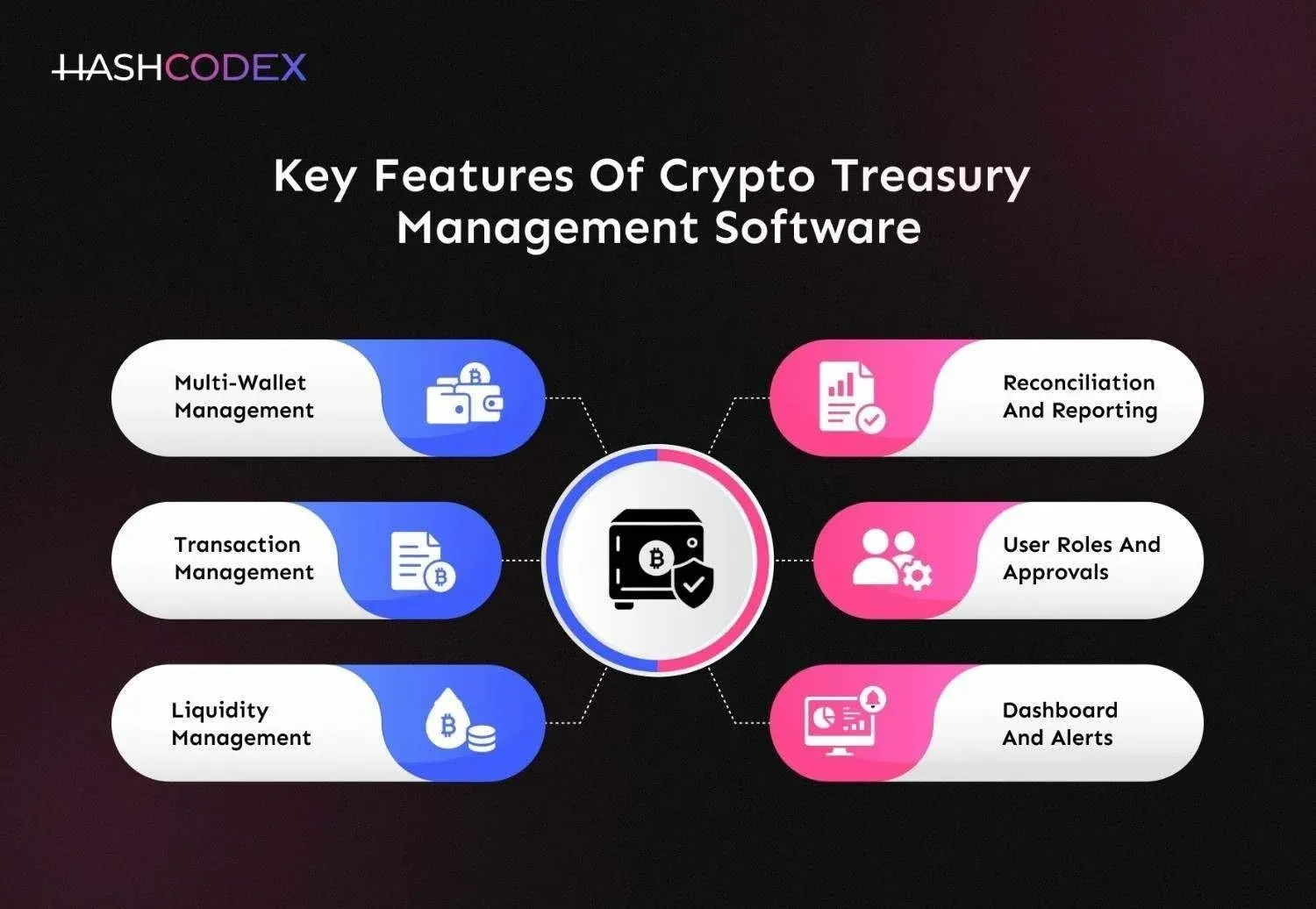
Multi-wallet management
Let users view balances and assets across multiple wallets and exchanges from one platform.
Transaction Management
Allow users to create, track, review, and approve crypto transactions while keeping a record of each activity.
Liquidity Management
Help treasury teams see available funds and manage where their assets are held.
Reconciliation and Reporting
Bring transaction data together with internal records and provide reports on assets, balances, and treasury activity.
User Roles and Approvals
Allow businesses to set different access levels and approval steps based on user roles and transaction needs.
Dashboard and Alerts
Give users a quick view of their treasury and send alerts for important events such as large transactions, low balances, or pending approvals.
Technology Stack and Integrations for Crypto Treasury Software
The main technology components include:
- Frontend: React or Angular for treasury dashboards, asset views, transaction screens, approvals, and reports.
- Backend: Node.js, Java, or Python for transaction processing, business rules, user management, and APIs.
- Blockchain infrastructure: Blockchain nodes, RPC providers, and APIs for accessing wallet balances, transactions, token activity, and on-chain data.
- Wallet and custody infrastructure: Wallet APIs, MPC-based wallets, multisignature wallets, and custody APIs for wallet connections and transaction signing.
- Database: PostgreSQL or a similar database for storing users, wallets, transactions, approvals, and reconciliation records.
- API layer: REST APIs and webhooks for connecting different blockchain and financial systems with the treasury platform.
But the technology does not work on its own. Your crypto treasury platform also needs to connect with the systems your users already work with.
These integrations can include:
- Blockchain networks
- Wallets and custody providers
- DeFi protocols
- Banks and payment providers
- Accounting and ERP systems
- Crypto market data providers
- Compliance and transaction monitoring tools
The final stack depends on what you want the platform to handle. A platform built for treasury tracking will have different requirements from one that also supports fund transfers, transaction approvals, and custody.
How Do You Ensure Security and Compliance in Crypto Treasury Software?
Crypto treasury software deals with assets that can move quickly, so security and compliance in crypto treasury management need to be considered from the beginning of development.
For example, the platform can include:
- Role-based access controls
- Multi-factor authentication
- Transaction approval rules
- Wallet allowlists
- Spending limits
- Multi-signature or MPC-based wallet controls
- Transaction monitoring
Access should also depend on the user's role. A person who can view balances does not necessarily need permission to approve or send funds.
Compliance requirements can vary based on the business model, assets, services, and countries where the platform operates.
So, it is important to define these requirements before development begins. Crypto treasury guidance also places a strong focus on governance, custody, approvals, reconciliation, and audit records.
How Much Does It Cost to Develop Crypto Treasury Management Software?
If you're considering building a crypto treasury management platform, budget is probably one of the first things you want to know. So, what does crypto treasury management software development cost?
Typically, development can cost anywhere between $30,000 and $300,000+, depending on how sophisticated your platform needs to be.
| Development Scope | Estimated Cost |
| Basic Treasury Platform | 30,000-80,000 |
| Standard Multi-Chain Platform | 80,000-150,000 |
| Advanced Treasury Solution | 150,000-220,000 |
| Enterprise-Grade Platform | 220,000-300,000+ |
The final cost usually comes down to a few key factors:
- Features and automation: More complex treasury workflows mean more development effort.
- Blockchain networks: Supporting multiple chains requires additional integrations and infrastructure.
- Wallet and custody integrations: Connecting external wallets and custody providers adds technical complexity.
- Security and compliance: Financial-grade security, permissions, approvals, and audit trails require additional investment.
- Customization: Custom crypto treasury management software designed around your specific treasury operations will cost more than a standard solution.
So, rather than asking, “What is the fixed cost?" The better question is, “What does my business actually need the platform to handle?” Once those requirements are clear, you can get a much more realistic development estimate.
Conclusion
So, is building a crypto treasury management platform worth it?
For businesses managing multiple wallets, transactions, assets, and blockchain networks, the answer can be a clear yes, but only when the platform is built around the right requirements.
From choosing the right features and integrations to getting security, compliance, and scalability right, there is a lot to consider before crypto treasury management software development begins.
And the earlier these decisions are made, the easier it becomes to build a platform that can actually keep up with your business.
This is where having the right development partner can make a difference. At Hashcodex, we develop cryptocurrency wallet solutions that help businesses manage digital assets and treasury operations tailored to their specific business needs and requirements.
Thinking about building a crypto treasury management platform?
Why keep it as an idea? Talk to Hashcodex, share your requirements, and let’s explore what we can build together.
Frequently Asked Questions
Who can use crypto treasury management software?
Crypto businesses, fintech companies, Web3 companies, asset managers, and other organizations that hold or manage digital assets can use this type of software.
How long does it take to develop crypto treasury management software?
A crypto treasury management platform typically takes 4–8 months to develop, depending on its features, integrations, blockchain networks, and security requirements. A basic MVP may take around 3–4 months, while an advanced enterprise platform can take 8–12 months or more.
Can crypto treasury software integrate with accounting systems?
Yes. Crypto treasury platforms can be connected with accounting and ERP systems to help transfer transaction and treasury data into existing financial workflows.
Is crypto treasury management software secure?
Yes, it can be highly secure with encryption, multi-factor authentication, role-based access, transaction approvals, and continuous monitoring.










 NDA on Request
 Free Consultation – Let’s discuss your ideas