
Many people say this. If you can work under high pressure, you can work anywhere.
Sounds familiar, right?
Now you may ask, why am I talking about pressure here?
Let me ask you something simple.
You drive on the same road every day. Traffic is normal. You arrive on time. No stress.
But one day, that same highway is fully packed.
Cars are not moving. You are stuck.
What happens then?
Irritated, you keep checking the time, fearing you’ll miss an important meeting or something else
And then you start blaming the road. Why was it not built for heavy traffic?
Now, replace that highway with your backend.
Replace those frustrated drivers with traders losing money because orders are delayed.
On a regular day, your exchange handles 3,000 orders per second. Then, breaking news hits.
Suddenly, orders jump to 30,000 per second.
Same system. Ten times more pressure.
Now tell me honestly. Will your backend handle it?
That is exactly why we need to compare Golang plus C++ and Node.js plus C++.
Let us understand this clearly, step by step.
Why Do Trading Platforms Crash When Trade Volume Suddenly Increases?
When the market becomes active, everything increases at once.
- More users log in
- More API requests hit the server
- More buy and sell orders are placed
- More balance checks happen
- More WebSocket updates are pushed
Now add one more thing.
Stop‑loss orders are set to sell when the price drops. If the market falls quickly, many of these orders get triggered at the same time.
This sudden rush puts heavy pressure on the platform.
On top of that, algorithmic trading bots also start placing orders instantly.
So humans and bots are both trading at the same time.
Pressure becomes very high.
Remember this. Every server has a limit.
A server can only handle a certain amount of work. When too many requests come in, the server gets overloaded. If the CPU reaches 100 percent or the memory is full:
- New requests have to wait
- Order matching slows down
- Traders face delays
But your backend still has to request, check if it is valid, send it to the matching engine, update the database, and then share the result with the user. All of this has to happen in just a few milliseconds
If it cannot handle thousands of operations together, it starts breaking.
And in trading, even a small delay means lost trust.
That is why architectural choice matters so much.
Why Backend Stack Selection Matters for High-Performance Crypto Exchanges?
Backend stack selection matters because your exchange must handle pressure without breaking.
In crypto, traffic can suddenly increase. One big news. One market crash. One big price pump. Suddenly, thousands of users start trading at the same time.
Now, here are the real reasons why backend stack selection matters.
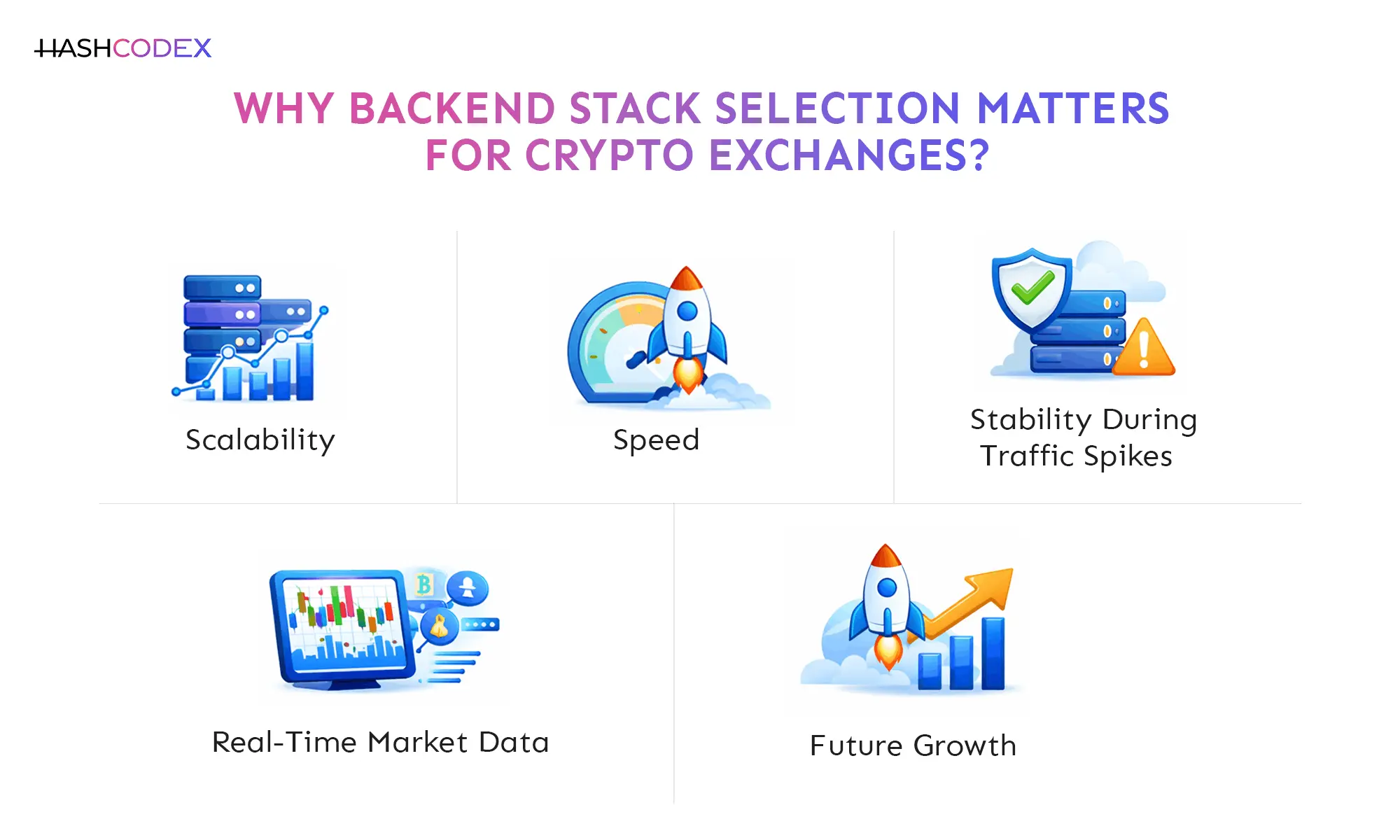
1. It decides how many users your system can handle at once.
If too many users log in and your backend is not strong, the system becomes slow.
2. It decides how fast each request is processed.
Every trade needs a balance check, a risk check, a database update, and confirmation. If this takes time, users feel a delay.
3. It keeps your system stable during traffic spikes.
When volume increases 5x or 10x, CPU and memory usage increase. A good backend stack manages this better and avoids crashes.
4. It controls live price updates.
Traders need real-time updates. If your backend cannot send updates quickly, users see wrong or delayed prices.
5. It helps your exchange grow in the future.
Today you may handle small traffic. Tomorrow it can become very big. Your backend must grow with your platform.
So backend stack selection is not just a technical choice.
- It decides speed.
- It decides stability.
- It decides user trust.
And in crypto trading, trust is everything.
Between Golang + C++ and Node.js + C++, Which Architecture Sustains Massive Trade Surges?
Now we answer the main question clearly.
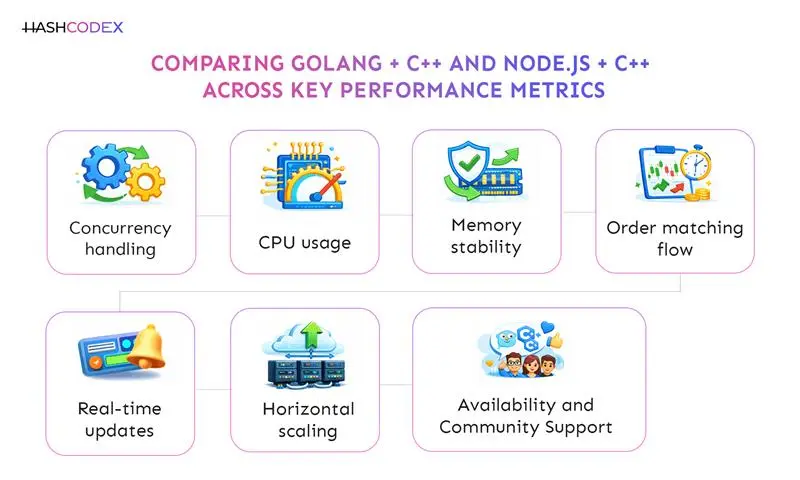
When trade volume jumps 10x, your system is tested in six major areas:
- Concurrency handling
- CPU usage
- Memory stability
- Order matching flow
- Real-time updates
- Horizontal scaling
- Availability and Community Support
Let’s compare both stacks step by step.
1. Concurrency Handling
This is the most important factor.
When thousands of traders place orders at the same time, your backend must process them simultaneously.
Golang + C++
Golang is built for concurrency.
It uses lightweight workers called goroutines.
Think of them as tiny helpers that handle tasks without consuming much memory.
If 20,000 users send orders together:
- Golang can create thousands of goroutines
- It spreads tasks across CPU cores
- It avoids blocking easily
This makes it strong during sudden spikes.
Node.js + C++
Node.js uses a single-threaded event loop.
It processes tasks very fast, but mostly one at a time.
For normal traffic, this works great.
But during heavy load:
- If one task blocks, others must wait
- CPU-heavy operations can slow everything
- You need worker threads or clustering
It works, but it needs more setup.
Clear advantage in extreme concurrency: Golang + C++
2. CPU Usage Under 10x Load
When traffic multiplies, CPU pressure increases fast.
Golang + C++
- Multi-threaded by design
- Uses multiple CPU cores automatically
- Handles parallel processing naturally
If your server has 16 cores, Golang will use them properly. It will use all 16 cores without extra setup.
Node.js + C++
- Single-threaded by default
- Needs clustering to use all cores
- More configuration required
In high-load systems, natural multi-core usage matters a lot.
Advantage: Golang + C++
3. Memory Management and Stability
Memory spikes can crash exchanges.
Golang + C++
Golang has integrated garbage collection.
Modern versions manage memory very efficiently.
Even during heavy load, pauses are short and predictable.
Node.js + C++
Node.js depends V8 JavaScript engine to use garbage collection.
Under extreme bursts:
- Memory usage can increase quickly
- Poor optimization can cause slowdowns
Both need tuning. But Golang often behaves more predictably under high concurrency.
Slight edge: Golang + C++
4. Order Matching Flow
Now let’s talk about C++.
In both architectures, C++ powers the matching engine.
That means:
- Microsecond execution
- Fast order book updates
- High-speed trade matching
So, matching speed itself is strong in both cases.
But here’s the key point.
If your API layer slows down, orders reach the C++ engine late.
So even if matching is fast, the overall system feels slow.
That’s why the backend layer matters more during surges.
5. Real-Time Updates and WebSocket Performance
Trading platforms depend on real-time updates.
Users expect:
- Instant price updates
- Live order book
- Immediate confirmations
Node.js + C++
Node.js is very strong for real-time communication.
Its event-driven model works well for WebSockets.
It feels very responsive for UI updates.
Golang + C++
Golang also handles WebSockets well.
But Node.js is slightly simpler and popular for real-time UI systems.
Small advantage for WebSocket broadcasting: Node.js + C++
6. Horizontal Scaling
When traffic grows, you add more servers.
Golang + C++
- Handles high concurrency per instance
- Often needs fewer servers
- Clean microservices support
Node.js + C++
- Scales well with clustering
- May require more instances under heavy CPU pressure
- Needs careful load balancing
For extreme scaling, Golang usually needs less complexity.
Advantage: Golang + C++
7. Availability and Community Support
Node.js has a very big community.
Many developers use Node.js all over the world. So if you face any problem, you can easily find answers online. There are many videos, blogs, forums, and ready-made packages.
This makes development easier and faster.
Node.js also has many tools and libraries. You can quickly build extra systems like trading bots, admin panels, dashboards, and other support features.
Now look at Golang.
Golang is strong and fast. But its community is smaller compared to Node.js. There are fewer tutorials and fewer ready-made tools.
So if you want more community support and more available tools, Node.js gives you more options.
That is why availability and ecosystem also matter when choosing your backend stack.
How Does C++ Support High-Speed Order Matching in Both Stacks?
First, understand this clearly.
In both Golang + C++ and Node.js + C++, the matching engine is built using C++.
Why?
Because C++ is very fast. It works with very low delay. It can process many orders in a very short time. It also gives better control over memory, which helps improve speed.
In crypto trading, speed is very important.
When thousands of buy and sell orders come at the same time, the matching engine must quickly match them. This should happen in microseconds. Even a small delay can cause problems for traders.
So in both stacks, C++ does this job very well.
But here is the important part.
C++ only handles order matching.
- It does not handle login requests.
- It does not manage API traffic.
- It does not send live price updates.
- It does not handle wallet or other services.
Those tasks are handled by Golang or Node.js.
So yes, C++ supports high-speed order matching in both stacks.
But the full system performance depends on how the backend stack handles heavy traffic.
So, Golang + C++ or Node.js + C++ — Which Should You Choose for 10x Trading Growth?
Now let’s keep it simple.
Choose Golang + C++ if:
- You expect sudden market spikes
- You plan to scale aggressively
- You want strong concurrency handling
- You want predictable performance under heavy load
Choose Node.js + C++ if:
- Your traffic is moderate
- You want faster development cycles
- Real-time user experience is your main focus
- You have strong DevOps support for scaling
You need to understand the pros and cons of both stacks and other tech stacks used to build a crypto exchange. Only then can you make the best decision.
You need better guidance from Hashcodex. We can analyze your requirements and provide the right solution based on your business needs.
In our opinion, both stacks can work. But they behave differently under heavy pressure. If your exchange fails during a bull run, users may never come back.
So do not build only for normal days.
Build for the craziest day in the market.
Because that day will come.











 NDA on Request
 Free Consultation – Let’s discuss your ideas