
Let me tell you something simple. You might have faced this before.
You go to a shop, you are ready to pay, but the payment fails. The screen says, Bank has problems, try again later.
Most of the time, what do we do? We simply give up on what we want and go to another shop.
Now think about it for a second. If you are the business owner, that means a customer has gone.
This happens many times in the fintech industry. You may try to fix it with one payment gateway, or maybe two, sometimes even more. And even though you may already be ready, the problem still comes up, and money doesn’t go.
It feels confusing because from your side, all seems fine.
Many people think it is a bank issue or a random failure.
But after this, it does not have to stay like that, because there are solutions for this.
It’s Called Payment Orchestration. It helps fix these problems.
It is a centralized system that keeps all payments together.
You might be asking, How does it work? That is what we will learn in this blog.
TL;DR
- A Payment Orchestration Platform helps manage all payment methods in one place. Businesses do not need to handle each gateway one by one.
- If one payment route fails, it can switch to another route and help avoid lost sales.
What Is a Payment Orchestration Platform and How Does It Work?
Payment Orchestration is a smart system that connects multiple payment gateways and automatically chooses the best, cheapest, and most reliable route for every payment, helping businesses increase payment success rates and reduce costs.
We can take Google Maps as an example. When we travel, it warns us about traffic on a route and suggests the best way to go.
Payment Orchestration works in a similar way, but slightly different. It did not warn you before. You will not even know there is an issue. When someone makes a transaction, the system automatically chooses the best payment route depending on the place.
This smart switching is called routing.
It helps increase success rates and reduces payment failures.
Here is how it works:
- First, a customer makes a payment.
- Then the orchestration platform receives the request.
- It checks the best available payment route.
- Then it sends the payment through that route.
- Finally, it confirms the payment back to your system.
All this happens in just seconds.
Without orchestration, businesses must manage each payment gateway separately. That is slow and complex.
With orchestration, everything is connected and automated.
Payment Orchestration Platform Development for Fintech Startups
Payment Orchestration Platform Development is the process of building a multi-gateway payment management system for fintech businesses. It allows companies to create their own centralized platform or offer payment orchestration services to businesses that need a better way to manage payments across multiple providers.
The development process involves designing a platform that connects payment gateways, banks, digital wallets, and crypto payment providers into one system. Through a single dashboard, businesses can manage transactions, smart routing, API integrations, crypto payments, client details, and reporting, making payment operations easier and more efficient.

Payment Gateway vs Payment Orchestration Platform: What Is the Difference?
Here are simple explanations of the differences between a payment gateway and a payment orchestration platform, along with a visual comparison
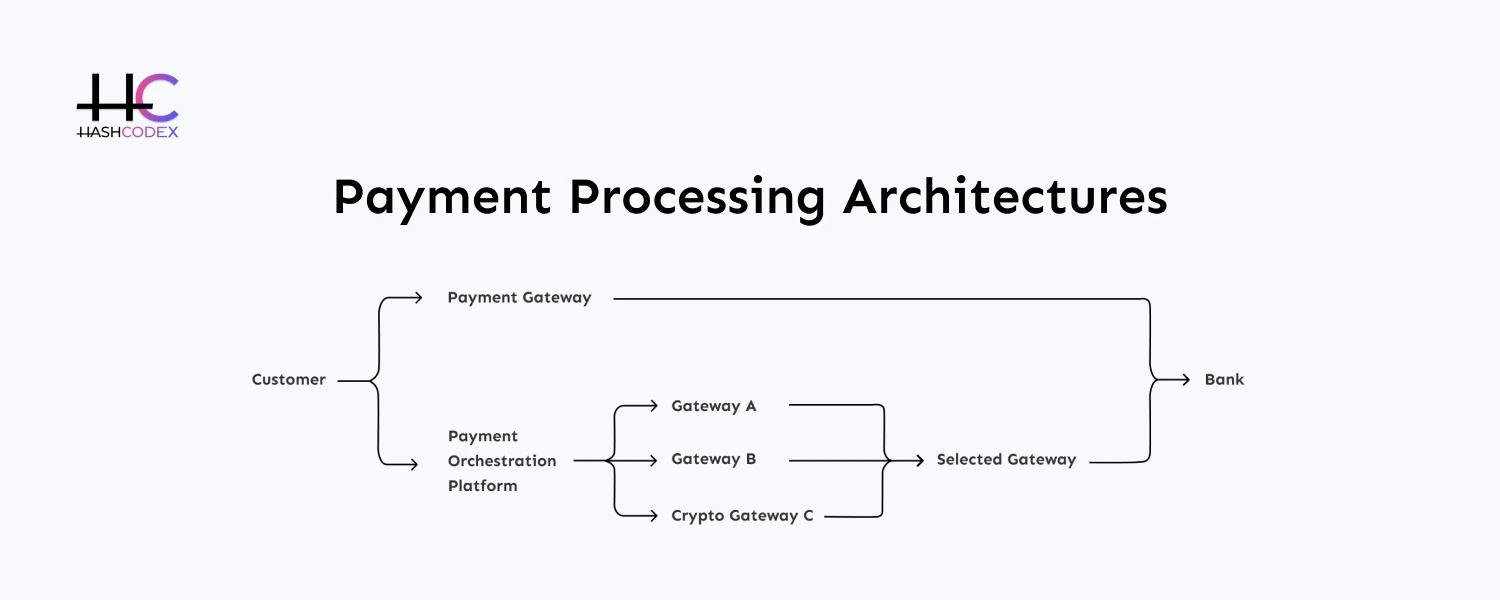
| Aspect | Payment Gateway | Payment Orchestration Platform |
| Main Purpose | Processes online payments between customers, businesses, and banks. | Manages and coordinates multiple payment gateways from one platform. |
| Role in Payments | Checks payment requests and processes them. | Decides which payment gateway should process each transaction. |
| Gateway Management | Focuses on processing payments through its own gateway. | Connects and manages multiple payment gateways in one place. |
| Business Control | Provides tools to accept and manage payments. | Gives central control over many payment providers and payment flows |
| Best For | Simple payment solutions for every business |
Businesses that use many payment gateways and want to control them all from one platform. |
What Payment Problems Do Fintech And Other Businesses Face Today?
Fintech companies deal with many payment issues every day.
These problems may look small at first, but they can hurt business growth.
Here are the most common ones:
- Payment failures during peak traffic
- Limited payment options for users
- Slow transaction confirmation
- High dependency on one provider
- Currency and region restrictions
- Manual work to track failed payments
- Poor success rate in international payments
Now think about this. Every failed payment is a lost customer moment.
And most users do not try again.
They simply leave.
That is why payment systems need to be more smart and flexible today.
How Does a Payment Orchestration Platform Solve These Problems?
A payment orchestration platform solves these problems by making payments smarter and more connected.
- Smart Payment Routing: When someone makes a transaction, the system automatically sends it through the most suitable and reliable gateway based on success rate, cost, and location. This helps businesses avoid failed payments.
- Automatic Failover Protection: We cannot expect every gateway to be active all the time. If one goes down, the platform quickly switches to another so the business keeps running without interruption.
- Centralized Payment Management: Businesses can manage gateways, banks, wallets, and even crypto providers from one dashboard.
- Lower Transaction Costs: Intelligent routing chooses the most cost‑effective provider, helping businesses save money on processing fees.
- Higher Success Rates: Transactions go through the best‑performing providers, reducing failures and lost revenue.
- Simplified Integrations: Instead of maintaining many separate integrations, businesses can handle all payment channels in one place.
- Global Payment Support: Companies can accept multiple currencies and payment methods across countries with one unified system.
- Unified Fiat and Crypto: Traditional payments and crypto payments can both be managed together under one orchestration layer.
Likewise, you will get many benefits when you provide services for a payment gateway or when you just want to improve your business. It will definitely help you by reducing failures, cutting costs, and giving customers a better experience.
Types of Payment Routing Used in Payment Orchestration Platforms
Payment routing means deciding how a payment should travel from customer to merchant.
There are different types of routing used in orchestration systems.
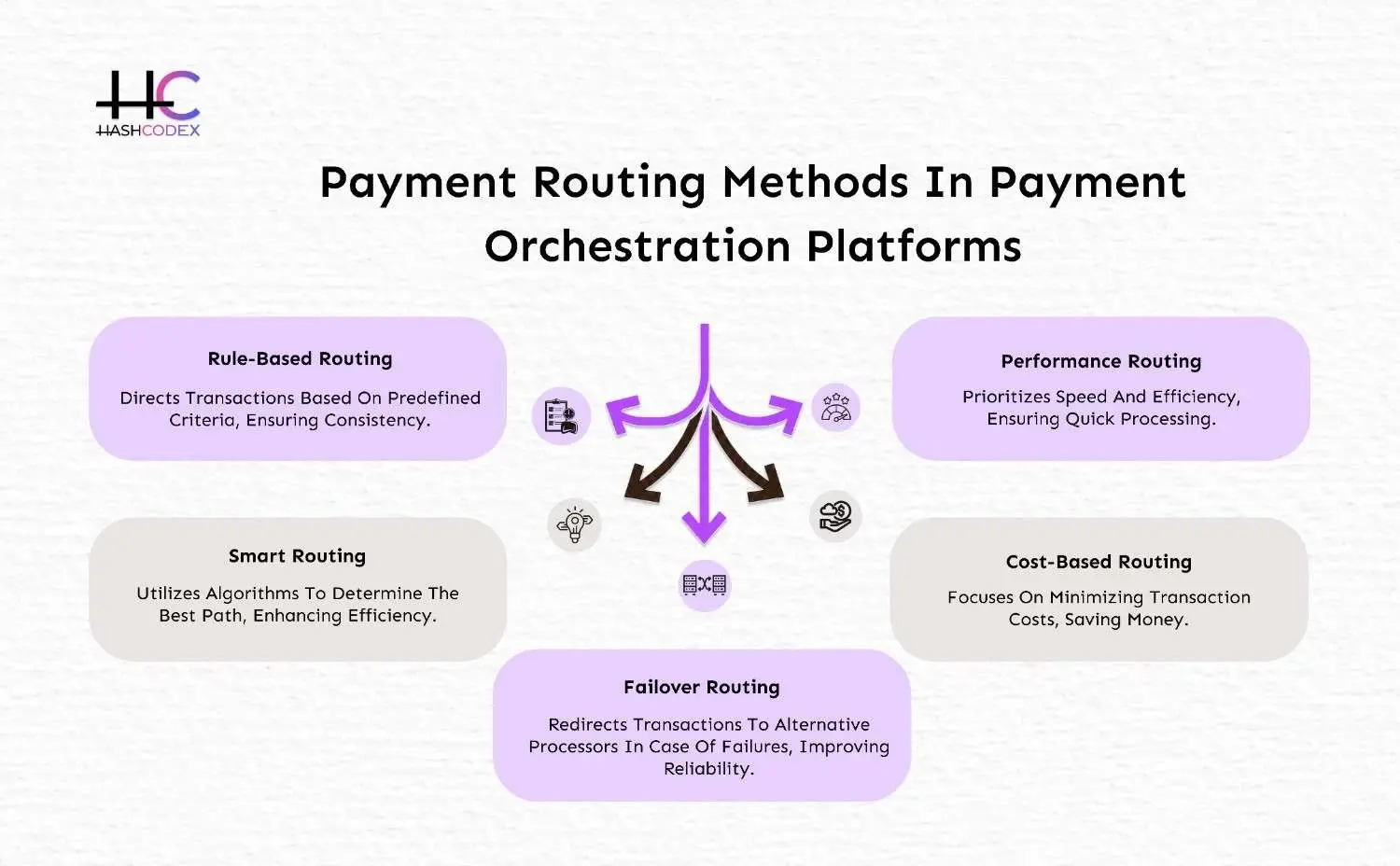
Here are the main ones:
- Rule-based routing
Payments follow fixed rules like country, currency, or payment method.
- Smart routing
The system chooses the best gateway based on the success rate.
- Failover routing
If one gateway fails, another is used automatically.
- Cost-based routing
Payments are sent through the cheapest available option.
- Performance routing
The system selects gateways that perform better in real time.
These routing methods help increase payment success and reduce failures. This is one of the most important parts of a payment orchestration system.
What Features Should a Payment Orchestration Platform Have?
A good payment orchestration platform should make payment management easy and flexible for businesses.
Here are some important features:
- Payment gateway management
- Smart payment routing
- Easy-to-use dashboard
- Transaction management
- API management
- Clear reports and analytics
- Real-time payment tracking
These features help businesses manage payments in one place and reduce manual work.
The goal is simple: to make payment operations easier, faster, and more organized.
Which Industries Are Using Payment Orchestration Platforms Today?
Payment orchestration platforms are used in many industries today, not just fintech.
Some of the industries using these platforms include:
- Fintech companies
- Crypto exchanges
- Forex brokers
- E-commerce businesses
- SaaS companies
- Travel and booking platforms
These industries handle a large number of payments every day. They need payment systems that are fast, reliable, and flexible.
That is why more businesses are adopting payment orchestration platforms to manage payments more efficiently and improve the customer experience.
Why Are Crypto Exchanges Adopting Payment Orchestration Platforms?
Crypto exchanges have users from many different countries. They also support different currencies and payment methods. This can make payment management difficult.
Some users prefer bank transfers. Others use cards, digital wallets, or crypto payments. A payment orchestration platform helps bring all these payment methods into one system. It makes payments easier to manage and helps reduce payment failures.
For crypto exchanges, this means faster transactions, a better user experience, and more trust from users.
Key Benefits of Using a Payment Orchestration Platform
Using a payment orchestration platform brings many advantages:
- Higher success rate
- Fewer failed transactions
- Easy gateway management
- Faster processing
- Better user experience
- Less manual work
- More control
In simple words, it helps businesses grow without payment issues slowing them down.
Build vs Buy: Should Fintech Startups Develop Their Own Payment Orchestration Platform?
Many fintech startups ask the same question:
Should we build our own payment orchestration platform, buy one, or use a hybrid?
- Building your own platform gives you full control. You can add the features you want and change things anytime. But it takes more time, more money, and strong technical skills.
- Buying or using an existing solution is faster. Startups can launch quickly and focus on growing. The downside is less freedom to customize and depending on the provider for updates.
- Hybrid approaches are popular. Many startups start with a third‑party solution and later build their own platform as they grow.
The best choice depends on your budget, stage of business, and future plans. If you are just starting, a ready‑made solution helps you begin faster. If your business is growing and earning good revenue, building your own platform gives more control and flexibility.
Common Challenges in Payment Orchestration Platform Development
Building a payment orchestration platform sounds exciting. But it is not always easy.
Think about it for a moment.
The platform needs to connect with many payment providers. Each provider has its own API, rules, and payment process. Bringing everything together in one place takes time and careful planning.
And there is more.
The platform also needs to handle a large number of transactions every day. Payments should reach the right provider, transaction data should stay safe, and businesses need to keep an eye on fraud.
As the business grows, the challenge becomes even bigger. More users mean more transactions. The platform must be ready to handle that growth without creating payment problems.
That is why payment orchestration platform development requires the right planning from the beginning. When the platform is built properly, businesses can manage payments more easily and avoid many problems in the future.
Why Choose Hashcodex for Payment Orchestration Platform Development?
Why choose Hashcodex for payment orchestration platform development? The answer is simple. We have strong expertise in this sector and have completed many projects in the fintech industry.
As an experienced fintech software development company, we make sure the platform we build matches your business needs and goals. Hashcodex works with fintech startups, crypto exchanges, and trading platforms to develop scalable payment systems.
We focus on simple system design, strong integration with multiple payment gateways, secure and stable architecture, custom features based on business requirements, and scalable systems that support future growth.
Our goal is to help businesses build payment systems that are easy to manage and ready to scale as the business grows.
Want to see our orchestration platform demo? We are just one click away. Click the link and talk with our experts today.








 NDA on Request
 Free Consultation – Let’s discuss your ideas