
If you visit any shop or supermarket, you will notice one thing.
There is always a door that says “Staff Only.”
Now think about it.
- You are free to walk around the whole store.
- You can see products, shelves, and counters.
But that staff room? You are not allowed inside.
Why?
Because that space is meant only for staff. It has systems, stock details, and internal work. So access is restricted for safety and control.
Now connect this to your business.
If a supermarket needs access rules, imagine a fintech business using blockchain.
How much security should you have?
This is exactly why permissioned blockchain exist. It allows only approved members to enter the system.
If you prefer clear rules over noise, this guide is for you. Let us understand permissioned blockchain properly, step by step.
What Is a Permissioned Blockchain?
A permissioned blockchain is a special type of blockchain where only approved people or organisations can join. They can validate transactions and see the data. It is not open to the public.
Public blockchains allow anyone to join. But a permissioned blockchain works more like a private business network.
You can understand it with a simple example.
Think of a WhatsApp group and a company board meeting.
- A WhatsApp group is open. Anyone can join if they get the link.
- A board meeting is private. Only selected members are allowed inside.
A permissioned blockchain is like a board meeting.
In this type of blockchain:
- Identities are known
- Access is controlled
- Data is shared only with the right people
Because of this, it is very useful for businesses that deal with sensitive or important information.
Permissioned Blockchain vs Permissionless Blockchain Key Differences for Businesses
Many entrepreneurs get confused between these two, so let us make it very clear.
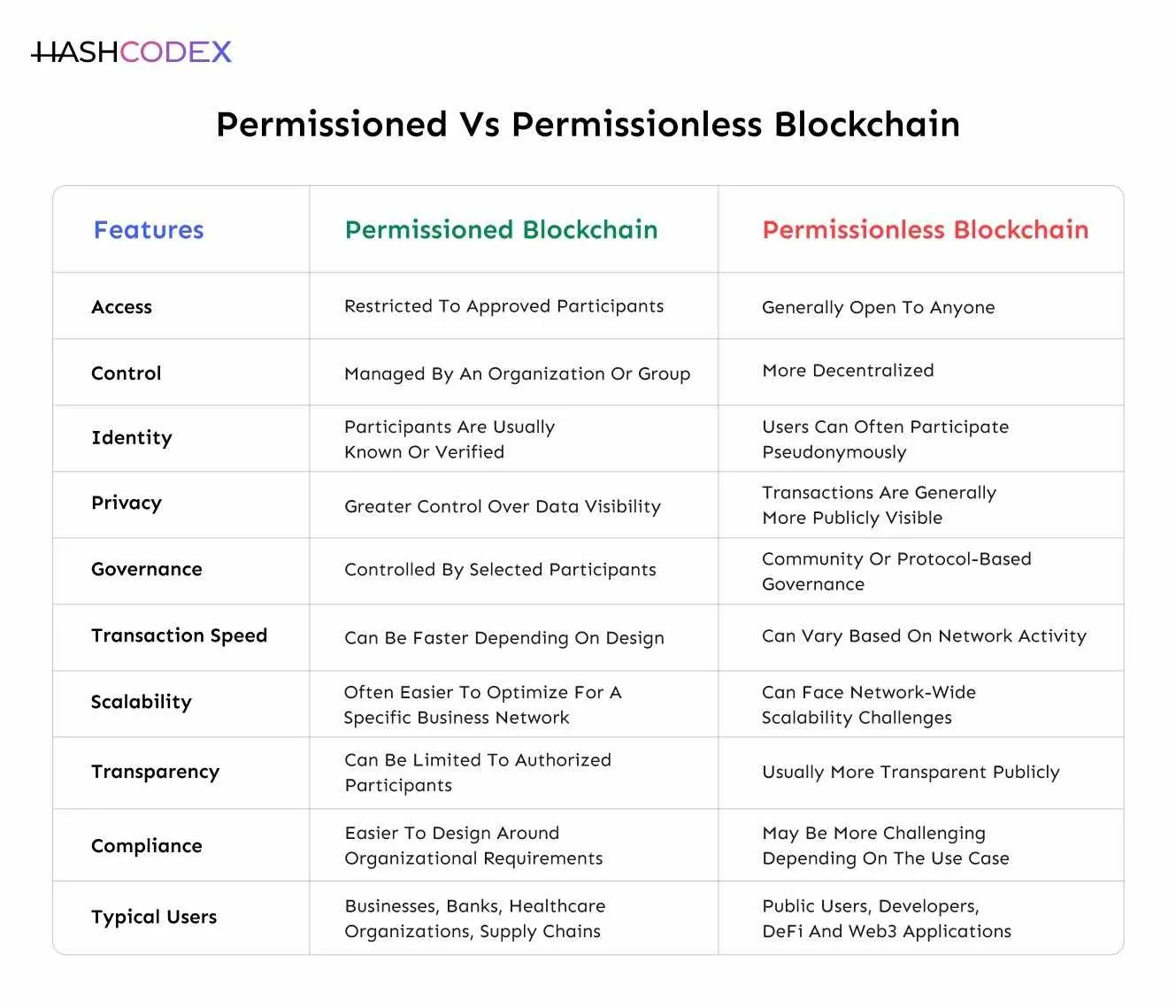
Many organizations prefer permissioned blockchains because they provide controlled access, clearer governance, and greater visibility over who can participate in the network.
Businesses are also exploring hybrid blockchain models, where permissioned and public blockchain networks can work together.
Why Do Enterprises Use Permissioned Blockchain Networks?
Let us understand the real reason.
By 2026, entrepreneurs will not just be testing ideas. They are building serious products that must work in real life. That is why many of them choose permissioned blockchain networks.
1. Data privacy is more important than hype
Businesses cannot show customer data to everyone. A permissioned blockchain shares data only with authorised people. This keeps information safe.
2. Rules and regulations are getting tighter
Governments want clear records and proper tracking. Permissioned blockchains support identity checks and help companies follow the rules without trouble.
3. Performance stays stable
Public blockchains can become slow when too many people use them. Permissioned networks give steady speed, which is important for business apps.
4. Businesses need control
Entrepreneurs want to decide who can join, who can validate and how the system should run. Permissioned blockchains give this control while still keeping some decentralisation.
5. Better security for sensitive work
Industries like banking, supply chain, and healthcare need strong security. Permissioned networks reduce the risk of unknown users entering the system.
6. Easy to connect with existing tools
Companies already use ERP, CRM, and other systems. Permissioned blockchains connect more smoothly with these tools.
Overall, permissioned blockchains match real business needs. They offer privacy, control, speed, and trust, which is exactly what entrepreneurs want when they build long‑term products.
How to Create a Permissioned Blockchain Network Step by Step?
A permissioned blockchain is basically a private blockchain. Only selected people or systems can join, see the data, or make changes.
Step 1: First, understand why you even need a blockchain
Before you start building anything, sit down and think clearly.
Ask yourself:
- What problem will this blockchain solve
- Who will actually use it
- What data should stay private
- Who should be allowed to see or update the data
For example, if many companies want to share data safely without trusting each other blindly, a permissioned blockchain helps a lot.
This step saves you from big confusion later.
Step 2: Choose the right permissioned blockchain platform
Developers don’t build everything from zero. They use ready platforms that already have:
- Security
- Networking
- User identity
- Basic blockchain rules
Popular ones include:
- Hyperledger Fabric
- Hyperledger Besu
- Corda
- Quorum
These platforms act as a strong base. If you run a big enterprise and want full control, you can even build your own blockchain. It may take a few months, but you can also earn extra revenue from it.
Also, with quantum tech growing fast, old security methods may break. So we need blockchains that can handle future threats too.
Step 3: Decide who will join the network
Now think about the people or companies who will be part of this network.
- How many members will join
- Who will run the servers
- Who will approve transactions
Each company can run its own node. A node is just a computer that runs the blockchain. This builds trust because everyone has their own copy.
Step 4: Give identity to every user and node
In a permissioned blockchain, nobody is anonymous. Everyone gets a proper identity.
This helps you:
- Allow or block access
- Track actions
- Keep data safe
If someone does not have permission, they simply cannot enter. This keeps the whole system secure.
Step 5: Decide who can do what
Not everyone should have full power. You must set clear roles.
Decide:
- Who can read data
- Who can add data
- Who can approve data
For example:
- Some users only view data
- Some users submit transactions
- Some nodes approve transactions
This gives you full control over the network.
Step 6: Choose how transactions will be approved
Whenever someone sends data, the blockchain must check if it is correct. This checking process is called consensus.
In a permissioned blockchain:
- Only trusted nodes check transactions
- Approval is fast
This makes the network smooth and efficient.
Step 7: Set the main rules of the blockchain
Before starting the network, you must set the basic rules.
These include:
- Who can join
- How blocks are created
- How approval works
All nodes follow these rules from day one. This keeps everyone aligned.
Step 8: Add smart rules for business work
Sometimes you want the blockchain to do things automatically.
For example:
- Approve a transaction when all conditions are met
- Stop wrong data entry
These automatic rules are called smart contracts. Once written, they work on their own without human help.
Step 9: Decide where the data will be stored
Not all data needs to sit inside the blockchain.
Usually:
- Important records stay on the blockchain
- Big files stay outside, but are linked
This keeps the system fast and safe.
Step 10: Test everything properly
Before going live, testing is very important.
Check:
- If users can access the right data
- If permissions work correctly
- If transactions move smoothly
Testing helps you avoid problems later.
Step 11: Start the blockchain and add users
After testing:
- Start all nodes
- Give access to users
- Begin real usage
Now your blockchain is officially live.
Step 12: Keep watching and improving
Even after launch:
- Monitor performance
- Add new users when needed
- Update rules if your business changes
Good maintenance keeps the blockchain healthy for a long time.

Summary for Quick Understanding
- Know why you need blockchain
- Choose a permissioned platform
- Decide who joins the network
- Give identity to users
- Set permissions
- Approve transactions properly
- Set basic rules
- Add smart rules
- Store data safely
- Test everything
- Go live
- Maintain the network
Consensus Protocols Used in Permissioned Blockchain Networks
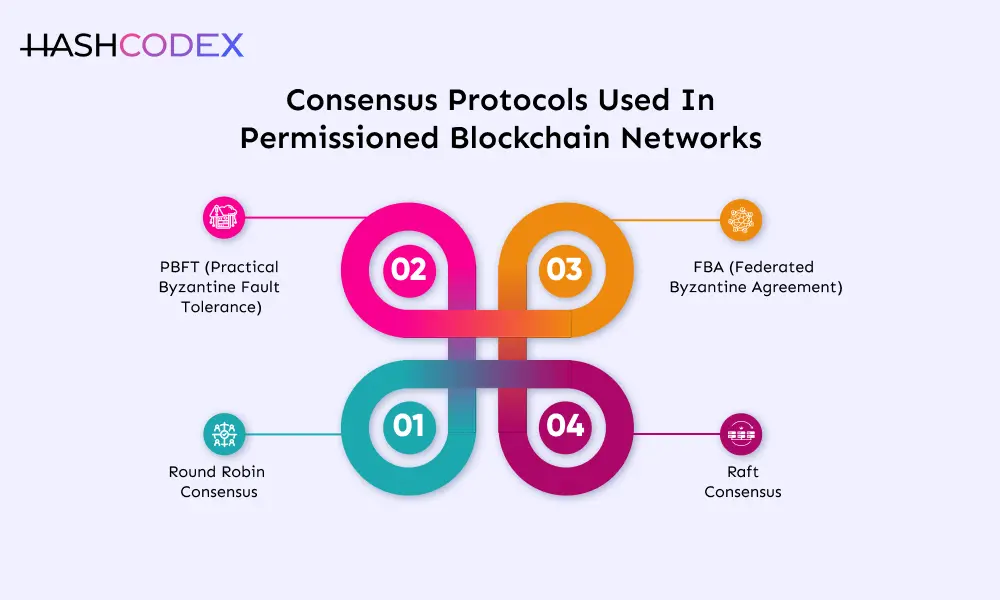
PBFT (Practical Byzantine Fault Tolerance)
PBFT is like saying, “Even if a few people lie, the system should still work.” It works quickly and requires some trust within the group.
How it works:
- One leader
- Others check the leader
- If most agree, it’s accepted
Think of this: Class monitor tells homework → students confirm → majority wins.
FBA (Federated Byzantine Agreement)
FBA means “I trust only some people, not everyone.” Each computer makes its own trust circle.
How it works:
- You choose trusted members
- This group is called a quorum
- If the quorum agrees, the decision is final
Simple example: In a society meeting, you trust the secretary + treasurer → if they agree, you agree.
Round Robin Consensus
Round Robin is “Everyone gets a turn one by one.” Fair and equal for all computers.
How it works:
- The first computer creates a block
- The next turn goes to the next computer
- Others vote
- If 2/3 say yes, block added
Easy example:
School duty:
- Monday: Lucas
- Tuesday:
- EthanWednesday: John
Raft Consensus
Raft is “One leader decides, others follow.” Very simple and easy to manage.
How it works:
- One leader
- Others follow
- If the leader fails, a new leader is chosen
Example: Office manager gives work → employees follow → new manager if the old one leaves.
Advantages of Using a Permissioned Blockchain
By using a permissioned blockchain in your business, besides these, you will get many advantages:
- Data Stays Only with the Right People
- Transactions Happen Super Fast
- Save Money on Middlemen
- Full Control Over Who Does What
- Plays Well with Your Current Systems
- Clear Track Record for Audit
- Less Chances of Cheating or Fraud
- Grows Along with Your Business
- Builds Trust with Partners and Investors
- Gives You an Edge Over Competitors
Limitations and Challenges of Permissioned Blockchain
Permissioned blockchain is strong and useful, but let’s be practical. It is not the best choice for every situation. Before using it, businesses should keep these points in mind.
1. Less Decentralisation
Control stays with a small group of approved members. So it is not fully open like public blockchains.
2. Trust Still Matters
Even if members are known, some trust is still needed. If someone behaves wrongly, the system must handle it properly.
3. Setup Complexity
Setting it up needs planning, technical skills, and clear rules. You cannot start it casually without preparation.
4. Smaller Developer Ecosystem
Not many developers work on permissioned blockchains. So finding skilled people may take extra time.
5. Integration Challenges
Connecting blockchain with old systems can be difficult. APIs, data flow, and processes must be planned properly.
6. Data Privacy Concerns
Even in private networks, data must be shared carefully. Wrong access settings can expose sensitive information.
7. Data Access Efficiency
Too many permission checks can slow down the system. You need a balance between security and speed.
8. Optimal Data Storage
You cannot store everything on the blockchain. Bad storage choices can reduce performance.
9. Participant Identity Management
Every user and node needs proper identity control. As the network grows, managing identities becomes tougher.
10. Governance Can Become Complicated
When multiple companies participate in a permissioned blockchain, they need to agree on network rules, responsibilities, upgrades, permissions, and decision-making.
Without clear governance, disagreements can slow down the network or create operational problems.
When Should You NOT Use a Permissioned Blockchain?
Not every business problem needs blockchain. Sometimes, a traditional database is simpler, faster, and more cost-effective.
A permissioned blockchain may not be necessary when:
- One organization controls all the data.
- A conventional database already solves the problem.
- Participants don't need shared governance.
- There is no multi-party trust issue.
- The application doesn't require an immutable shared record.
Before choosing blockchain, ask yourself:
- Are multiple independent parties involved?
- Do they need to share the same trusted records?
- Do they need controlled access to those records?
- Would a shared ledger reduce reconciliation, disputes, or manual processes?
- Can the benefits justify the additional technical complexity?
If most answers are yes, a permissioned blockchain could be worth evaluating.
If the answer is mostly no, a conventional database or centralized application may be the better solution.
For enterprises, this mindset can prevent unnecessary development costs and help teams choose an architecture based on actual business requirements rather than technology hype.
Use Cases of Permissioned Blockchain Across Industries
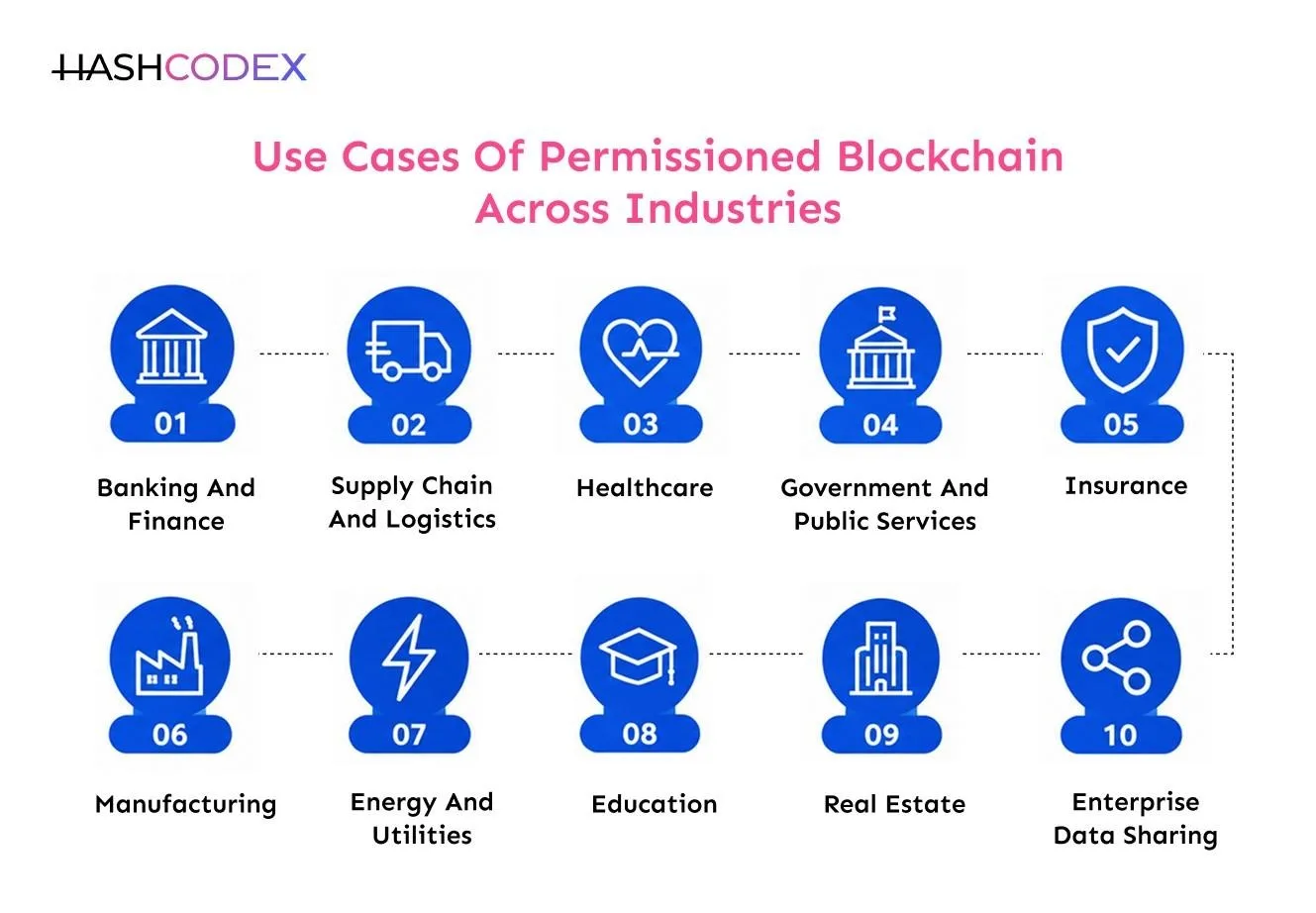
- Banking and Finance: Secure transactions, faster settlements, and reduced fraud between financial institutions.
- Supply Chain and Logistics: End-to-end tracking of goods across suppliers, manufacturers, and distributors.
- Healthcare: Secure sharing of patient data between hospitals while maintaining privacy.
- Government and Public Services: Tamper proof systems for identity, land records, and public data management.
- Insurance: Faster claims processing with reduced fraud and automated verification.
- Manufacturing: Real-time tracking of production, quality, and supplier data.
- Energy and Utilities: Secure energy trading, billing, and grid data management.
- Education: Verifiable academic records and tamper-proof certificates.
- Real Estate: Transparent property records and secure ownership transfers.
- Enterprise Data Sharing: Controlled and secure data exchange between trusted organizations.
Real-World Examples of Permissioned Blockchain
1. IBM Food Trust (Food Supply Chain)
IBM built the IBM Food Trust network using Hyperledger Fabric to improve food traceability.
It allows:
- Retailers, farmers, and suppliers to share verified food data
- Faster tracking of contamination sources (from days to seconds)
- Better transparency across the supply chain
Used by companies like Walmart and Nestlé to ensure food safety and authenticity.
2. R3 Corda (Banking & Finance)
Corda is a permissioned blockchain platform designed specifically for financial institutions.
It is widely used for:
- Secure interbank transactions
- Trade finance automation
- Digital agreements between trusted parties
Unlike public blockchains, Corda shares data only between involved parties, not the entire network.
3. Hyperledger Fabric (Enterprise Blockchain Framework)
Hyperledger Fabric is one of the most widely adopted permissioned blockchain frameworks.
It is used in:
- Banking systems
- Healthcare data sharing
- Supply chain tracking
- Government record management
Its modular architecture allows businesses to define their own rules, privacy layers, and consensus models.
4. TradeLens (Shipping & Logistics – Historical Example)
Maersk and IBM developed TradeLens, a blockchain-based shipping platform.
It was used for:
- Tracking global shipping containers
- Sharing documents between ports and customs authorities
- Reducing paperwork delays
(Note: TradeLens was discontinued, but it remains a key real world case study in enterprise blockchain adoption.)
5. we.trade (Trade Finance Network)
we.trade was a consortium of major banks using permissioned blockchain for international trade.
It enabled:
- Secure digital trade agreements
- Reduced risk in cross-border transactions
- Faster financing for SMEs
Is Permissioned Blockchain the Right Choice for Your Business?
Now the important question.
Permissioned blockchain is right for you if:
- You handle sensitive data
- You need compliance
- You want controlled access
- You work with partners or vendors
- You need predictable performance
If you want only approved people to join and use the network, a permissioned blockchain suits you better. So choose based on business need, not hype.
Conclusion:
Permissioned blockchain is not about reducing the power of blockchain. It is about using blockchain in a practical way for real businesses.
In 2026, many entrepreneurs are choosing permissioned blockchain networks because they need:
- Better control
- Strong security
- Compliance with rules
- Good performance
Permissioned blockchain gives all the main benefits of blockchain, while still fitting into real business needs and operations.
If you are planning a serious blockchain-based product, then a permissioned blockchain is definitely worth considering.
One more thing is very important. You must choose the right Blockchain development Company.
A good blockchain partner should:
- Understand your business clearly
- Deliver what they promise
- Stay connected throughout the project
- Have real experience, because blockchain needs deep technical knowledge
When a partner meets all these points, the project becomes smooth and successful.
We believe Hashcodex can meet these expectations and support you at every step of your blockchain journey.
If you want to discuss your idea and understand the full project scope, feel free to connect with us and get complete details.











 NDA on Request
 Free Consultation – Let’s discuss your ideas