
In 2026, the way people pay is changing, and businesses need to keep up.
Why am I saying this?
Because digital payments are changing, especially with the rise of stablecoins.
Usually, stablecoins make digital payments stable, fast, and easier to access.
Now, stablecoin cards are taking this a step further. They allow customers to spend stablecoins through familiar card payment networks without changing how they shop.
For business owners and fintech startups, this creates an opportunity to offer modern payment options, reach global customers, and build new financial products.
So, what exactly are stablecoin cards, and how can your business benefit from them? Let’s explore.
What Is A Stablecoin Card?
A stablecoin card is a simple idea that allows stablecoins such as USDC to be spent through debit/credit cards like a normal payment, while the receiver gets normal fiat currency.
In other words, it is a concept that evolved from the crypto debit card introduced by Rain. Later, in April 2025, it became more widely recognized when Bridge and Visa publicly launched stablecoin-linked Visa cards.
And now, in 2026, many businesses are starting to show interest and begin to explore this payment model.
How Does a Stablecoin Card Work?
The working of a stablecoin card is quite simple from the user’s perspective because it is designed to provide a familiar payment experience.
For instance, a user holds stablecoins such as USDC in a supported wallet. When the user makes a payment using the card, the underlying payment infrastructure handles the conversion and settlement so that the merchant can receive fiat currency.
Here is how the process looks:
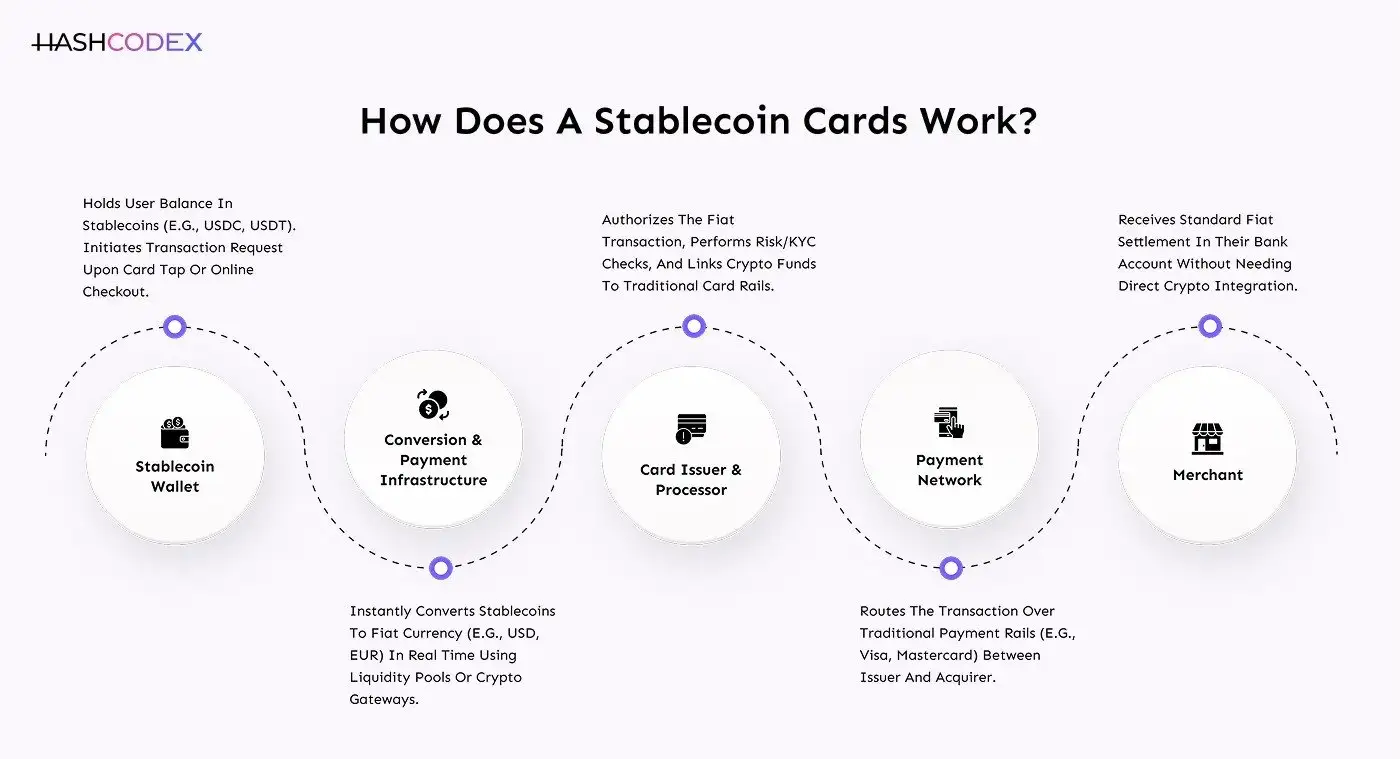
For the customer, it feels almost exactly like using a normal debit card.
But behind the scenes, blockchain infrastructure can become part of the payment process. Now let's take a close look at how it is evolving.
Stablecoin Cards: The New Era of Digital Payments in 2026
Stablecoin cards are gaining attention in 2026 because they could bring blockchain-based settlement into the existing payments infrastructure without requiring businesses to completely rethink how they pay and get paid.
For businesses, the value goes beyond simply using digital assets at the point of sale. It can connect traditional card networks and familiar payment rails with blockchain-based treasury and settlement infrastructure.
This creates a bridge between traditional financial infrastructure and blockchain-based payments, allowing businesses to benefit from flexible settlement without replacing the system they already use.
A good example of this wider shift is Western Union's move toward stablecoin-based infrastructure.
Traditionally, sending money across borders could involve several banks and intermediaries, which could make the process slower and more expensive. With blockchain-based settlement, payments can potentially move around the clock instead of depending entirely on traditional banking hours.
What makes this interesting is that stablecoin cards aren't necessarily trying to replace the payment experience.
The real change is happening behind the scenes.
The card may look familiar, but the money moving underneath can be powered by stablecoins and blockchain infrastructure. That combination of a familiar payment experience with new financial technology is one of the main reasons stablecoin cards could become the evolution of digital payments in 2026.
How Is Regulation Supporting Stablecoin Cards and Their Payment Infrastructure?
As stablecoin cards become more popular, regulators around the world are also starting to catch up. Governments and financial authorities are introducing clearer rules, giving businesses and financial institutions more confidence to explore stablecoin-based payment solutions.
This shift is already becoming visible across regions such as Latin America, Europe, and the Middle East.
The United States is a good example. The GENIUS Act of 2025 introduced a federal framework for payment stablecoins, setting clearer requirements for compliant stablecoin issuers. For businesses and financial institutions, this provides a more defined regulatory foundation for exploring stablecoin payments and card-based solutions.
Canada is moving in a similar direction. Measures linked to Bill C-15 are bringing more structure to certain digital-asset activities while still leaving room for payment technologies to develop. This balance between regulation and innovation could help stablecoin payment solutions grow in a more responsible and sustainable way.
Europe has also made significant progress through the MiCA framework, which sets rules for crypto-assets, including stablecoins.
Overall, clearer regulations are helping stablecoin payments move beyond the early stages of experimentation and toward becoming a more structured financial solution. As more countries introduce practical and well-defined rules, businesses can adopt stablecoin cards and payment infrastructure with greater confidence, knowing there is a clearer regulatory path to follow.
Why Do Stablecoin Cards Matter To Fintech Startups And Payment Companies?
Stablecoin cards matter to fintech startups and payment companies because they can turn stablecoins into a practical payment tool, combining the speed and flexibility of digital assets with the familiarity and global acceptance of traditional card payments.
Here are the benefits for businesses through stablecoin cards,
- Everyday stablecoin spending: Users can spend stablecoins online and offline through familiar card payment networks without manually converting their assets before every transaction.
- Faster cross-border payments: Stablecoins can simplify international transactions by reducing dependence on multiple intermediaries and lengthy settlement processes.
- New revenue opportunities: Fintechs and wallets can use stablecoin cards to expand into payments, transaction services, FX, and other financial products.
- Enterprise treasury management: Businesses can hold liquidity in stablecoins and access those funds when payments are made, reducing the need to pre-fund multiple accounts across different markets.
- Faster vendor settlement: Stablecoin-based payment infrastructure can help businesses settle with global vendors more efficiently.
- Programmable spending controls: Corporate cards can include controls based on spending limits, employee permissions, merchant categories, geography, subscriptions, and specific vendors.
- Reduced FX complexity: Businesses operating across multiple markets can use stablecoin-based liquidity to reduce unnecessary currency conversions and simplify cross-border spending.
- Growing market adoption: According to Visa, stablecoin-linked card payment volume reached approximately $5.2 billion in 2025, up 319% year over year, showing that stablecoin cards are moving beyond experimentation.
In short, stablecoin cards give businesses a simpler way to bring stablecoins into everyday payments while improving flexibility and global access. But to make these benefits work reliably, businesses need the right infrastructure to support stablecoin-based card payments.
Essential Infrastructure for Businesses Using Stablecoin Payment Cards
A stablecoin payment card is more than just a card linked to a digital wallet. Behind every transaction, there is an infrastructure layer that manages funds, processes payments, connects to blockchain networks, protects user assets, and handles compliance.
For fintech startups and payment companies, choosing the right infrastructure is important because it directly affects how securely and efficiently the platform can operate as transaction volumes increase.
Here are the key infrastructure components businesses need:
Non-custodial Stablecoin Wallet Infrastructure
The wallet layer is where stablecoins are stored and managed. Unlike first-generation crypto cards, which usually rely on centralized wallets, stablecoin cards can use a non-custodial model. This allows businesses to give full control of user’s funds to them while still authorizing and making payments through the platform.
Blockchain Infrastructure
When a platform provides a stablecoin card, they need reliable blockchain connectivity to move and settle digital assets.
Supporting multiple networks can give businesses more flexibility in terms of transaction speed, network fees, and stablecoin availability. The infrastructure may also need to handle blockchain confirmations, transaction tracking, gas fees, and on-chain settlement.
Smart Contract Infrastructure
Smart contracts can bring programmable controls to stablecoin payment systems. Instead of relying entirely on manual processes, businesses can use smart contracts and authorization logic to define how funds can be used.
For example, they can support:
- Spending limits
- Transaction approvals
- Employee permissions
- Merchant restrictions
- Treasury controls
- Automated settlements
These controls give businesses more flexibility over their funds while reducing the need for manual approval and intervention.
Security and Fraud Prevention
Security needs to be built into the platform from the beginning. Since it handles both digital assets and payment transactions, strong monitoring and access controls are essential parts of the infrastructure.
Also, these controls help businesses identify unusual activity and protect funds before a small issue becomes a major financial loss.
Compliance and KYC Infrastructure
A strong compliance layer is especially important for businesses operating across multiple markets. Depending on the business model and local regulations, the platform may need to support KYC and KYB checks to verify individuals and businesses.
AML monitoring can help identify unusual or suspicious activity, while sanctions screening can check users and transactions against restricted-party lists.
Building these capabilities into the platform from the start makes it easier to adapt as regulations change and expand into new markets without rebuilding the compliance layer later.
This is the reason most businesses are working closely with fintech development partners to help build the infrastructure connecting stablecoins with the payment networks and financial systems users already rely on.
Conclusion
In this article, we’ve seen how stablecoin cards make payments feel more like normal payments while opening opportunities for cross-border transactions and global payouts.
In 2026, they are becoming an important part of the digital payments landscape as businesses look for flexible ways to move money globally. Building the right infrastructure across wallets, blockchain, payments, security, and compliance will be essential for turning this opportunity into a reliable product.
Businesses looking to develop a crypto payment gateway need the right technology to connect stablecoins with modern payment systems while supporting secure transactions, compliance, and global payments.
If stablecoin payments are part of your roadmap, it’s worth exploring the infrastructure needed to build them and discussing your requirements with our experts.










 NDA on Request
 Free Consultation – Let’s discuss your ideas