Crypto is the most talked-about term right now
If you want crypto payments inside your business, you need a proper payment gateway to make it work.
In this case, many founders in 2026 are trying to bring crypto payments into their apps and platforms.
But when it is time to choose between using a ready-made gateway or building their own, most of them get stuck.
They keep thinking too much.
And here’s the surprising truth.
Founders don’t avoid embedded gateways because they are bad. They avoid them because they want:
- Full control over how payments work
- Better branding in their own style
- Long-term stability
- No dependency on outside companies
Now, let’s understand more about it.
The Real Reason Founders Skip Embedding Crypto Gateways in 2026
Getting access from a payment gateway gives a quick process, but building from scratch gives some extra advantages. Here are the key reasons why founders skip embedding a payment gateway.
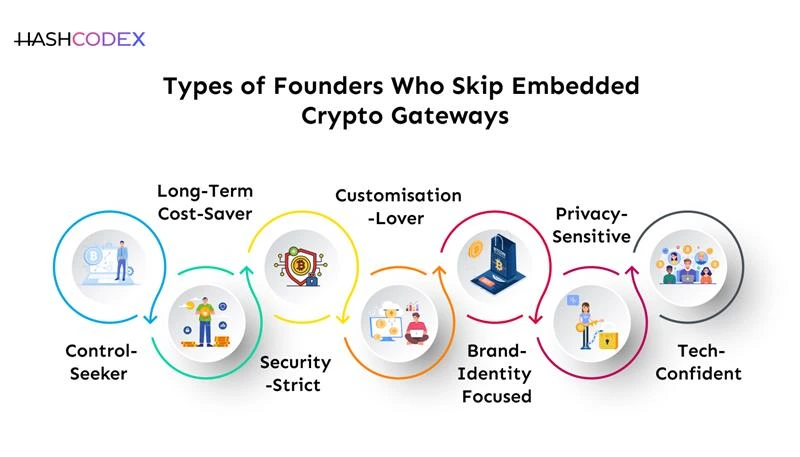
1. The Control-Seeker Founder (Wants Full Ownership)
This type of founder wants every part of the product to be in their hands. They don’t like depending on third partys.
They think like this:
- If the gateway goes down, my business goes down.
- If they change their pricing, my costs go up, and I have to raise my prices.
- If they stop supporting a feature, I get stuck.
For them, owning the full payment flow brings peace of mind.
2. The Long-Term Cost-Saver Founder
At first, embedded gateways look affordable.
But long-term?
Monthly charges, per-transaction fees, and extra costs slowly rise.
This founder does simple math.
Building from scratch = one-time investment
Embedded gateway = lifetime recurring bill
So they choose scratch.
3. The Security-Strict Founder (High Risk Awareness)
This founder is very serious about user funds. They don’t want to trust third-party systems.
They ask questions like:
- “Who controls private keys?”
- “Who handles the logs?”
- “Where is the data stored?”
If the answers aren’t crystal clear, they avoid embedded gateways.
4. The Customisation-Lover Founder (Wants Flexibility)
These founders want to make the gateway the way they like.
They want to add new chains, adjust the flow, change the UI, and fine‑tune every small thing.
👉With gateways, you get fixed features.
👉With scratch, you get freedom.
So customization pushes them toward building from zero.
5. The Brand-Identity Focused Founder
Some founders care a lot about brand experience. They want users to feel like everything is built by them.
Embedded gateways often break this flow.
- Logos change.
- UI looks different.
- Users feel the shift.
To protect brand trust, they choose scratch.
6. The Privacy-Sensitive Founder
This founder doesn’t want data passing through third-party systems.
They want:
- Local control
- Full audit access
- Zero data sharing
So, privacy concerns move them away from embedded gateways.
7. The Tech-Confident Founder
Some founders are fully confident about development. They trust their team’s skills, or they are comfortable giving the work to a crypto payment gateway development company.
For them, building from scratch feels normal and even exciting.
- They are not scared of technical work
- They think they can create a better gateway than any ready-made option
Because of this mindset, scratch development feels like the right path for them. They want full freedom to build the gateway exactly the way they imagine.
Bonus Point: Business Owners Worry About Integration Complexity
Adding crypto payments is not as simple as copy and paste.
A Deloitte survey found that 89% of merchants faced at least one challenge when integrating digital currency payments with their existing systems.
So, some founders think, if integration is already complex, why not build a payment gateway that fits our system from the start?
They prefer to design the gateway around their own tech stack instead of forcing their system to fit a third party tool.
Why Building From Scratch Makes More Sense for 2026 Startups?
Developing a crypto payment gateway from scratch gives many strong benefits. It gives more freedom, more control, and a better long‑term future for the product.
More control
Building your own system keeps everything inside your platform. If something breaks, your team can fix it immediately.
You do not have to wait for any support team. With third‑party services, you must wait for their reply, but in scratch development, you handle everything on your own.
Feel of a premium product
Users trust platforms that have their own payment system. It looks more professional and gives a strong first impression.
It also builds more trust because the product feels complete and well-made, not a mix of different tools.
Investor pressure
Investors prefer companies that build their main systems internally. It shows that the team is serious and has long‑term plans.
Many VCs even tell founders to own their core systems because it proves technical strength and stability.
Better scalability
When your user base grows, a scratch system can handle the growth better. You can add new chains anytime and expand features whenever you want.
Embedded gateways limit your growth because you must wait for their updates and use whatever features they provide.
What Founders Get Wrong About Embedded Gateways?
Founders often believe small myths. Let’s clear them up.
They believe it is quick, but hidden steps take time
Yes, integration is fast.
But verification, documentation, feature testing, and API approvals slow it down.
Scratch development can sometimes be equal in time when your team knows the work.
They believe it reduces the burden, but support is slow
If any issues come up, you rely on support. Response times might be slow during busy hours.
If you have a team, you can fix issues faster when you choose scratch.
They think it is cheap, but monthly fees add up
You pay every month, and the fees grow as your user base grows.
From Scratch is a one‑time investment that saves money over the years.
They think it is stable, but updates create sudden issues
When the gateway updates its APIs, your system can break without warning. You end up fixing things again and again.
Scratch development gives more predictable stability.
Common Situations Where Founders Avoid Gateways Without Any Real Reason
Sometimes, founders skip gateways not with logic, but with fear.
Let’s see the common cases.
Small teams
They feel gateways are dangerous because they lack control.
But sometimes the simple reason is trust issues.
Early-stage products
Some founders want to “look bigger” by building their own gateway.
So they skip embedded ones.
No compliance knowledge
They fear making a mistake. So they avoid everything that looks complicated.
There are many more reasons, too. In the beginning, everything may feel risky, but with proper guidance and a clear plan, everything will turn out right.
Comparison Table – Build From Scratch vs Embedded Gateway
|
Factor |
Embedded |
Scratch |
|
Time |
Quick setup |
Longer setup |
|
Cost |
Cheap at start |
Saves more later |
|
Maintenance |
Vendor controlled |
Fully controlled |
|
Compliance |
Limited |
Full |
|
Branding |
Restricted |
Custom |
|
Conversion |
Average |
Higher |
The Smart Founder’s Path in 2026
If you choose scratch development, here’s a simple roadmap.
Start planning your architecture
Decide how the whole flow will work. Plan wallet system, settlement, logs, and chains.
Build core payment logic
Create the base engine. Focus on sending, receiving, and verifying transactions.
Add KYC, AML, fraud checks
This makes your system safe. It also builds trust with users and investors.
Integrate multiple chains
Support more networks. It gives users more choice and increases trust.
Add your own branding
Set the UI and UX in your own style. Give users a natural and comfortable experience.
Scale as your users grow
Add more features as demand rises. Scratch systems grow easily with user load.
Final Takeaway
Embedded gateways are fine for very small ideas. But if you want to build a serious business in 2026, scratch development is better. It gives you:
- Control
- Security
- Branding
- Long-term stability
Most founders skip embedded gateways because they want freedom and a system that lasts long. Scratch development gives you exactly that. When you decide between a third-party gateway or scratch development, always choose a well-known provider.
At Hashcodex, we are trusted for crypto payment gateway development solutions. We build solutions that work just the way you expect.
We are just one click away. Connect with us and let’s grow your business.








 NDA on Request
 Free Consultation – Let’s discuss your ideas