Tell me one thing…
If I say even a giant like Amazon started with a small MVP, will you believe it?
We only notice a product after it becomes successful in the market. But we don’t usually see the first step that made it possible.
Now listen…
Every product you see today began as one small thought. But most ideas fail. Why?
Because people try to build everything at once. They spend money, time, and energy without checking if anyone even wants it.
So what’s the smarter way? 👉 Start small. Start smart. Start with an MVP.
And why should you care?
Because it saves you from big mistakes. It gives you real feedback. It helps you build something people will actually use.
Wait for it… In this guide, you’ll learn:
- What exactly an MVP is
- How to build it step by step
- Why it matters for your success
- And how great companies use it to grow
Stay with me till the end. You’ll see MVPs in a completely new way.
TL;DR
- An MVP is the smallest version of your product that lets real users try the real thing. It helps you learn fast, before you waste months building the wrong idea.
- An MVP is not a rough prototype or a cheap version of your product. It's the first loop in an ongoing cycle of build, measure, and learn.
- You build one by picking your riskiest assumption, defining a real customer, setting a budget, and testing with real users. Not friends who are just being nice.
- Once your MVP proves the idea works, you move into MLP and MMP. Most founders never plan for these next two stages.
What Is a Minimum Viable Product and Why Do We Need It in 2026?
MVP means a small version of your actual product. It has only the main features that are needed for real users to try it out.
The idea is simple: let people use it, give feedback, and then you can see if your product idea is really useful.
Think of it like cooking.
Before serving a full meal to guests, you first give them a small taste. If they like it, you continue with the recipe. If they don’t, you change it. MVP works exactly like that.
Why do we need it?
Because creating a full product from day one is risky. It is like cooking a big meal without knowing what people prefer to eat. With an MVP, you show a small sample first. If users like it, you go ahead. If they do not, you change your plan early.
Another reason is that in tech, nothing stays constant for too long.
- User behaviour changes quickly.
- Trends come and go.
- Competitors may launch something before you if you take too long.
If you spend one year building a big product, you may miss the chance.
MVP is like your safety shield. It saves money, reduces stress, and protects you from building something nobody wants.
The Skateboard Analogy (This Will Change How You Think About MVPs)
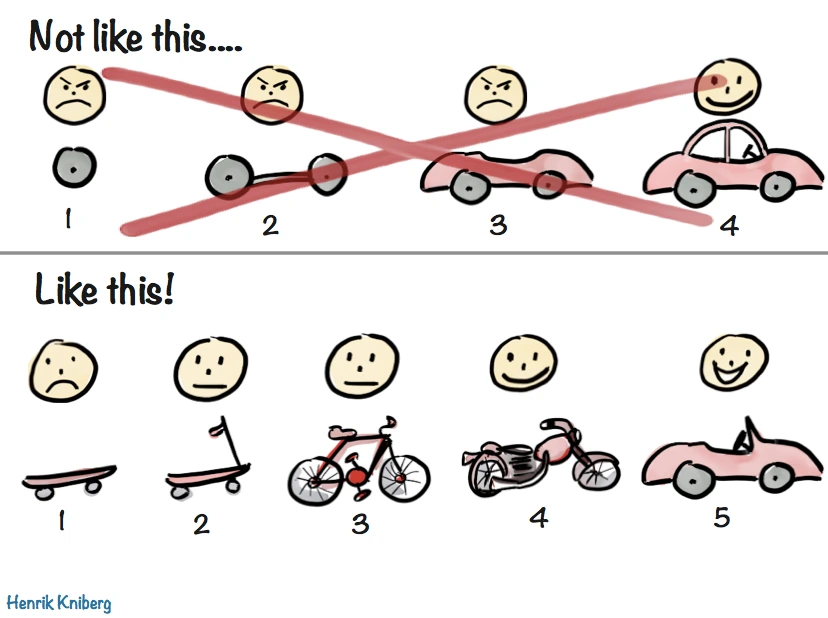
There's a famous image in product circles. Once you see it, you can't unsee it.
Picture this. Someone asks you to build a car.
The wrong way is to hand them one wheel first. Then a chassis. Then an engine. Then finally a full car at the end.
None of those middle steps help anyone. A chassis with no wheels goes nowhere.
The right way is to start with a skateboard. It's small and rough. But it gets someone from point A to point B today.
Then you upgrade it to a scooter. Then a bike. Then a motorcycle. Then finally the car.
At every stage, the user has something that actually works. It's nowhere near the final vision, but it still delivers value.
That's what a real MVP looks like. Not a broken piece of the final thing. A small, complete thing that works on its own.
Image Credit: Henrik Kniberg
Who First Introduced the MVP Concept?
The idea of MVP (Minimum Viable Product) was first introduced by Frank Robinson in 2001. His idea was simple. Instead of spending a lot of time and money building a full product, startups should first launch a simple version with only the important features.
Later, Eric Ries made the MVP concept very popular through his book The Lean Startup. He explained how startups can test their ideas quickly, get feedback from real users, and improve the product step by step.
The MVP concept was also influenced by Steve Blank and his customer development method. He believed startups should first understand what customers actually need before building a complete product.
The main idea was simple:
Don’t build everything at the beginning. Start small, test the idea, learn from users, and improve the product slowly.
Who Needs an MVP?
MVPs are useful for:
- Startups
- Entrepreneurs
- Software companies
- Mobile app developers
- SaaS businesses
- E-commerce platforms
- Internal business tool teams
- New product teams in large organizations
What Types of MVPs Do We Use in Software Development?
This is the part where many beginners get confused. Most people think MVP is only one fixed method. But that is not true.
There are different ways to create an MVP, and each one is useful for a different situation. Here are the types of MVPs in the current market.
- Landing Page MVP
- Wizard of Oz MVP
- Single Feature MVP
- Concierge MVP
- Prototype MVP
1. Landing Page MVP
This is the easiest one.
You create a simple landing page that explains your idea. Then you check how many people show interest by clicking or signing up.
- If many people sign up, it means the idea has demand.
- If very few sign up, you know something needs to change.
You do not write any code in this stage. It is only to test if people like your concept.
2. Prototype MVP
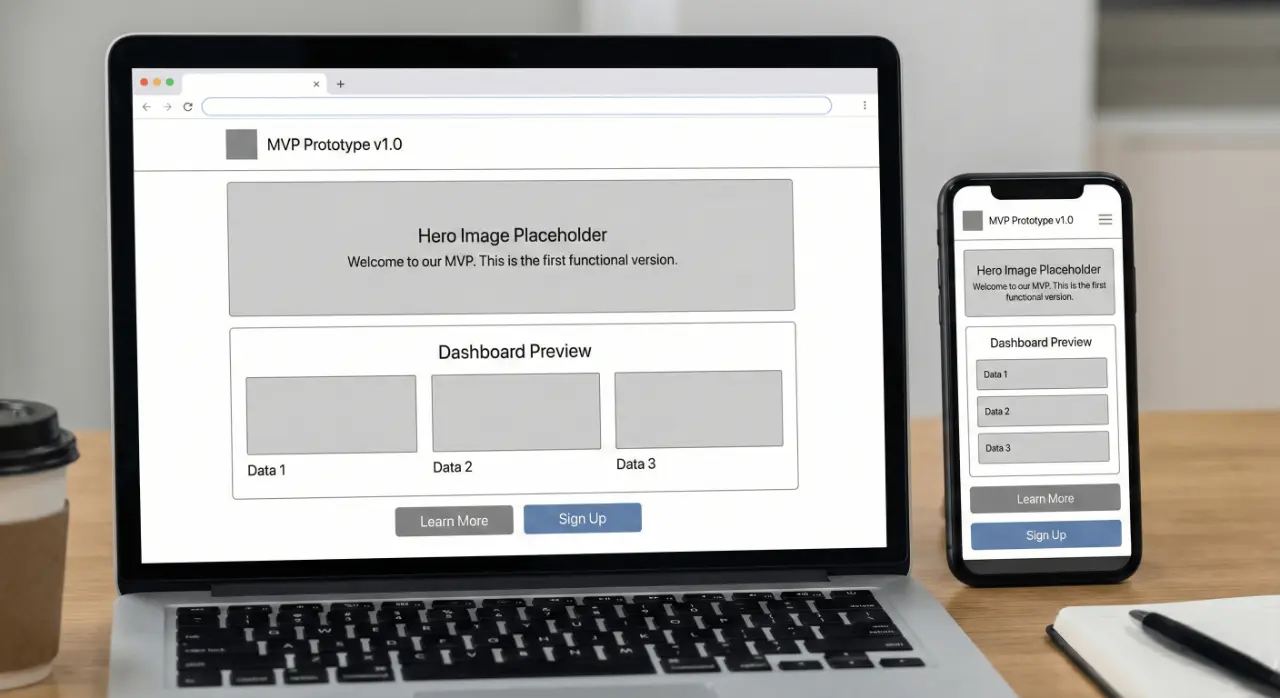
A prototype is a visual model of your app. It shows how your app looks, what screens it has and how users will move inside the app.
Remember, a prototype does not work like a real app. It only feels like one.
This is very useful for collecting early feedback from users, founders or investors before spending money on development.
3. Concierge MVP
In this method, you give the service manually instead of building the full technology.
For example, let us say you want to build an AI chatbot.
But instead of coding the whole thing, you reply manually to users like a human.
They still get the experience, and you learn what they actually want.
This method is helpful when you want to test the idea without spending on development.
4. Wizard of Oz MVP
This is similar to the Concierge MVP, but with one difference.
In the Concierge method, users know you are doing things manually.
In the Wizard of Oz method, users think everything is automatic.
For example, imagine an e-commerce website where the user thinks the system checks stock and ships the product.
But behind the scenes, a person is doing all the tasks manually.
Amazon used this idea in the beginning when they started with books.
So remember:
Concierge MVP = manual service openly.
Wizard of Oz MVP = manual service secretly.
5. Single Feature MVP
Here, you choose only one strong feature of your product and release that first.
Think about a social media app.
It has many features like posting, reels, messaging, profile, comments and more.
But in a single-feature MVP, you launch only one main feature to test user interest.
Example:
If your most important feature is “upload and share photos,” then only that feature will work in the MVP.
This helps you understand whether users really want your idea without building the entire product.
What Are the Best Real-World Examples of MVPs?
When we talk about MVPs, the best way to understand them is through real stories. These examples show how simple ideas, tested in small ways, grew into global companies.
Airbnb
The founders, Joe Gebbia and Brian Chesky, were living in San Francisco.
At one point, they could not afford to pay their rent. So they got a simple idea. Why not rent out a part of their home to people visiting the city?
They put three airbeds in their living room and called it Airbed and Breakfast.
There was no big website, no fancy features. Just a simple idea tested with real guests.
People liked the experience.
Slowly, the idea grew.
Today, we know it as Airbnb, one of the biggest travel companies in the world.
This is a perfect example of how a small MVP can change everything.
Uber
Uber also started very small.
It was first launched in San Francisco as a basic app that simply connected riders with nearby black car drivers.
- No map tracking.
- No multiple payment options.
- No big features like we see today.
It was just a simple concept tested with a few users. People loved the convenience, and the idea took off.
That early MVP became the foundation for the global ride-sharing company we know today.
Amazon
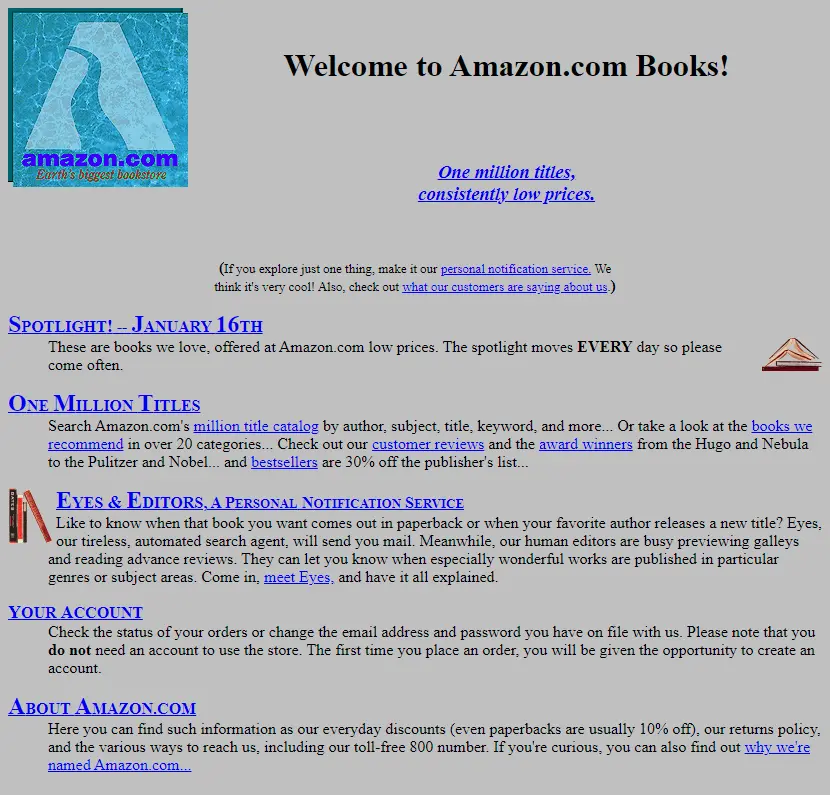
Amazon is one of the strongest examples of an MVP mindset.
When Jeff Bezos started Amazon in the 1990s, it was only an online bookstore.
He did not have the money to buy all the books in advance.
So what did he do?
He listed the books online.
Whenever customers placed an order, Jeff would go to the supplier, buy the book and pack it himself. He even shipped many orders manually in the early days.
This simple, low-cost way of testing demand helped him understand what users really wanted.
Today, Amazon is worth more than 2 trillion dollars, but it all started with a humble MVP.
Here are a few other companies
Dropbox
Before writing complex file-sync code, the founder made a simple explainer video showing how the product would work.
That video alone took their beta waitlist from around 5,000 signups to 75,000 overnight. No working product. Just a video proving people wanted the idea.
Spotify
At the beginning, the team built a very simple music player with only a few fixed songs. They tested it with their friends and family.
The goal wasn't features. It was proving that instant, gapless music streaming was even technically possible before they built the business around it.
Zappos
The founder had zero inventory. He walked into local shoe stores, took photos of shoes, and listed them online.
What Do These Examples Teach Us?
All these stories tell the same lesson. You do not need a perfect product to start. You need the right idea tested in the simplest and smartest way.
- MVP saves time.
- MVP saves money.
- Most importantly, MVP gives real clarity about whether your idea can survive in the market.
When you start small and test properly, you build something strong for the future. That is why MVP is the safest path for any new business.
What an MVP Is NOT?
Let's clear up some confusion before we go further. A lot of founders get this part wrong.
An MVP is not a low-quality version of your product. It's not "the full app, but buggy." It's a small piece that actually works well.
An MVP is not a prototype. A prototype is used to test if an idea looks and feels right. It is usually shown to your own team, not real customers. An MVP is different. Real users use it to do a real task. A prototype asks, "Does this idea make sense?" An MVP asks, "Will people actually use it?"
An MVP is not a proof of concept. A proof of concept just shows that something can be built. An MVP shows that something is worth building. Those are two very different questions.
An MVP is not a one-time launch. You don't build it once and walk away. It's the first step in a loop. You build something small, watch how people use it, learn from that, then build the next small thing.
An MVP is not "as small as possible."It should be small, but it must still be useful on its own. That is the key difference. The next section will explain this with a simple example.
Before You Build Anything: Find Your Riskiest Assumption
Here is a step that many people miss, but it is one of the most important.
Every startup idea is based on a few guesses. Before you build anything, ask yourself: "What is the one guess that, if it is wrong, could make the whole idea fail?"
Maybe it is "Will people pay for this?" Maybe it is "Will businesses trust us with their data?" Or "Will people change their habits to use this?"
Find that biggest risk and make your MVP test only that. Do not try to build every feature. Extra features will only waste your time and money.
How to Actually Build Your MVP: A Step-by-Step Process
Now, let us talk about the practical part. If you want to create an MVP that actually works, follow these clear steps.
Step 1: Understand the Problem Clearly
Before building anything, make sure the problem is real. Talk to users. Ask questions. Observe their behaviour.
Step 2: Find Your Core Feature
What is the one feature that solves the main problem? Focus only on that. Do not try to add everything in the first version.
Step 3: Create Simple User Flows
Sketch how users will move inside your product. Keep the journey clean and easy.
Step 4: Build Only the Needed Features
Select the must have features. Remove nice to have features. Less is better for an MVP.
Step 5: Design With Clarity
Use a simple UI. Keep things clean. Make sure even a first-time user can understand it without help.
Step 6: Develop the MVP
Write clean, basic, and functional code. Do not chase perfection. Chase learning.
Step 7: Test With Real Users
Let users try your MVP. Watch how they use it. Listen to their feedback carefully.
Step 9: Decide: Improve, Build, or Stop
After getting feedback, choose what to do next: improve the idea if it needs changes, build more if it works, or stop if the main assumption is wrong because the MVP helped you find out early.
This step-by-step plan makes your MVP strong and helps you move in the right direction.
What Mistakes Should You Avoid While Building an MVP?
Many first-time founders make common mistakes. If you avoid these, your MVP will perform much better.
Mistake 1: Adding Too Many Features
The purpose of MVP is to stay small. If you overload the product, you lose the whole meaning.
Mistake 2: Ignoring User Research
Building without understanding users is like walking blindfolded. Always research first.
Mistake 3: Delaying the Launch
Do not wait for perfection. MVP is meant for early launch.
Mistake 4: Taking Feedback Lightly
Users tell you what works and what does not. Listen carefully and improve.
Mistake 5: Not Tracking Data
If you do not measure results, you cannot grow. Always use proper analytics.
Mistake 6: Assuming Your Idea Is Perfect
Even the best ideas need testing. MVP helps you validate, not assume.
How Do Startups Use MVP to Raise Funding?
Many startups use an MVP to show investors that their idea can really work. Instead of only talking about the idea, they show a simple working product with real users.
An MVP helps startups show:
- People are interested in the product
- Users are using the platform
- The idea solves a real problem
- The business has future growth
Investors usually trust startups more when they see real user feedback and product activity.
Even a simple MVP can help founders:
- Get early users
- Test the market
- Improve the product
- Build investor trust
This is why many startups build an MVP first before spending too much money on full product development.
The Biggest Benefits of Starting With an MVP
- You test your idea first. Before you spend a lot of time and money, you find out if people even want it.
- You save money. You only spend on what you need to test. Not on a full product.
- You get real feedback fast. You don't have to guess. You watch what real people actually do.
- You find product-market fit sooner. You learn what works, what doesn't, and what to build next. All from real use, not guessing.
- You build trust with investors. Real users and real numbers convince investors more than a pitch deck.
- You lower your risk. If the idea doesn't work, you find out early. Before your money runs out.
- You launch faster. You can go live in weeks. You don't have to wait months for a "perfect" product.
- You keep your team focused. With one clear goal, it's easy to skip extra features you don't need yet.
- You get a strong starting point. Every version after your MVP is built on real learning, not guesswork.
Pivot, Continue, or Stop: A Decision Every Founder Must Make
This is a common idea in the Lean Startup method. Every founder will face this decision after testing an MVP.
Persevere means your idea is working. The data shows that people want your product, so you should keep improving it and grow it further.
Pivot means your original idea was not completely right, but you learned something that can lead to a better idea. For example, users may not like your main feature, but they may love another feature. You change your direction based on what you learned.
Kill means your main idea did not work, and there is no better direction to follow. It can be difficult, but finding out early saves you from wasting more time and money.
Conclusion: What Should You Do Next?
Now you already know what MVPs are, why they are important in 2026, the different types, and how to set one up properly.
The next step is very clear. If you have an idea, don’t wait. Start building your MVP today. The more you delay, the more your success gets pushed away.
If you need help in planning, designing, or developing your MVP, you can connect with Hashcodex. We are one of the leading fintech software development companies.
We build strong MVPs for fintech businesses. With the right approach and the right support, your idea can easily grow into a real business.
And yes, we are always ready to give you that support.
Frequently Asked Questions
What is an MVP in a startup?
It's the smallest working version of a product that lets real users try the core idea, so founders can learn whether the idea actually works before investing in a full build.
What's the difference between an MVP and a prototype?
A prototype tests how something looks and feels, usually reviewed by a small internal team. An MVP tests real behavior with real users doing the actual task, which is a much stronger signal.
How much does it cost to build an MVP?
The cost depends on what type of MVP you build. A simple landing page MVP may cost almost nothing except your time. A working software MVP may cost a few thousand dollars or even more than $30,000. The cost depends on how complex it is and whether you build it yourself or hire a team.
Who invented the MVP concept?
Frank Robinson coined the term in 2001. Eric Ries popularized it through The Lean Startup, and Steve Blank contributed the "get out of the building" philosophy behind it.
What comes after an MVP?
Most founders next build an MLP (Minimum Lovable Product). This version focuses on making the product enjoyable for users. After that, they build an MMP (Minimum Marketable Product), which is the version ready to launch in the market.
What does it mean to pivot after an MVP?
Pivoting means your first idea did not work exactly as planned, but you learned something that showed you a better idea to try. It means changing direction based on what you discovered.









 NDA on Request
 Free Consultation – Let’s discuss your ideas