If we want to launch a crypto exchange, what do we need?
You may say technology and liquidity. Yes, both are very important.
But one decision quietly decides how much profit your crypto exchange makes every year.
That decision is where you register your exchange.
Many entrepreneurs understand this very late. They build a good platform, bring users, and start earning revenue.
Then taxes start eating their profit.
This becomes very painful for anyone running the business.
That is why smart founders now think differently.
They plan the jurisdiction before launch. Not to break rules, but to run a clean and profitable crypto exchange business.
In this blog, we will talk only about that.
Which countries offer tax-free crypto environments in 2026, and how entrepreneurs should think before choosing one?
Tax Free Countries to Start a Crypto Exchange Business in 2026
Now, let us get into the main part.
But wait.
Before listing countries, we need to understand one thing clearly. Tax-free does not mean rule-free.
These countries still expect proper compliance.
The difference is, they do not drain your profits with heavy taxes.
Let us look at the top choices entrepreneurs are considering in 2026.
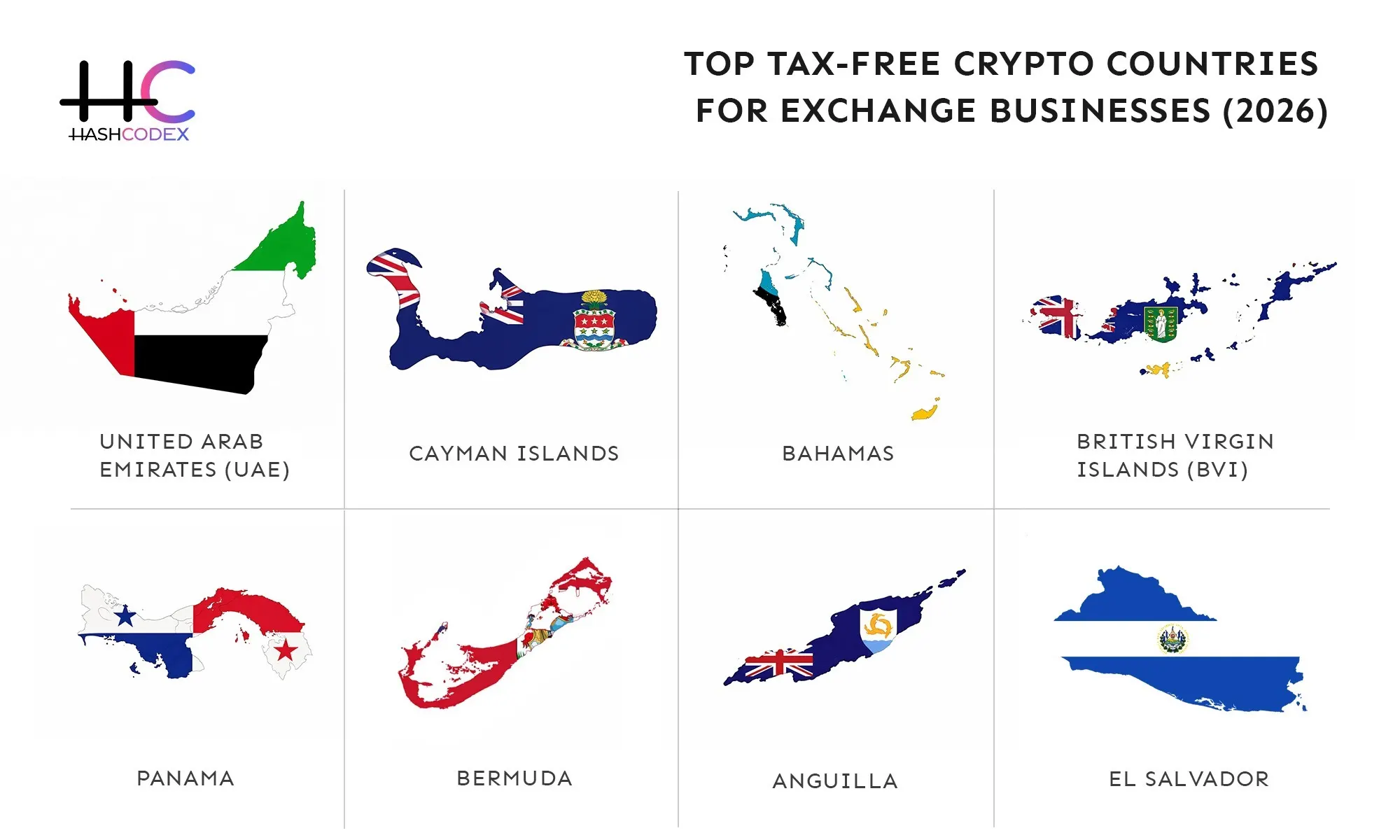
Quick Comparison of Tax-Free Crypto Countries (2026)
| Country | Tax Rate | Licensing Authority | Banking Access | Best For |
| UAE | Low / 0% in free zones | VARA / ADGM | Strong | Global exchanges |
| Cayman Islands | 0% |
CIMA |
Moderate |
Offshore exchanges |
| Bahamas | 0% | DARE framework | Moderate | Regulated startups |
| BVI | 0% | FSC | Moderate | Holding structures |
| Panama | Territorial tax | Local authority | Moderate | International trading |
| Bermuda | 0% | BMA | Strong | Institutional exchanges |
| Anguilla | 0% | Limited framework | Basic |
Early stage startups |
| El Salvador | Tax benefits for certain Bitcoin related activities | CNAD | Moderate | Bitcoin focused businesses |
1. United Arab Emirates (UAE)
The UAE is one of the most preferred countries for starting a crypto exchange business. Many founders choose the UAE because of its favorable tax policies, strong financial sector, and growing support for digital asset companies. The country has also introduced crypto regulations that provide a clear framework for businesses looking to register and operate legally.
Key Highlights
- No personal income tax.
- Businesses in eligible free zones can receive tax benefits based on applicable rules.
- Crypto companies can register in locations such as DMCC, ADGM, and DIFC.
- VARA and ADGM provide licensing frameworks for virtual asset businesses.
- Many free zones support 100% foreign ownership.
- Strong banking and financial infrastructure.
The UAE suits founders who want tax benefits, strong business support, and a recognized location for building a crypto exchange.
2. Cayman Islands
The Cayman Islands is a popular jurisdiction for international crypto businesses because of its favorable tax structure. The country does not charge corporate income tax, capital gains tax, or withholding tax, making it attractive for companies operating across global markets.
Key Highlights
- No corporate income tax.
- No capital gains tax.
- No withholding tax.
- Crypto businesses are regulated under the Virtual Asset Service Providers Act.
- Popular location for international blockchain companies.
- Established financial services sector.
The Cayman Islands suits founders planning global crypto exchanges with a tax friendly structure and international business operations.
3. British Virgin Islands (BVI)
The British Virgin Islands has been a well known destination for international businesses for many years. Its tax friendly structure and flexible company setup process have also made it an option for blockchain and crypto related businesses.
Key Highlights
- No corporate income tax.
- No capital gains tax.
- No inheritance tax.
- Simple company registration process.
- Regulated by the Financial Services Commission.
- Common choice for international business structures.
BVI works well for founders looking for flexible company structures and tax advantages for international crypto businesses.
4. Bermuda
Bermuda is another attractive destination for digital asset businesses because of its favorable tax policies and crypto focused regulations. The country has built a framework that supports companies operating in the blockchain and digital asset sector.
Key Highlights
- No corporate income tax.
- No capital gains tax.
- No withholding tax.
- Digital asset businesses are regulated under the Digital Asset Business Act.
- Supervised by the Bermuda Monetary Authority.
- Strong reputation in financial services.
Bermuda is suitable for founders who want tax benefits with a regulated environment for digital asset businesses.
5. Bahamas
The Bahamas has gained attention among crypto businesses because it combines tax benefits with dedicated digital asset regulations. The country introduced the DARE Act to provide rules for companies involved in digital asset activities.
Key Highlights
- No corporate income tax.
- No personal income tax.
- No capital gains tax.
- Digital asset businesses are regulated under the DARE Act.
- Growing support for blockchain innovation.
- Business friendly company registration process.
The Bahamas fits founders looking for tax advantages and clear digital asset rules when setting up a crypto exchange.
6. Panama
Panama follows a territorial tax system, which makes it different from many other jurisdictions. Income earned outside Panama is generally not taxed locally, making it an attractive option for businesses serving international customers.
Key Highlights
- Foreign sourced income is generally not taxed locally.
- Business friendly company registration.
- Suitable for international business models.
- Growing interest in blockchain and cryptocurrency.
- Strategic location for global companies.
Panama can suit founders building international crypto exchanges where foreign market operations are part of the business model.
7. Anguilla
Anguilla is a Caribbean jurisdiction known for its tax friendly business structure. Many international companies consider Anguilla because it does not charge corporate income tax, capital gains tax, or personal income tax. This makes it an attractive option for businesses looking for favorable tax policies.
Key Highlights
- No corporate income tax.
- No capital gains tax.
- No personal income tax.
- No inheritance tax.
- Simple company registration process.
- Suitable for international businesses.
- Growing interest from blockchain companies.
Anguilla is suitable for founders seeking a simple tax friendly jurisdiction for international crypto business structures.
8. El Salvador
El Salvador became globally recognized after adopting Bitcoin as legal tender, bringing attention from cryptocurrency businesses worldwide. The country has introduced policies that support Bitcoin and digital asset related activities.
Key Highlights
- Tax incentives for certain Bitcoin related activities.
- Bitcoin recognized as legal tender.
- Supportive approach toward blockchain businesses.
- Digital asset regulations continue to develop.
- Growing interest from international crypto companies.
El Salvador suits founders building Bitcoin focused businesses and exploring opportunities in the digital asset sector.
If you want to know more about crypto-friendly countries in 2026, click the link to see the details.
Why These Fully Tax-Free Countries Matter for Exchange Founders?
Now here is the key takeaway.
Tax-free countries help you:
- Retain more profit
- Reinvest into marketing and liquidity
- Scale faster without tax pressure
- Attract investors and partners
But remember one thing.
Tax advantage works only when licensing and compliance are handled properly. Otherwise, it becomes a risk instead of a benefit.
That is why serious founders always plan jurisdiction, licensing, and technology together.
How Licensing Rules Change Your Tax Advantage?
Now pause for a second.
Here is where many founders get confused.
They think choosing a tax-free country is enough. It is not.
Licensing plays a huge role in whether your tax advantage actually works.
Let me explain simply.
Some countries are tax-free but demand strict licensing. Others are flexible but need careful structuring.
If licensing is ignored, you may face penalties, blocked banking, or forced shutdowns.
And here is the truth.
A tax-free country without proper licensing can become a liability.
For example, if your exchange processes user funds, offers spot trading, or provides custodial wallets, regulators will expect licensing. Even in tax-free regions.
Licensing impacts:
- Banking approvals
- Payment gateway access
- Investor trust
- Platform credibility
In 2026, regulators are smarter. Banks are stricter. Payment partners ask tough questions. So what should you do?
Before choosing a jurisdiction, founders should understand the complete process of launching an exchange. Read our guide on How to Start a Crypto Exchange.
Align your licensing strategy with your tax plan.
When licensing is handled properly, your tax advantage becomes stable and long-term.
Otherwise, tax savings today can turn into business trouble tomorrow.
Final Thoughts
Let us be honest.
There is no single best country for every crypto exchange.
The right country depends on your vision, budget, target market, and long-term plan.
Tax-free countries give you an advantage. But only when combined with proper licensing, strong compliance, and the right technology.
As an entrepreneur, your goal should not be just to save tax. Your goal should be building a trusted, scalable exchange that survives regulation changes and market cycles.
So take your time.
Understand your business model. Compare jurisdictions carefully. Plan licensing and tax together.
Because in 2026, smart founders will not ask, Where is tax zero?
They will ask, Where can my crypto exchange grow safely and profitably?
Frequently asked questions
Which tax-free country is best to start a crypto exchange business?
The UAE is one of the most preferred tax-friendly countries for starting a crypto exchange business. It offers attractive tax benefits, crypto licensing options, and a growing digital asset industry. Other popular choices include the Cayman Islands, Bahamas, Bermuda, British Virgin Islands, and Anguilla.
Which countries offer tax benefits for crypto exchange businesses?
Countries such as the UAE, Cayman Islands, Bermuda, British Virgin Islands, Bahamas, and Anguilla offer tax advantages for crypto businesses. Some provide zero corporate tax, while others offer favorable tax structures based on business activities and location.
Is the UAE a good choice for a crypto exchange business?
Yes, the UAE is a popular choice for crypto exchange founders because it offers tax benefits, virtual asset licensing options, strong financial infrastructure, and support for international businesses.
Do tax-free countries require a crypto exchange license?
Yes, most tax-friendly countries still require crypto exchanges to complete registration or obtain licenses before offering services. The requirements depend on the country and the type of crypto activities provided.
What should founders consider before choosing a tax free country for a crypto exchange?
Founders should consider tax policies, crypto regulations, licensing requirements, company registration, banking options, and their target market before selecting a country for their crypto exchange business.
Can foreigners start a crypto exchange in tax-free countries?
Yes, many tax-friendly countries allow foreign founders to register crypto businesses. However, ownership rules, licensing processes, and regulatory requirements may differ depending on the selected jurisdiction.











 NDA on Request
 Free Consultation – Let’s discuss your ideas