
Starting a futures prop firm may look simple from the outside, especially if you are new to this industry.
You might think, “What do we need to do?
Build a website, add a few trading challenges, connect a trading platform, and start bringing in traders
Is that all? Not really
Once you start planning the business, you’ll quickly realise there’s a lot more to think about.
You need to decide:
- What type of futures prop firm do you want to build?
- Who do you want to serve?
- How will your evaluation model work?
- Which futures markets will you offer?
- How will traders trade?
- How will you manage risk?
And that's only half of it.
You also need to think about your trading platform, market data, execution system, trader management, payments, and back office.
Is that everything? Not yet.
You also need to understand your legal and regulatory setup, including the CFTC, NFA, and FCM, depending on your business structure.
So, if you’re thinking about starting a futures prop firm, read this blog till the end. We’ll cover the main things you need to know before you start.
Key Takeaways
- Choose the right model and legal structure: Start by choosing your futures prop firm model and understanding requirements from authorities like the CFTC and NFA before entering the futures market.
- Pick futures-focused trading platforms: Choose infrastructure that supports futures trading, such as Tradovate or NinjaTrader, and connect with markets like CME Group, CBOT, NYMEX, and COMEX.
- Plan your budget carefully: Building a futures prop firm can cost around $20,000 to $80,000+, depending on features. You’ll also need to budget for licensing, compliance, technology, market data, and marketing.
What Is a Futures Prop Firm?
A futures prop firm is a company that gives traders access to trade futures contracts under a specific set of rules. Depending on the firm's business model, traders may trade contracts such as E-mini S&P 500, crude oil, gold, or other futures products.
In a common prop firm model, traders pay a fee to take an evaluation or challenge. They then need to trade while following rules such as a profit target, maximum drawdown, and daily loss limit.
But there is a small difference with a futures prop firm.
Here, traders are specifically trading futures contracts. The firm sets the trading rules, account size, targets, and time period for the evaluation.
During that period, traders need to manage their trades and stay within the firm's rules. Based on their performance, they may pass the evaluation and move to the next stage.
So, the basic idea is simple: the trader proves their trading skills by trading futures while staying within the firm's rules.
How to Build a Futures Prop Firm: A Guide for Aspiring Prop Firm Founders
Here are 11 important step-by-step processes for building a futures prop firm:
1. First Decide What Kind of Futures Prop Firm You Want to Build
Before you speak to a prop firm software provider, you need to decide what your business model will look like.
Evaluation-Based Futures Prop Firm
This is the model most people already know.
The trader chooses an evaluation, pays a fee, and trades under specific requirements.
The rules may differ based on the evaluation they choose. These can include a profit target, maximum drawdown, daily loss limit, minimum trading days, and other conditions.
At the end, the system checks the trader's activity and determines whether they have passed or failed.
Instant Funding Futures Prop Firm
In this model, the trader gets an instant-funded trading account without following the traditional evaluation path.
But here, you need to make your decisions more carefully.
How much trading access will you provide?
What limits will you set?
How will you manage payouts?
These decisions can directly affect your business and risk.
Hybrid Futures Prop Firm
You can also provide a different experience by offering both models on the same platform.
For example, you could offer a normal evaluation while also providing another account option for traders who want a different path.
But don't choose a model just because it is trending or popular with another prop firm.
Choose a model that makes sense for your target trader and your business.
2. Define Your Trader Before You Build Your Prop Firm
Who are you trying to attract?
Are they beginners? Or are they experienced traders who are already familiar with futures trading and understand concepts such as contracts, margin, and risk?
There is one more thing you need to focus on.
Which markets are you planning to offer?
- Will your traders focus on equity index futures?
- Energy?
- Metals?
- Currency futures?
- Micro futures?
This decision will affect your trading platform, market data, risk engine, and overall technology setup.
For example, CME Group offers products across equity indexes, energy, metals, interest rates, FX, agriculture, and micro futures. Its micro products include smaller-sized contracts across several asset classes.
So, don't start with technology.
Start with the trader.
Ask yourself:
What does this trader want to trade, and what would make them choose my firm?
3. Build the Economics Before You Build the Website
Most founders start by thinking about the logo, website, dashboard, and marketing.
But we need to start somewhere else.
You need to calculate your evaluation price, payment costs, technology costs, data costs, support costs, payout costs, and other expenses too.
Then, you need to think about the risk.
- What if more traders pass than you expected?
- What if payment providers increase their charges?
- What if payouts suddenly increase?
You need to ask these questions before you launch.
By thinking about these things early, you can avoid many problems that other businesses face later.
Because a good-looking website cannot fix weak business economics.
4. Choose Your Legal and Regulatory Architecture
Think about this first.
Are you planning to build your futures prop firm in a particular country such as the US, UAE, Nigeria, India, or are you planning to operate worldwide?
Based on where you operate and what your business actually does, different legal and regulatory requirements may apply.
The Commodity Futures Trading Commission (CFTC) and National Futures Association (NFA) are key entities in the US futures regulatory system.
The NFA explains that businesses operating in the derivatives industry may need to register with the CFTC, depending on their activities and whether an exemption applies.
You may come across several important terms during your planning.
FCM: A Futures Commission Merchant handles certain customer futures orders and customer funds. Registration is generally required unless an exemption applies.
CTA: A Commodity Trading Advisor generally provides trading advice about futures and other related products for compensation.
CPO: A Commodity Pool Operator generally operates a commodity pool and raises funds for that pool.
The exact requirements depend on your business model and activities.
So, talk to a qualified futures lawyer or compliance professional before you launch. They can help you make sure your business structure follows the rules that apply to you.
5. Connect Your Prop Firm to the Futures Market
Now let's talk about the actual market.
Some of the major futures exchanges you will come across include:
- CME
- CBOT
- NYMEX
- COMEX
These exchanges cover different types of futures products, including equity index futures, energy futures, metals futures, currency futures, commodities, and micro futures.
Micro futures can be a useful option when you want to offer smaller contract sizes to traders.
But you don't need to offer everything from day one.
Start with the markets your target traders actually understand and want to trade.
6. Choose the Trading Infrastructure That Powers Your Futures Prop Firm
This is one of the most important technical parts of your business.
Trading Platforms
Your traders need a platform where they can view markets, place trades, check their positions, and manage their trading activity.
Depending on your budget and business requirements, you can consider futures-focused platforms and systems such as Tradovate, NinjaTrader, Rithmic, Quantower, ATAS, or other supported systems.
The right choice depends on your broker, data feed, execution model, trader needs, and technology partner.
Don't choose a platform only because it is popular.
Make sure it can support the way you want to run your futures prop firm.
7. Your Risk Engine Is the Heart of the Prop Firm
This is one part you need to take very seriously.
Your risk engine should understand and monitor your trading rules.
For example:
- Maximum drawdown
- Daily loss limits
- Profit targets
- Position limits
- Trading hours
- Contract limits
- Account rules
The risk management system should monitor trader activity and take action automatically based on your rules.
Why?
If you are handling more than 5,000 traders, you cannot expect your team to check everything manually.
That would consume a lot of time and manual effort.
A good risk management system can monitor accounts and apply your rules within seconds or minutes, depending on the setup.
8. Design the Trader Evaluation Program
The evaluation system is where you decide how traders can pass your challenges.
Are you going to use a one-step model, a two-step model, or a completely different approach?
- What profit target will you set?
- What drawdown rules will you have?
- How many trading days will you give traders?
These decisions will shape the entire trader experience.
So, keep your rules clear.
If traders need five pages just to understand your challenge, you may have made it too complicated.
9. Build the Trader Journey From Checkout to Payout
For one minute, think like a trader.
You find the website.
You choose an evaluation.
You make the payment.
You receive your account.
You start trading.
You check your progress.
You pass the challenge.
Then you request your payout.
There are many steps in this journey.
So, every step should feel connected.
Your CRM, trader dashboard, payment system, KYC process, trading platform, risk engine, and payout system should work together.
That is the real trader's journey.
And every broken step can create support problems.
10. Design Your Payout System Before Launch
Don't wait until you have your first successful trader to decide how payouts will work.
Decide your payout process before launch.
- How often are you going to release payouts to traders?
- What conditions do they need to meet?
- Which payment methods will you support?
- How will your team track the payout status?
Clear payout rules can make the trader experience much easier.
It also helps your operations team know exactly what needs to happen when a trader becomes eligible for a payout.
11. Turn Traders Into a Long-Term Community
Your job does not end when a trader passes.
You also need to think about how you can retain them and keep them connected with your brand.
- Can you provide useful education about the market?
- Can you create a trading community?
- Will you offer a leaderboard?
- Can traders receive important account notifications?
- Can your support team respond quickly?
You need to make sure these areas are handled properly.
Because when traders feel connected to your brand and receive good support, they are more likely to stay with your platform for longer.

The Complete Futures Prop Firm Architecture
A futures prop firm is not just one piece of software. It is a combination of multiple systems. Here is the visual architecture.
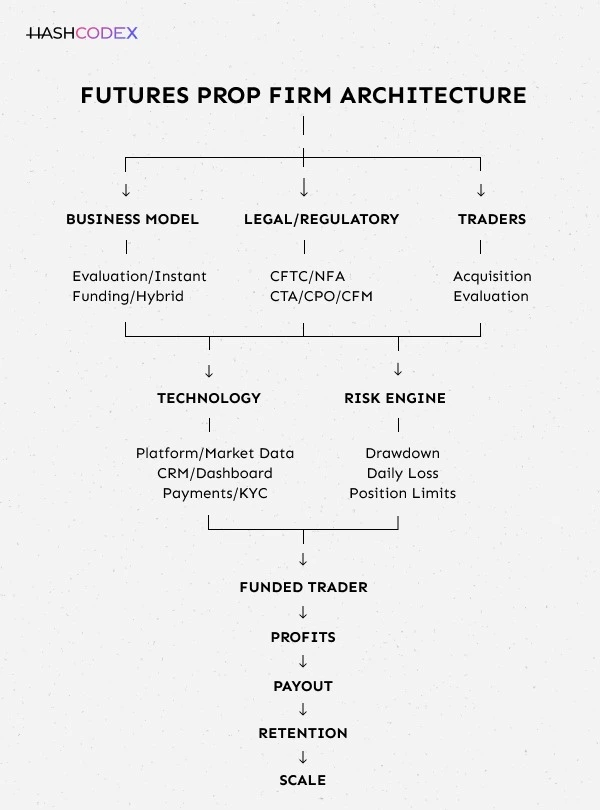
When these systems work together, your team has much better control.
How Does a Futures Prop Firm Differ From Other Prop Firm Models?
If you are planning to build a futures prop firm, you may wonder, “Can't I use the same setup for forex and crypto?”
Not really.
The main difference is what your traders are going to trade and what your business needs to support it.
A futures prop firm needs technology that can handle futures markets, market data, trading platforms, and trade execution.
A forex prop firm mainly deals with currency pairs, so its technology and liquidity setup are built around forex trading.
Then you have crypto prop firms, which focus on digital assets such as Bitcoin and Ethereum. Their technology needs to support crypto markets and crypto exchanges.
So, if you are building a futures prop firm, don't simply copy a forex or crypto setup.
Start with the market you want your traders to trade, then choose the technology around it.
What Can Go Wrong? 12 Expensive Future Prop Firm Mistakes
Before you launch, look for these problems:
- Choosing the wrong business model
- Not defining the target trader
- Setting weak risk rules
- Choosing the wrong trading platform
- Using poor market data
- Ignoring execution quality
- Building without proper testing
- Making payout rules unclear
- Depending too much on manual work
- Ignoring scalability
- Choosing technology based only on price
- Treating compliance as an afterthought
Fixing these issues before launch is usually easier than fixing them after thousands of traders join.
Where Does a Futures Prop Firm Make Money?
One common income source is evaluation fees, where traders pay to take your challenge. You may also earn a share of the profits from traders who get funded. Depending on your model, you may also generate revenue from resets, subscriptions, or other services.
But revenue is only one side. You also need to consider software, marketing, payment fees, support, and payouts. Your profit depends on what you earn after covering these costs.
Build From Scratch or Choose White Label Futures Prop Firm Software?
Still deciding?
Here is the simple way to look at it.
Build from scratch if you have a strong technical team, enough capital, enough time, and a clear reason to build your own infrastructure.
Choose white label if you want to enter the market faster and reduce the amount of technology you need to build yourself.
White label does not mean you should stop asking technical questions.
- Check the trading integrations.
- Check the risk engine.
- Check the CRM.
- Check payment support.
- Check scalability.
- Check security.
- Check support.
Most importantly, understand what you can customize.
Main Advantages of Building a Futures Prop Firm
If you are comparing a futures prop firm with other prop firm models, here are some practical benefits you may get
- Focus only on futures traders
- Build a brand around the growing futures market
- Offer popular contracts from major futures markets
- Provide micro contracts for traders with smaller account needs
- Create different evaluation plans for different trader types
- Start with a small number of markets and expand later
- Manage more traders through automated systems
- Create your own rules, pricing, and payout structure
- Build a dedicated futures trading community
- Expand your business into new futures products as demand grows
Why Are NFA Rules Important When Building a Futures Prop Firm in the USA?
If you are planning to start a futures prop firm in the USA, don't leave the legal side until the end. You need to understand which NFA rules may apply to your business before you start operating.
Why does this matter? Following the right rules can help you avoid legal problems, fines, and delays that could affect your business. The NFA explains that many futures professionals may need to register with the CFTC, while some registered firms may also need NFA membership.
The exact requirements depend on what your business does, and some exemptions may apply. So, before you launch, check your business model with a qualified legal or compliance professional and make sure you understand the rules that apply to you.
What Trading Platforms Do Futures Prop Firms Use?
There is no single platform that every futures prop firm must use.
The right choice depends on your business.
You may come across platforms and technology such as NinjaTrader, Tradovate, Rithmic, Quantower, ATAS, and other futures trading systems.
Your decision should be based on execution, market data, integrations, user experience, risk controls, and the ability to support your expected trader volume.
Ask one simple question before choosing:
Can this technology support the business I want to build, not just the business I have today?
Conclusion
Starting a futures prop firm is much bigger than creating a website and selling trading challenges.
Why?
Because you are building a complete trading business, and every part needs to work together.
As we discussed throughout this guide, you need a clear business model, the right target traders, sensible pricing, proper legal planning, reliable futures market access, trading infrastructure, risk controls, payments, payouts, and strong day-to-day operations.
Your Prop firm technology provider can make a big difference as your business grows. Choose a provider who understands your business and can support you when your requirements change. Hashcodex can help you build different prop firm models with the technology and support you need.
Now, bring everything together.
Build the business first. Then choose the technology that supports it.
When you know who you want to serve, what you want to offer, how you will manage risk, and where you want your business to go, choosing the right technology becomes much easier.
And remember, your first 100 traders may test your idea.
Your first 1,000 traders will test your systems.
So don't build only for today's requirements.
Build with the future of your futures prop firm in mind.
Frequently Asked Questions
Do futures prop firms need an FCM?
It depends on how your futures prop firm works and how you handle trader funds and orders. Check your business model with a legal or compliance expert before launch.
Which trading platforms can futures prop firms use?
You can use futures trading platforms such as Tradovate, NinjaTrader, Rithmic, Quantower, and ATAS. Your choice depends on your traders, broker, data, and business needs.
How do I acquire traders for a futures prop firm?
You can bring in traders through SEO, paid ads, social media, trading communities, referrals, and partnerships. First, understand where your target traders spend their time.
What is the difference between an FCM, CTA, and CPO?
An FCM handles certain futures orders and customer funds. A CTA usually gives trading advice for payment. A CPO usually manages a commodity pool and raises money for it.









 NDA on Request
 Free Consultation – Let’s discuss your ideas