
Decentralized prediction platforms are getting attention right now for good reasons.
They combine blockchain, shared insights, and real world data to help businesses build prediction systems.
Instead of relying on one central system, these platforms collect input from many users, keeping the process open and fair.
This helps create tools for forecasting, trend analysis, and decision making.
For startups and businesses, it also brings new ways to design platforms and earn revenue.
Some key advantages include:
• wider participation in predictions
• clear handling of outcomes
• flexible development options
In this guide, we will explain what a decentralized prediction platform is, how prediction marketplaces function, and which features really matter.
Understanding Decentralized Prediction Platform
A decentralized prediction platform is a system where users make predictions about future events and earn rewards if they are correct.
It runs on blockchain, so every prediction and result is recorded and visible to everyone.
Smart contracts manage predictions, results, and rewards automatically, with no central authority involved.
This makes the platform transparent and fair, giving users a clear way to participate in predictions.
How does Prediction Marketplace work?
A decentralized prediction platform works by following a clear and simple process.
→ Users choose an event and place their prediction using crypto tokens. This means they are putting their value on what they think will happen.
→ The platform saves every prediction on the blockchain, so everyone can see it and nothing can be changed later.
→ Smart contracts handle everything in the background. They follow fixed rules and manage predictions without any manual control.
→ Oracles (systems that bring real world data into the blockchain) provide the final result, so the platform knows what actually happened.
→ After that, smart contracts automatically send rewards to users who predicted correctly.
How to Build Your Own Decentralized Prediction Platform?
Building a decentralized prediction platform isn’t as complicated as it sounds when you follow the right plan.
Our prediction marketplace development approach uses smart contracts to handle predictions and rewards automatically.
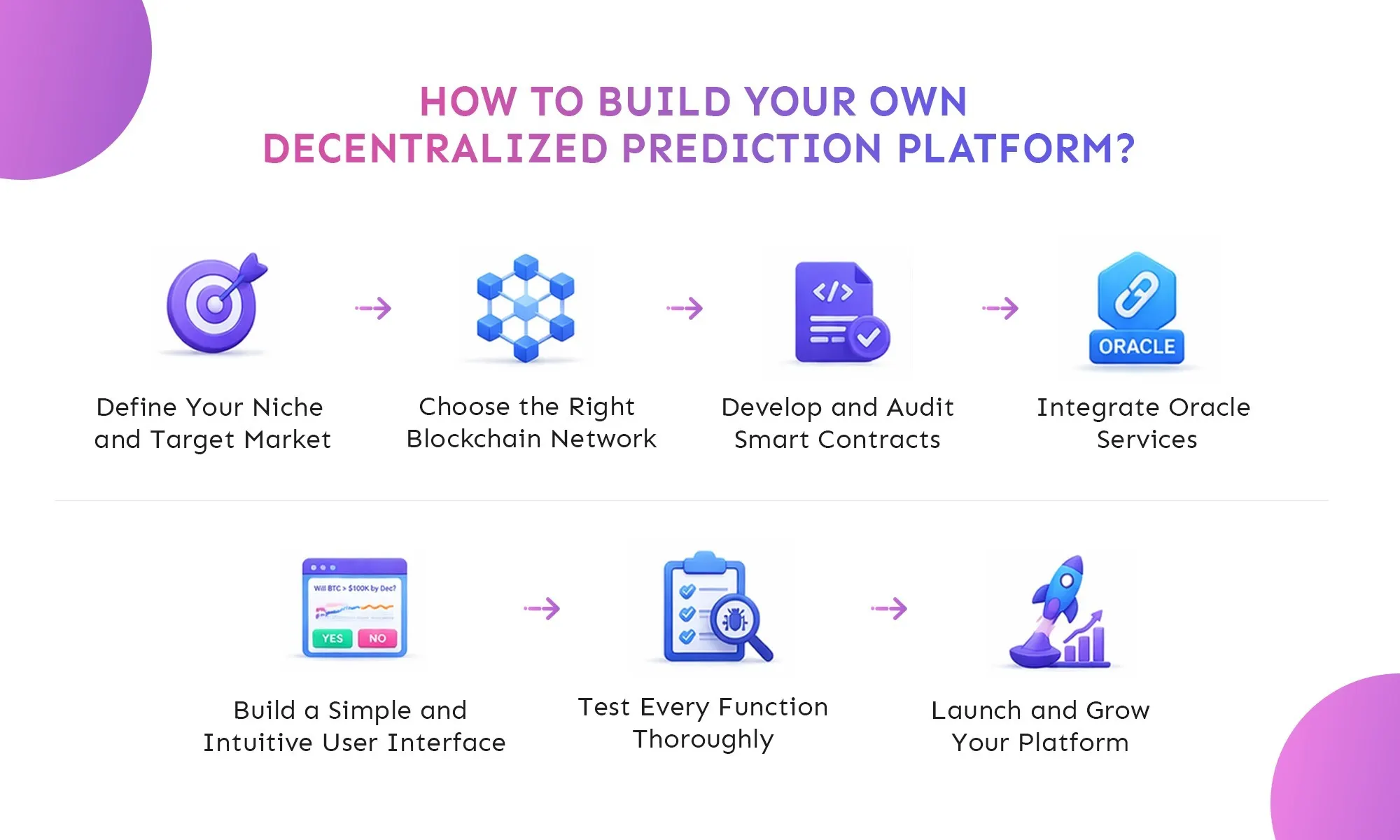
Define Your Niche and Target Market
Before writing any code, decide what your platform will focus on. Ask yourself:
- Are you targeting sports predictions?
- Financial markets like crypto or stocks?
- Political outcomes or global events?
- A mix of categories to appeal to a broader audience?
Your niche affects the features you include, your marketing approach, and the overall direction of your platform. Starting focused helps you attract the right users and avoid unnecessary complexity.
Choose the Right Blockchain Network
The blockchain network you choose impacts transaction speed, costs, and user trust. Popular options include:
- Ethereum – widely trusted with a large developer community, higher fees.
- Polygon – fast transactions with lower costs, ideal for smaller budgets.
- Binance Smart Chain – affordable deployment, widely adopted by new platforms.
Your choice should consider your budget, desired performance, and the kind of users you want to attract. Each network has trade-offs in speed, cost, and adoption.
Develop and Audit Smart Contracts
Smart contracts are the backbone of your platform. They:
- Handle predictions automatically
- Verify outcomes without manual intervention
- Distribute rewards fairly
Even a small vulnerability can result in serious financial losses. Have all smart contracts audited by a trusted third party before deploying them.
Integrate Oracle Services
Oracles feed real-world data into your platform. They:
- Provide accurate results from trusted external sources
- Connect directly to smart contracts
- Make predictions verifiable and reliable
Reliable oracle integration is critical to maintain credibility and smooth operations.
Build a Simple and Intuitive User Interface
A clean interface is essential for both beginners and experienced users. Include:
- Clear market listings
- Easy prediction placement
- Wallet connection options
- Personal dashboards for tracking predictions and earnings
A confusing design can discourage users, no matter how strong your backend is.
Test Every Function Thoroughly
Test all flows multiple times, including:
- Placing predictions and staking tokens
- Smart contract execution
- Oracle data feeds
- Reward distribution
- Platform performance under heavy traffic
Thorough testing helps prevent errors and builds user confidence.
Launch and Grow Your Platform
Once tested, deploy your platform and start building a community. Focus on:
- Engaging early users actively
- Collecting feedback for improvements
- Continuous updates based on performance and user needs
Growth depends on trust, transparency, and active user participation. A strong community is the foundation of a successful decentralized platform.

Must-Have Features for a Decentralized Prediction Platform
If you want to build a platform that users trust and return to regularly, these are the features you absolutely cannot skip.
Smart Contract Integration
Smart contracts are the core of the platform. They handle staking, verify outcomes, and distribute rewards automatically without manual steps. Setting them up correctly from the beginning is very important.
Oracle Integration
Your platform needs real world data to work properly. Oracles provide this data from trusted sources and pass it into the system so results can be verified correctly.
Multi Market Support
A strong platform should support predictions across different categories like sports, politics, crypto prices, and global events. This keeps users interested and active.
Token Based Reward System
Users place predictions using tokens and earn rewards when they are correct. This encourages regular participation.
Crypto Wallet Integration
Adding a prediction marketplace to a crypto wallet allows users to explore markets and place predictions while managing deposits and withdrawals from the same platform.
Decentralized Governance
Users can take part in decisions by voting on updates, disputes, and new markets. This builds trust and involvement.
User Dashboard and Analytics
A simple dashboard helps users track predictions, view earnings, and follow results clearly.
KYC and Compliance Module
Identity checks may be needed based on your target market. This helps meet legal requirements and builds credibility.
Types of Decentralized Prediction Markets
Not all prediction markets work in the same way. Before building your platform, it is important to understand the different types you can offer to users.
→ Binary Prediction Markets
This is the simplest type. Users choose between two options like yes or no. For example, will Bitcoin cross a certain price by the end of the year. It is easy to understand and works well for beginners.
→ Scalar Prediction Markets
In this type, users predict a value within a range instead of picking a fixed answer. For example, guessing the price of Ethereum on a certain date. Rewards depend on how close the prediction is.
→ Categorical Prediction Markets
Here users choose from multiple options. For example, selecting which team will win from a list of teams. This gives more variety compared to simple yes or no predictions.
→ Conditional Prediction Markets
This type depends on a condition. A prediction only matters if another event happens first. It is more advanced and usually attracts users who prefer detailed and complex setups.
Tech Stack Required to Build a Decentralized Prediction Platform
Choosing the right technology from the start saves a lot of time and money later. Each key part has an important role in making your platform work correctly and handle user activity.
| Platform Part | Technology Options |
| Blockchain Network | Ethereum, Polygon, Binance Smart Chain |
| Smart Contracts | Solidity, Rust |
| Oracle Integration | Chainlink, Band Protocol |
| Frontend Framework | React.js, Next.js |
| Backend | Node.js, GraphQL |
| Wallet Integration | MetaMask, WalletConnect |
Monetization Models for Decentralized Prediction Platforms
A great platform also needs a smart revenue strategy. Here are the most effective ways to monetize.
Platform Fee
Charge a small percentage on every winning prediction payout. This is the most straightforward and consistent revenue stream for prediction platforms of any size.
Market Listing Fee
Charge businesses or individuals a fee to create and list new prediction markets on your platform. As your platform grows, this becomes a strong secondary revenue source.
Native Token Economy
Launch your own platform token that users need to participate in markets. Token appreciation and transaction fees create a self sustaining revenue ecosystem over time.
Premium Subscription
Offer advanced analytics, early market access, or exclusive prediction categories through a paid monthly subscription for serious traders and power users.
Liquidity Provider Rewards
Attract liquidity providers to your platform and earn a percentage from the spread they generate. This model works especially well for high volume prediction markets.
Why Choose Hashcodex for Your Decentralized Prediction Platform Development?
Hashcodex is the right choice for decentralized prediction platform development. We build platforms that work well and meet user needs.
We make everything simple.
Our team handles smart contracts, oracle integration, frontend design, and support after launch. Every part of your platform is fully managed.
Our goal is to make your platform successful from the very start.
Ready to start your decentralized prediction platform development? We can do it together.









 NDA on Request
 Free Consultation – Let’s discuss your ideas