
You’ve decided to start a prop firm.
Great.
Now comes the question that can change how the whole business operates: CFDs or Futures?
Both models have their place in the prop trading industry, but they are far from identical. They differ in the markets available, trading costs, technology, rules, and the traders they tend to attract.
Choosing one is not just about picking a market. It’s about deciding what kind of prop firm you want to build.
Let’s take a closer look at CFD vs. Futures and see which option could be right for you.
Understanding the Two Prop Firm Models
Before building a prop firm, one of the first decisions you need to make is the trading model your business will follow.
CFD and futures are two common models used by prop firm businesses.
Understanding the difference between CFD and futures is important before choosing the right model for your business.
What Is a CFD Prop Firm?
A CFD prop firm is a business that gives traders funded accounts to trade Contracts for Difference (CFDs).
Think of a CFD as a way to trade price movements instead of owning the actual asset. Traders simply predict whether the price will go up or down. If they're right, they make a profit. If they're wrong, they take a loss.
For example, if a trader believes the price of gold will rise, they can open a CFD trade on gold without buying any physical gold.
If you're planning to build a CFD prop firm, you'll need software that can manage funded trader accounts, evaluation challenges, trading platforms, risk management, payments, and back-office operations all from one place.
What Is a Futures Prop Firm?
A futures prop firm is a business that gives traders funded accounts to trade futures contracts.
A futures contract is simply an agreement to trade an asset at a fixed price on a future date. Instead of buying the asset itself, traders use these contracts to profit from future price movements.
For example, if a trader believes the price of an index will increase next month, they can trade a futures contract based on that expectation. If the market moves in their favor, they make a profit. If it doesn't, they take a loss.
If you're planning to launch a futures prop firm, your software should support futures trading, exchange connectivity, evaluation programs, trader account management, and robust risk controls.
Understanding both models is the first step for businesses planning to build their own prop firm software.
Starting a Prop Firm Business: CFD vs. Futures – Which Model Is Better?
Choosing between a CFD and futures prop firm model depends on how you want to build your business, the traders you want to serve, and the type of software setup your prop firm requires.
This is why many businesses ask which is better: CFD or futures when planning their prop firm model.
Both models can support funded trading programs, but they follow different approaches when it comes to markets, technology, and operations.
Let’s look at the key areas you should consider before choosing a model.
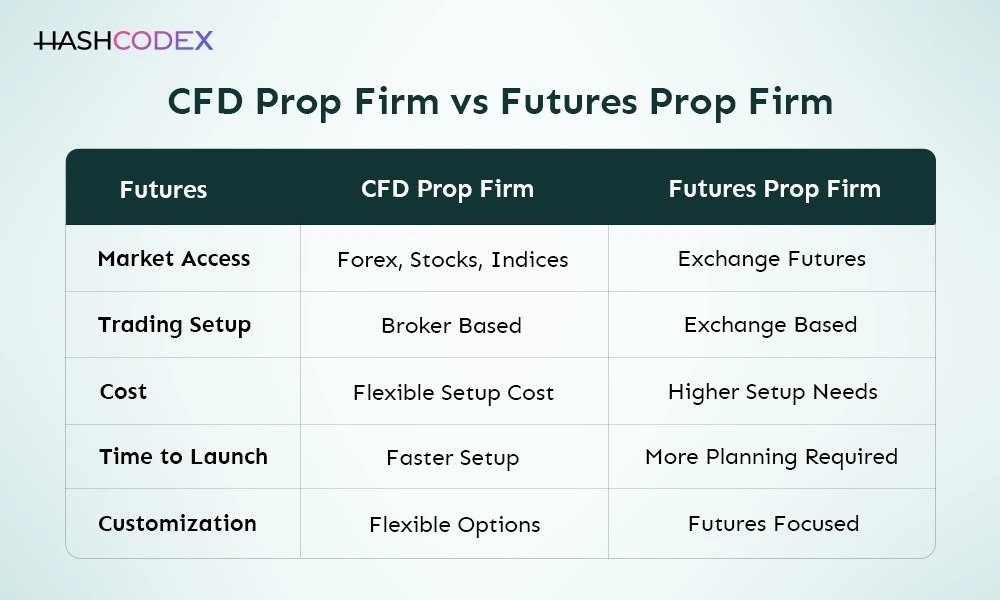
Market Access
- A CFD prop firm gives your business the ability to offer traders access to multiple markets, including forex, stocks, indices, commodities, and cryptocurrencies. This makes it suitable for businesses looking to provide a wider range of trading instruments.
- A futures prop firm focuses on exchange-traded futures markets, allowing businesses to offer products such as stock index futures, commodity futures, energy futures, and currency futures.
Trading Setup
- A CFD prop firm operates using broker-based infrastructure, where trading platforms connect with CFD brokers or liquidity providers to deliver market access.
- A futures prop firm relies on exchange-based infrastructure, requiring connections with futures trading platforms, exchanges, and market data providers.
Software Requirements
- A CFD prop firm requires software that supports trader account management, evaluation challenges, broker integrations, risk management, payment processing, and reporting.
- A futures prop firm requires software that supports futures trading workflows, exchange connectivity, market data, trader account management, and futures-specific risk controls.
Setup & Operating Costs
- A CFD prop firm generally offers more flexible setup costs, with expenses depending on the broker, trading platform, software features, and third-party integrations you choose.
- A futures prop firm may require additional investment in exchange connectivity, market data subscriptions, and futures trading infrastructure, which can increase operational costs.
Customization
- A CFD prop firm provides greater flexibility when creating account types, evaluation challenges, trading rules, and funded programs, allowing businesses to tailor their offerings to different trader segments.
- A futures prop firm also supports customization, although some workflows and trading processes are influenced by futures platform and exchange requirements.
Time to Launch
- A CFD prop firm can typically be launched faster by using existing broker integrations and ready-to-use prop firm software.
- A futures prop firm usually requires additional planning for exchange integrations, market data, and futures platform configuration before launch.
When a CFD Model May Be a Better Fit?
A CFD model may be a better fit if you want to build a prop firm that offers multiple markets and flexible trading programs.
It can work well for businesses that want to reach traders interested in forex, indices, commodities, stocks, and other CFD products.
When a Futures Model May Be a Better Fit?
A futures model may be a better fit if your business focuses on futures markets and traders who prefer exchange-based products.
It can work well for businesses that want to build a prop firm around futures trading and futures-specific platforms.
Both CFD and futures models can work well for businesses planning to build a prop firm. The right choice depends on your target audience, software requirements, market offering, and long-term business plans.
How Your Choice Impacts Your Prop Firm's Success
When you are building a prop firm, choosing the right model is not just about deciding what markets to offer.
It can affect important parts of your business, so make sure you think about the bigger picture before starting development.
Your choice can influence:
- The type of traders you want to attract
- The software features your platform needs
- The partnerships and integrations required
- The support experience you provide to users
- Your future plans for expanding the business
A common mistake is focusing only on launching quickly and thinking about these things later.
Instead, plan your model around the type of prop firm you want to build. This helps you create a platform that matches your goals from the beginning.
Key Questions Before Choosing Your Prop Firm Model
Before you decide between a CFD and futures prop firm, take some time to look at the bigger picture.
Ask yourself these questions before moving forward:
- Who are the traders I want to attract?
Are you planning to serve traders who are familiar with forex and CFDs or traders who already focus on futures markets?
- Which markets do I want to offer?
Think about the trading products you want your prop firm to provide and whether your chosen model supports them.
- What is my budget for building and running the prop firm?
Consider not only the initial setup cost but also ongoing expenses like software, integrations, support, and daily operations.
- What technology does my prop firm need?
Look at the platform features, trading tools, integrations, and systems required to deliver the experience you want.
- What legal requirements should I consider?
Understand the rules and requirements in the regions where you plan to operate before choosing your model.
- Where do I want my prop firm to be in the next few years?
Choose a model that matches your future plans and gives you room to grow based on your business goals.
Taking time to answer these questions can help you avoid making a decision based only on what is popular and instead choose a model that fits the prop firm you want to build.
Conclusion
Choosing between a CFD and futures prop firm model is an important step when planning your prop firm business.
There is no single model that works best for everyone. The right choice depends on the type of traders you want to attract, the markets you want to offer, and the kind of platform experience you want to build.
If your goal is to offer multiple markets and flexible trading programs, a CFD model may be the right direction. If you want to focus on exchange-based markets and futures traders, a futures model may be a better fit.
Once you have a clear idea of your business model, the next step is building the right technology foundation to support it.
At Hashcodex, we help businesses build custom prop firm software with the features required to launch and manage modern funded trading platforms. From trading integrations and account management to risk tools and platform requirements, we help you create a solution based on your business needs.
Whether you are starting a new prop firm or looking to expand your existing platform, our team can help you build the right foundation for your goals. Connect with us.











 NDA on Request
 Free Consultation – Let’s discuss your ideas