Want to build a platform for fractional real estate investment?
You’re in the right place.
For fintech companies and real estate businesses, a fractional real estate tokenization platform can be used to represent portions of properties as digital tokens and make them available to multiple investors.
The platform can serve as a central space where real estate assets are presented, investment activities are managed, and token ownership is recorded.
But what should be planned before development begins?
Which features will users need? Which blockchain network fits the project? What development cost should be expected?
This guide explains the platform requirements, development process, technology choices, estimated costs, real world examples, and important considerations for launching a fractional real estate tokenization platform.
What is Fractional Real Estate Tokenization?
Fractional real estate tokenization converts a property or an investment interest in real estate into smaller digital units, represented by blockchain-based tokens.
It lets multiple investors participate in a property investment without purchasing the entire asset. Each token represents a defined interest or economic right, depending on the legal structure of the offering.
By combining blockchain, smart contracts, and digital investment infrastructure, fractional tokenization can simplify ownership tracking, investor management, transactions, and asset administration while making real estate investment more accessible and transparent.
How to Build a Fractional Real Estate Tokenization Platform: Complete Guide
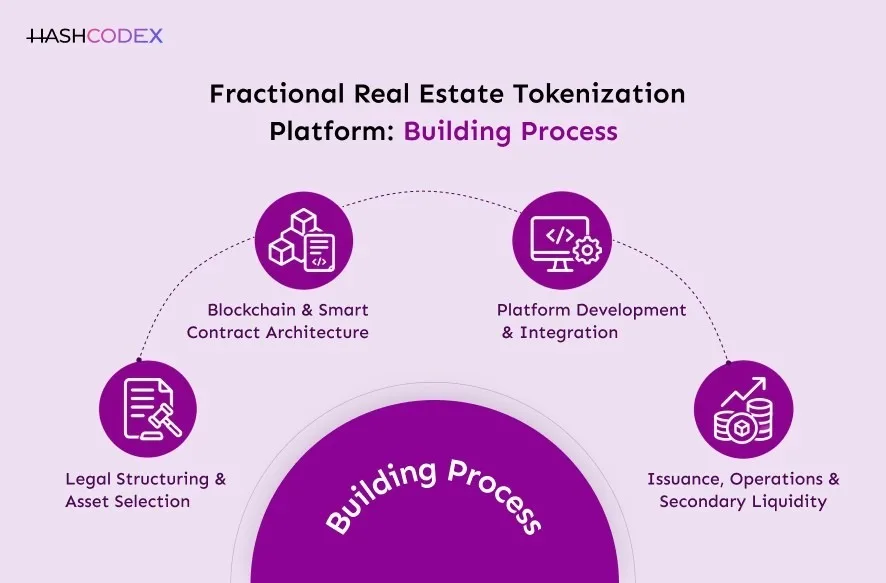
A complete platform can be divided into four major stages:
- Legal Structuring & Asset Selection
- Blockchain & Smart Contract Architecture
- Platform Development & Integration
- Issuance, Operations & Secondary Liquidity
Each stage connects to the next.
The technology should be designed around the legal rights attached to the investment rather than treating blockchain as the starting point.
1. Legal Structuring & Asset Selection
Asset Due Diligence: Start by selecting properties with clear ownership, verified documents, and reliable financial records. Review the property's value, rental income, expenses, existing loans, and other liabilities before tokenization.
SPV Formation: Create a Special Purpose Vehicle (SPV) to hold the property or the investment interest. The SPV structure helps define how investor interests are held and managed.
Legal Wrapper: Clearly define what each token represents. It may represent an interest in the SPV, rental income, property profits, or another legal investment right.
Regulatory Compliance: Check the rules that apply to the offering, property, and target investors. KYC, AML, investor eligibility, transfer restrictions, and reporting requirements should be addressed before issuing tokens.
2. Blockchain & Smart Contract Architecture
Blockchain Selection: Choose a blockchain based on transaction costs, security, wallet support, and the needs of the platform. Ethereum and other EVM-compatible networks can be considered.
Permissioned Token Standards: Choose a token standard that supports regulated real estate investments. Standards such as ERC-3643 and ERC-1400 can provide features for identity-based transfers, restricted ownership, and compliance requirements.
On-Chain Compliance & Identity: Connect investor verification with the token transfer logic. Before a transfer occurs, the compliance layer can check KYC/AML status, investor eligibility, jurisdiction, accreditation requirements, and applicable transfer restrictions.
Smart Contract Architecture: Develop smart contracts to manage token issuance, allocation, transfers, ownership records, distributions, and other investment functions. Transfer rules should be enforced according to the applicable legal structure.
Multi-Sig Administration: Use multi-signature controls for sensitive administrative actions such as minting, pausing transfers, updating compliance settings, or managing authorized administrators.
Smart Contract Security & Auditing: Conduct independent security audits before deployment. Testing should cover access controls, reentrancy, logic errors, transfer restrictions, privilege escalation, and other potential vulnerabilities.
3. Platform Development & Integration
Investor Portal: Build a simple investor portal where users can explore properties, review investment details, complete verification, invest, and track their holdings.
Asset Listing Engine: Showcase property financials, photos, and 3D walkthroughs to build trust.
Identity & Compliance: Connect KYC and AML services to verify investors. The platform can also check investor eligibility before allowing access to specific offerings.
Wallet Infrastructure: Provide secure wallets for investors to hold their tokens. The platform can support custodial wallets, non-custodial wallets, or embedded wallets based on the target users.
Fiat & Crypto Payments: Allow investors to fund their investments through supported payment methods. Depending on the market, this can include bank transfers, fiat payment services, stablecoins, or selected cryptocurrencies.
Property & Data Infrastructure: Store important property information such as valuation, rental income, expenses, legal documents, and financial reports. Investors should be able to access relevant information before making an investment.
4. Issuance, Operations & Secondary Liquidity
Primary Offering: List the property on the platform and open it for eligible investors. Once an investment is completed, the platform can record the investment and allocate the corresponding tokens.
Distribution Engine: If the property generates rental income, the platform can calculate each investor's share and manage distributions according to the investment terms.
Corporate Actions: Support events such as rental distributions, refinancing, property sales, investor voting, redemptions, and other changes related to the investment.
Secondary Trading: A secondary marketplace can allow eligible investors to trade their tokenized interests. The platform should apply the required transfer and investor eligibility rules before completing a trade.
Reporting & Analytics: Give investors access to their token holdings, transactions, distributions, and property performance. Administrators can use separate dashboards to monitor assets, investors, compliance, and platform activity.
Core Features Required for a Fractional Property Tokenization Platform
A fractional property tokenization platform should make the entire investment journey simple, transparent, and compliant. Key features can include:
Property Marketplace: Showcase tokenized properties with investment details, property information, expected returns, and available token units.
Investor Dashboard: Let investors view their holdings, transactions, distributions, portfolio value, and investment history.
Token Management: Support token issuance, allocation, transfers, ownership tracking, and compliance-based transfer restrictions.
KYC & AML Verification: Verify investor identities and apply eligibility checks before allowing users to access or invest in specific offerings.
Investment Management: Allow eligible investors to select properties, purchase fractional interests, and track their investments.
Payment Integration: Support suitable payment methods such as bank transfers, fiat payments, stablecoins, or other approved options.
Rental & Distribution Management: Calculate investor shares and automate rental income or other distributions based on the investment structure.
Property Document Management: Provide access to important property documents, valuation reports, financial statements, and other relevant information.
Secondary Marketplace: Enable eligible investors to trade tokenized interests when permitted by the applicable legal and regulatory framework.
Admin Dashboard: Give administrators tools to manage properties, investors, transactions, compliance, tokens, distributions, and platform activity.
Notifications & Communication: Send updates about investments, distributions, transactions, property performance, and important platform events.
Reports & Analytics: Provide investors and administrators with detailed reports covering holdings, transactions, returns, property performance, and platform activity.
Cost Breakdown: Real Estate Tokenization Platform Development
The cost of developing a real estate tokenization platform typically ranges from $10,000 to $100,000+.
The final cost depends on the platform’s features, blockchain network, compliance requirements, integrations, security needs, and development scope.
Cost Breakdown by Development Tier
| Tier | Price Range | Core Features |
| MVP | $10,000 – $20,000 | Property listings, user registration, basic smart contracts, wallet integration, and standard dashboard |
| Mid-Tier | $21,000 – $45,000 | Advanced wallet integration, automated rental distribution, KYC/AML integration, investor dashboard, and custom UI/UX |
| Enterprise | $100,000 + | Multi-property management, secondary trading features, advanced compliance, custom blockchain infrastructure, and enterprise security |
Key Factors That Affect Development Cost
- Smart Contracts & Blockchain Setup: $8,000 – $25,000 ( choosing networks like Ethereum, Polygon, or Solana, plus security audits).
- Legal & Compliance Integration: $12,000 – $75,000 (jurisdiction setups, SEC/MiCA guidelines, and regulatory reporting).
- Third-Party Services: $2 – $8 per user onboarding for KYC/AML, plus fiat payment gateway integrations.
- Ongoing Maintenance: $500+ per month for server hosting, security patches, and node management
Keep in Mind: Tokenization complexity, compliance requirements, and investor features can change the overall development budget significantly.
Global Real Estate Tokenization Regulations: US, EU, UAE & India
Your target country affects how your platform is built, what investors need to do, and how much compliance may cost.
The basic structure can remain similar. Usually, an SPV holds the property, while digital tokens represent an investor’s interest in that SPV.
However, the legal rules are different in each market.
United States: Securities-Based Approach
In the US, tokenized real estate interests can be treated as securities, depending on how the investment is structured.
Many projects therefore use securities exemptions instead of registering a public offering.
- Regulation D – Rule 506(c): Companies can advertise the offering publicly, but investors must be accredited. The issuer must also take reasonable steps to verify their status. (General solicitation — Rule 506(c))
- Regulation S: Can be used for certain offerings made outside the US, subject to its conditions.
- Resale restrictions: Securities issued through private offerings are generally restricted. Depending on the issuer and circumstances, Rule 144 can require a six-month or one-year holding period before certain resales.
Key point: The US model requires strong investor verification and securities compliance.
European Union: Financial Markets Framework
In the EU, tokenized real estate investments may fall under existing financial-market rules when the tokens qualify as financial instruments.
- MiFID II: Provides the EU framework for markets in financial instruments and related investment services.
- Prospectus Regulation: Can apply to securities offered to the public or admitted to trading on a regulated market, subject to applicable exemptions.
- MiCA: MiCA does not apply to crypto-assets that qualify as financial instruments, meaning existing financial-services rules remain relevant in such cases.
Key point: EU platforms need to carefully determine whether their tokens are financial instruments and follow the relevant securities rules.
UAE: Real Estate Tokenization Pilot
The UAE has developed an active regulatory framework around digital assets and real estate tokenization.
Dubai Land Department launched its real estate tokenization project with VARA and other partners. The project connects blockchain-based tokenization with the real estate registration system.
In 2026, Dubai moved into Phase II, which introduced resale activity in the secondary market under the regulated project.
However, VARA states that businesses offering or facilitating tokenized real estate activities in Dubai need the required regulatory approvals. (VARA Consumer and Marketplace Alert)
Key point: Dubai is developing a regulated infrastructure specifically for tokenized real estate.
India: GIFT City / GIFT IFSC
Tokenizing Indian real estate for domestic investors requires careful consideration of India's securities and financial regulations.
For businesses exploring tokenization, GIFT IFSC in GIFT City provides a separate international financial-services framework regulated by IFSCA.
IFSCA has also published a consultation paper specifically examining the regulatory approach to real-world asset tokenization.
GIFT IFSC also has a FinTech Sandbox framework that allows eligible businesses to test innovative financial solutions under regulatory supervision.
Key point: GIFT City can be relevant for businesses exploring regulated tokenization models and international financial activities, but the exact structure and investor base matter.
Final Thoughts
Fractional real estate tokenization is creating new opportunities by combining traditional property investment with blockchain technology.
Building a successful platform, however, requires the right combination of regulatory planning, secure smart contracts, scalable infrastructure, investor management, and seamless platform functionality.
With expertise in real estate tokenization platform development, Hashcodex provides the technology infrastructure needed to build platforms that enable fractional property ownership, investor participation, token management, and flawless real estate investment.
Frequently Asked Questions
1. Does Hashcodex build a fractional property tokenization platform?
Yes. Hashcodex develops custom fractional real estate tokenization platforms based on your business requirements. We can customize the platform architecture, investor journey, token model, dashboards, smart contracts, integrations, and administrative controls.
2. How does a fractional real estate tokenization platform work?
A property is placed into an SPV, which issues digital tokens representing ownership shares. Investors buy tokens through a compliant investor portal after completing KYC/accreditation checks. The tokens carry rights to rental income and appreciation, distributed automatically via smart contracts, and can potentially be resold on a secondary market.
3. How long does it take to develop the fractional real estate tokenization platform?
A minimum viable platform can take 4–6 months. A fully compliant, audited, production-ready system with secondary trading capability more commonly takes 9–18 months, largely due to legal structuring timelines and smart contract audit cycles rather than raw development speed.
4. Can tokenized real estate assets be traded on a secondary market?
Yes, where the platform has built or integrated with a licensed trading venue (such as an ATS in the US). Trading is still subject to the same compliance restrictions as the primary offering, tokens can generally move between wallets belonging to verified, eligible investors.








 NDA on Request
 Free Consultation – Let’s discuss your ideas