
Buying and selling agri products sounds simple, but it rarely works that way.
A farmer has products ready but looks for the right buyer. A trader wants good quality but checks multiple sources before deciding.
In between, there are always a few common issues:
- Too many calls and follow-ups
- Price confusion from different sources
- Delays in closing deals
Now imagine all of this happening in one place.
Buyers can check options instantly. Sellers can list their products and reach more people without waiting.
Yes, you heard it right.
This is exactly what agri commodity marketplaces are changing.
When more users join, activity starts building. And when activity builds, transactions follow. That is where the real business opportunity begins.
But launching a platform like this is not just about bringing buyers and sellers together. It depends on how the system is planned, how trading is handled, and how the first set of users is brought in.
Let’s look at what it takes to build and launch an agri commodity marketplace the right way.
What is an Agri Commodity Marketplace?
An agri commodity marketplace is a platform where agricultural products are bought and sold between farmers, traders, and businesses. It brings all participants into one place to make trading easier and more direct.
Instead of relying on middlemen or offline markets, users can list, discover, and purchase commodities through a single system. This helps reduce delays and improve access to better pricing.
These platforms usually support products like grains, pulses, spices, and other farm produce. Buyers can compare options, and sellers can reach a wider market.
Why Are Businesses Investing in Agri Commodity Marketplaces?
Businesses are showing interest in agri commodity marketplaces because trading is shifting from offline to digital platforms. It helps them manage buying and selling in a more organized way.
Instead of depending on limited local networks, businesses can connect with multiple buyers and sellers in one place. This opens up more opportunities for trade.
Here are some key reasons driving this shift:
- Better market access
Businesses can reach suppliers and buyers across different regions without physical limitations. - Price visibility
They can view and compare prices before making decisions instead of relying on one source. - Direct transactions
Reduces dependency on multiple intermediaries and simplifies the process. - Faster deal closure
Listings and communication happen on the same platform, saving time. - Consistent supply and demand flow
Ongoing activity on the platform helps maintain regular trading.
As more participants join, these platforms become active trading spaces. For businesses, this creates a steady environment to operate and grow.
Agri Commodity Marketplace Development
Agri commodity marketplace development is the process of building a platform where agricultural products can be listed, traded, and managed in one place. It focuses on creating a system that connects buyers and sellers and supports real-time transactions.
This involves setting up product listings, pricing methods, user roles, and transaction flow. The goal is to create a platform that can handle trading activity while keeping the process simple for users.
Hashcodex helps businesses develop agri commodity trading marketplaces based on their specific requirements. Our team works on platform setup, trading features, and integrations to help you launch a marketplace that fits your business model.
A Step-by-Step Approach to Launching an Agri Commodity Marketplace
Launching an agri commodity marketplace may seem like a big task, but it becomes easier when you follow a clear process. Here are the key steps to get started:
Step 1: Define Your Marketplace Focus
Start by deciding what your platform will focus on:
- Which commodities will you support (grains, spices, etc)
- Who are your users (farmers, traders, businesses)
- Which region do you want to target
This helps you set a clear direction from the beginning.
Step 2: Choose the Right Business Model
Decide how your marketplace will operate:
- Will it be business-to-business or farmer-to-business
- Will pricing be fixed or based on bidding
- How will you earn revenue (commission, subscription, etc)
This step shapes how your platform functions.
Step 3: Plan the Platform Structure
Outline how your platform will work:
- Product listing and search
- Order placement and tracking
- User roles and permissions
A clear structure avoids confusion during development.
Step 4: Develop Core Features
Build the main parts of your platform:
- User registration and profiles
- Commodity listings with details
- Pricing and transaction flow
Focus only on what is needed to start.
Step 5: Set Up Payments and Logistics
Decide how transactions will be completed:
- Payment methods and settlement process
- Delivery and logistics handling
- Order status updates for users
This ensures the trading process works end-to-end.
Step 6: Test the Platform
Before launch, check everything:
- Make sure all features work as expected
- Fix any issues in listings or transactions
- Test with a small group of users
This helps avoid problems after launch.
Step 7: Launch and Onboard Users
Go live and bring users to your platform:
- Start with a limited group of buyers and sellers
- Help them understand how the platform works
- Collect feedback and make small improvements
Early activity is important for growth.
Step 8: Monitor and Improve
After launch, keep improving the platform:
- Track user activity and transactions
- Add features based on feedback
- Support users when they face issues
This helps the platform stay active and useful over time.
Key Features Every Successful Agri Commodity Platform Must Have
A well-built agri commodity platform should make trading simple for both buyers and sellers. The following features play an important role:
Product Listings with Clear Details
Sellers should be able to list their agricultural products with all the required information. This includes quantity, quality, price, and location so buyers can make quick decisions.
Search and Filtering Options
Buyers should find what they need without spending too much time. Filters based on product type, price range, and location make this easier.
User Profiles and Verification
Each user should have a profile with basic details and verification. This helps build trust between buyers and sellers on the platform.
Order and Contract Management
The platform should support order handling along with basic contract agreements. This helps both sides clearly understand terms before completing a transaction.
Messaging System
Buyers and sellers should be able to communicate directly on the platform. This reduces delays and avoids the need for external communication.
Payment Integration
The platform should support simple payment methods for completing transactions. This ensures the process moves forward without confusion.
Admin Panel and Control
An admin panel is needed to manage users, listings, and transactions. It helps maintain control over platform activity.
Simple User Interface
The platform should be easy to use for all types of users. Clear navigation helps users complete actions without difficulty.
Agri Commodity Marketplace Architecture (System Design Overview)
An agri commodity marketplace is a digital platform that connects farmers, buyers, and traders in one system. Its architecture is designed in layers to manage users, data, and transactions efficiently.
The user layer includes farmers who list their crops, buyers who purchase or bid, and traders who handle bulk trading. All users interact with the platform through a website or mobile application.
The frontend layer is the visible part of the system where users can browse products, place orders or bids, and track their transactions in real time. It provides a simple and user-friendly interface.
The backend layer is the core of the system that handles important operations such as user authentication, product listing, bidding, order management, payment processing, and notifications.
The database layer stores all the critical information, including user details, product listings, transactions, and payment history, in a structured and secure way.
The system also connects with external services like payment gateways, logistics providers, and SMS/email services to support secure payments, delivery tracking, and alerts.
In simple terms, the workflow starts when a farmer lists a product, a buyer places an order or bid, the system processes payment, assigns delivery, and finally completes the transaction.
Revenue Models of an Agri Commodity Marketplace
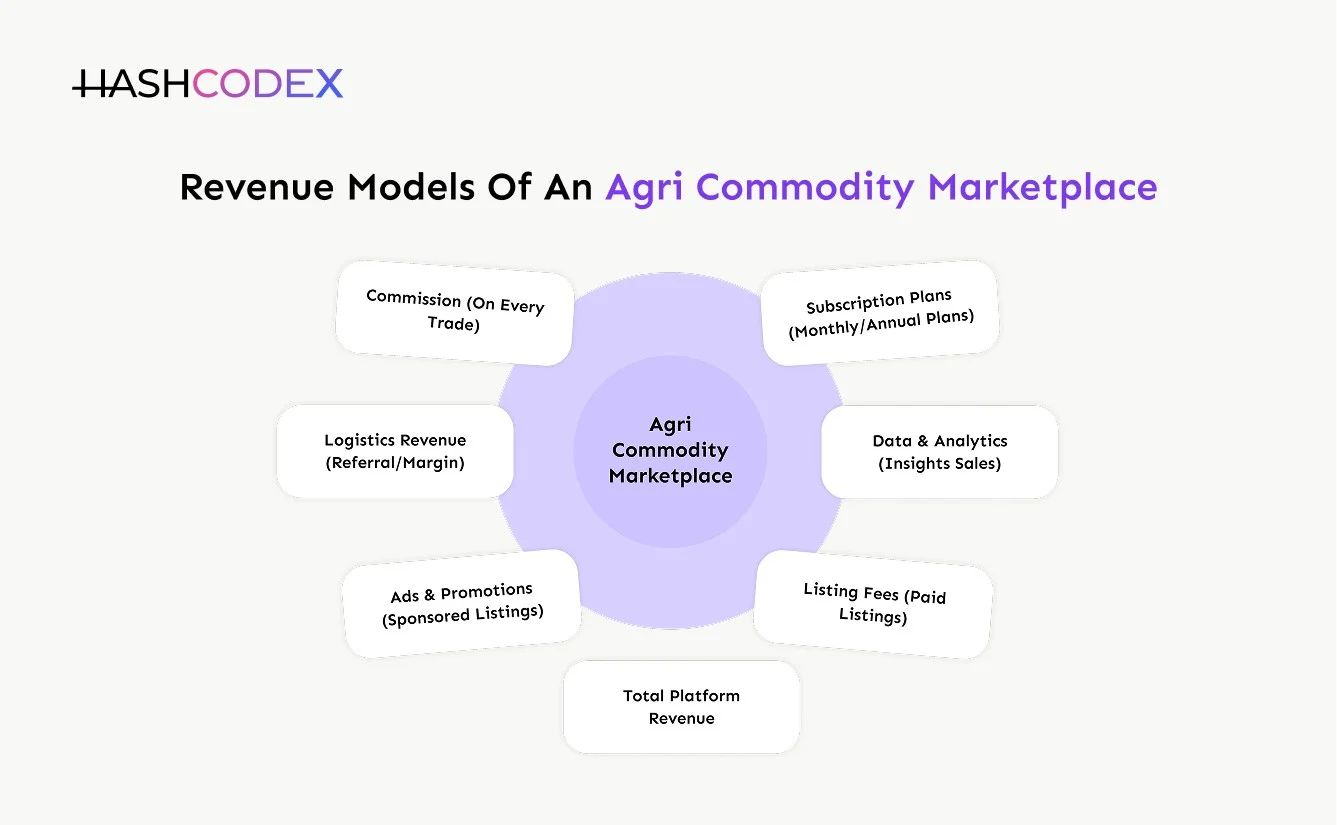
- Commission on Transactions: The platform earns a percentage fee on every successful agri commodity trade between farmers, buyers, and traders.
- Listing Fees: Sellers are charged for listing their agricultural products, especially for premium or featured product visibility.
- Subscription Plans: Monthly or yearly subscription plans are offered to traders and bulk buyers for advanced features, analytics, and priority access.
- Logistics Partnerships: Revenue is generated through partnerships with logistics providers by earning referral fees or delivery commissions.
- Data & Analytics Monetization: The platform sells agricultural market insights, price trends, and demand forecasting reports to businesses and institutions.
- Advertising & Sponsored Listings: Agri-input companies and brands pay for advertisements or sponsored product placements on the marketplace.
Challenges & Solutions in Building an Agri Commodity Marketplace
| Challenge | Impact | Solution |
| Farmer onboarding issues | Farmers may find the platform difficult to use due to low digital literacy | Simple UI, local language support, and assisted onboarding via field agents |
| Trust & quality verification | Buyers may doubt product quality and seller authenticity | KYC verification, product grading system, and ratings/reviews |
| Price fluctuations | Unstable commodity prices affect buying and selling decisions | Real-time price integration and dynamic pricing systems |
| Logistics & delivery delays | Slow transport can affect perishable goods and trade efficiency | Partner with reliable logistics providers and enable real-time tracking |
| Payment security concerns | Farmers may hesitate due to delayed or unsafe payments | Escrow-based payment system with release after delivery confirmation |
| Low digital awareness | Limited internet access and tech knowledge in rural areas | Mobile-first design, SMS alerts, and offline-friendly features |
How Much Does It Cost to Build an Agri Commodity Marketplace?
The cost of building an agri commodity marketplace usually starts from $10,000 and can go up to $80,000 or more, depending on the features, platform type, and level of customization.
If you are looking to launch quickly with basic trading features, the cost will be on the lower side. If you plan to build a full platform with advanced features and custom workflows, the cost will increase.
Estimated Cost Breakdown
| Platform Type | Estimated Cost |
| Basic platform (core features) | $10,000 – $20,000 |
| Mid-level platform (custom features) | $20,000 – $50,000 |
| Advanced platform (full-scale solution) | $50,000 – $80,000+ |
The final cost depends on your business requirements and how you want the platform to operate. It is always better to focus on building a platform that supports your long-term goals.
How Hashcodex Helps You Launch Your Agri Commodity Platform?
At Hashcodex, we work with businesses to build agri trading commodity platforms that match their requirements and business goals. Our expertise in commodity exchange software development allows us to create systems that support real buying and selling activity across agricultural markets.
Our approach starts with understanding how your marketplace should operate. From there, we handle platform setup, core features, and integrations required for trading, ensuring everything aligns with your business model.
We take care of the complete process, from development to testing and final launch. This helps you move from idea to a working platform without unnecessary delays or confusion.
With experience in building trading and exchange platforms, we ensure your system is ready for real users from the start. Every feature is designed to support actual transactions, user interaction, and platform growth.
If you are planning to enter the agri trading space, our team supports you at every stage, whether you are building a niche marketplace or a full-scale commodity exchange.
Let’s build a platform that connects buyers and sellers and supports long-term growth.










 NDA on Request
 Free Consultation – Let’s discuss your ideas