
Building an exchange starts with choosing the right trading engine.
During your search, you will likely find two common choices: An Open-Source Trading Engine or an Enterprise trading engine from a software provider.
At first, both options may seem similar, and choosing between them may look easy.
But when you start looking at factors like performance, support, security, and maintenance, the differences become much clearer.
That is why many exchange businesses spend time comparing both options before making a decision.
In this blog, we will break down the key differences and help you understand which option may work best for your exchange.
Overview of Open Source and Enterprise Trading Engines
Open source and enterprise trading engines provide the underlying framework for electronic trading activities.
Read on to understand their core components, architectural approaches, and the considerations involved in choosing between them.
What Is an Open Source Trading Engine?
An open source trading engine is a trading system whose source code is publicly available. Businesses and developers can access it and modify it based on their requirements.
Many businesses explore open source trading engines when they want to build and manage the system themselves.
What Is an Enterprise Trading Engine?
An enterprise trading engine is a commercially developed trading system provided by a specialized software provider. It is offered as a complete solution for exchange businesses.
Many businesses choose enterprise trading engines when they prefer a ready-to-use system supported by an experienced provider.
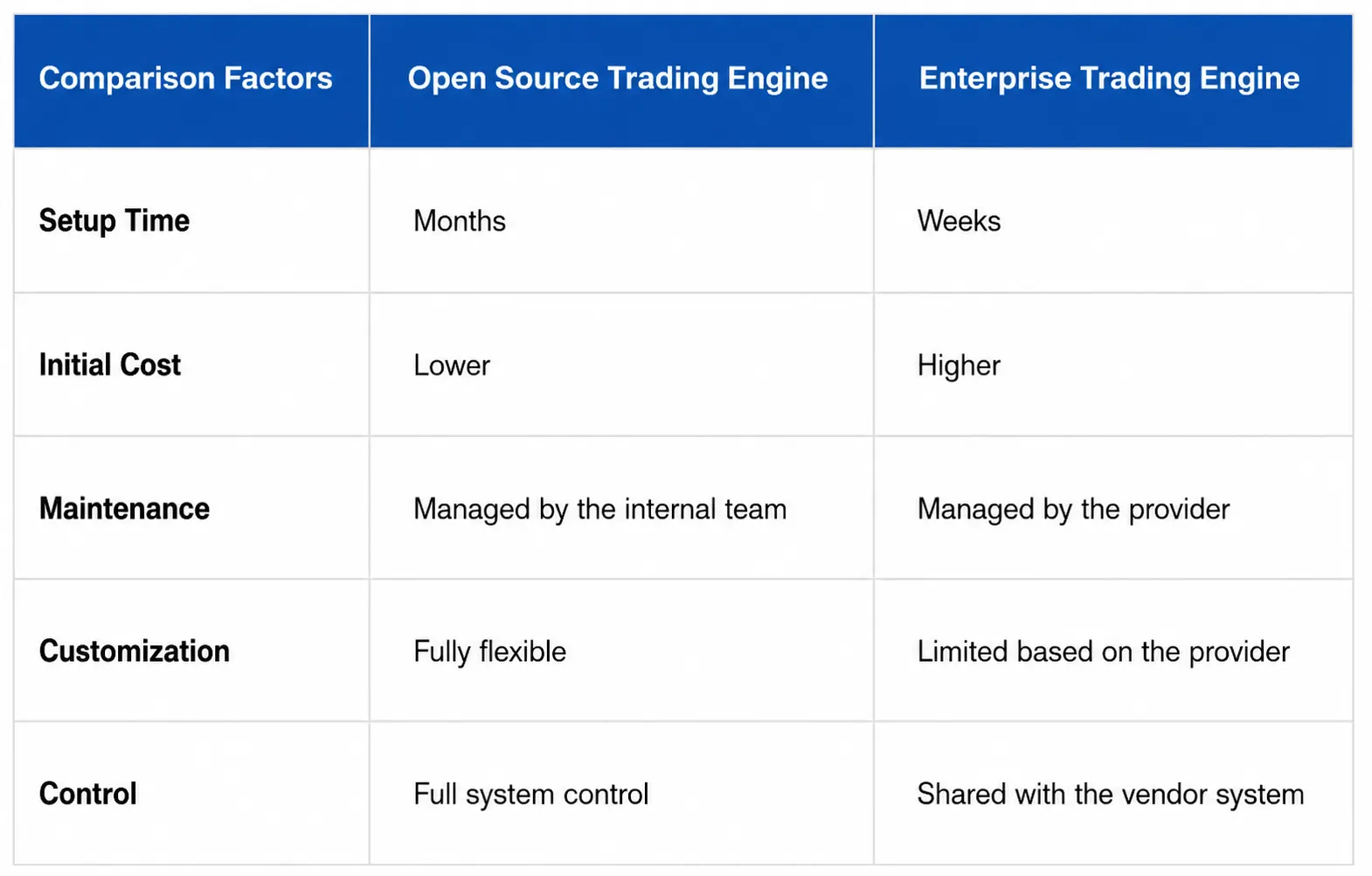
Open Source vs Enterprise Trading Engine: Which Is Right for Your Exchange?
Choosing between an open source and an enterprise trading engine depends on how you want to build your exchange and how much control you want over the system.
Development & Setup
- Open source trading engines require custom development and configuration. Your team is responsible for building, testing, and managing the system.
- Enterprise trading engines come ready to use with core trading features already built. This helps exchanges launch faster and reduce development effort.
Cost & Maintenance
- Open source trading engines usually have lower upfront costs. However, your team must handle maintenance, updates, and ongoing system improvements.
- Enterprise trading engines involve higher initial costs but include ongoing support, updates, and maintenance from the provider.
Customization & Control
- Open source trading engines give full control over the platform. You can modify trading features and system logic based on your requirements.
- Enterprise trading engines offer customization options, but changes are usually limited to what the provider supports.
Scalability & Performance
- Open source trading engines can support growing trading activity when properly developed and maintained.
- Enterprise trading engines are designed to handle large trading volumes and high user activity from the start.
Security & Reliability
- With open source trading engines, your team is responsible for managing security, monitoring, and system reliability.
- Enterprise trading engines often include built-in security measures, regular updates, and dedicated operational support.
Support
- Open source solutions rely on internal teams or community resources for troubleshooting and maintenance.
- Enterprise solutions include vendor support, helping businesses resolve technical issues more quickly.
When Open Source Makes Sense
- You want full control over the trading system
- You have a strong in-house development team
- You need extensive customization
When Enterprise Makes Sense
- You want to launch faster
- You prefer a ready-to-use trading infrastructure
- You need ongoing technical support
Which Option Works Better?
Both options work well, but they serve different build approaches.
The right choice depends on the level of control, speed, and operational effort you want for your exchange.
How Does Trading Engine Performance Impact Exchange Success?
Trading engine performance affects how fast orders are processed and how well the exchange handles high trading activity without delays.
When users place orders, the system must match them quickly. If the engine is slow, traders may miss price changes or face delays.
Key areas affected by performance:
- Order matching speed
- Handling large trade volumes
- System response during high activity
For example, during major market movement, thousands of orders may enter the system in seconds. A strong trading engine keeps order flow consistent. A weak system creates delays and a poor trading experience.
This is why performance testing is a key step before launching any exchange trading engine.
Common Mistakes When Choosing a Trading Engine
Choosing a trading engine is a critical step when building an exchange. Small mistakes in evaluation can lead to long-term issues.
Understanding these mistakes helps you make better and more informed decisions.
Choosing based only on cost
One of the most common mistakes is focusing only on initial cost. It may look cheaper at first, especially with open-source solutions.
But you also need to consider development, maintenance, and infrastructure costs. If you ignore this, your long-term expenses can become much higher.
Ignoring scalability requirements
Many teams forget to plan for future growth in trading activity. An exchange can scale quickly once it goes live.
Your trading engine must handle increasing order volumes well. If not, you may face slowdowns during peak market activity.
Underestimating maintenance effort
Open source trading engines need continuous updates and monitoring. This responsibility usually stays with your internal engineering team.
If you don’t have the right resources, system stability can suffer.
Not evaluating vendor support properly
If you choose an enterprise solution, vendor support becomes important. You should check response times and the issue resolution processes carefully.
Weak support can delay fixes during important trading hours. This can directly impact your exchange operations.
Overlooking latency and performance requirements
Trading engines work in real-time, where every millisecond matters. Even small delays can affect order execution and trading experience.
If performance is not evaluated properly, system efficiency can drop. This becomes more visible during high market activity.
Avoiding these mistakes helps you choose a trading engine that fits both your current needs and future exchange growth.
What Should You Look for in a Trading Engine Software Provider Before Choosing One?
When you are choosing a trading engine software, you are not just selecting a tool. You are choosing a system that will run your exchange operations every day.
That is why it is important to understand how the trading engine software provider handles core trading requirements and ongoing support.
Before choosing a provider, you can look at a few key areas:
- How the trading engine handles high order activity during busy trading periods
- Whether it supports the type of exchange model you are planning to build
- How quickly technical issues are addressed when they occur
- How frequently system updates and improvements are released
- Whether the engine can be adjusted based on your platform requirements
A trading engine provider becomes part of your exchange operations from day one. It affects how your platform behaves during real trading activity.
Choosing the right provider helps reduce operational gaps and gives more stability as your exchange grows.
Conclusion
Trading engines are a key part of any exchange, and there is no single option that fits all needs. Some businesses want full control and customization, while others prefer faster setup and managed systems. The choice depends on how the exchange is planned.
If you have a strong technical team and want more control, open source trading engines can be a better fit. If you want a quicker setup with support, enterprise trading engines may suit your needs.
If you are exploring enterprise trading engine solutions, Hashcodex can help. As a trading software development company, we work with businesses to build scalable trading infrastructures that support exchange growth, trading performance, and long-term operational requirements.










 NDA on Request
 Free Consultation – Let’s discuss your ideas