Are you planning to build OMS software for a trading platform or looking for a better way to manage orders on your existing one?
At first, handling orders may seem like a simple task. But behind every buy or sell request, there are multiple updates happening that your platform needs to track.
A trader might create an order, modify it, partially fill it, or cancel it within seconds. Keeping up with every update while making sure nothing gets missed can become challenging as your trading activity grows.
But this is exactly the problem an Order Management System (OMS) is designed to solve.
If you're considering OMS development for your trading platform, understanding how it works, what features you need, and how it fits into your setup is an important first step.
In this blog, we'll walk you through everything you need to know about OMS software development services, from the basics of an Order Management System to its features, development process, and cost.
What Is an Order Management System (OMS) in Trading?
An Order Management System is a software solution designed to manage trading orders from creation through execution and settlement. It provides traders and operations teams with centralized visibility into orders while automating critical processes.
A modern trading OMS can support activities such as:
- Order creation and validation
- Order routing and execution
- Trade allocation
- Portfolio and position management
- Pre-trade risk checks
- Market connectivity
- Order and trade monitoring
- Compliance and audit reporting
- Post-trade processing
By bringing these capabilities together, an OMS can reduce manual processes and give trading teams greater control over their operations.
Why Do Trading Platforms Need a Modern OMS?
Trading environments are becoming increasingly complex. Firms may need to connect to multiple exchanges, brokers, liquidity providers, and market data sources while supporting different asset classes and regulatory requirements.
A modern OMS helps address these challenges by providing:
Faster Order Processing: High-performance order management infrastructure can validate, route, and update orders with minimal latency. This is particularly important for platforms where execution speed directly affects trading outcomes.
Centralized Order Visibility: Traders can monitor order status, executions, positions, and related information through a centralized interface, making it easier to manage high volumes of trading activity.
Automated Workflows: An OMS can automate repetitive processes such as order validation, routing, allocation, reconciliation, and reporting, helping reduce operational effort and human error.
Risk and Compliance Controls: Trading platforms can integrate pre-trade risk checks, trading limits, approval workflows, surveillance capabilities, and detailed audit trails into the order lifecycle.
Scalability: A well-designed OMS can scale as order volumes, users, instruments, and market connections increase, allowing trading businesses to expand without continuously replacing their core infrastructure.
OMS Software Development Services for Trading Platforms
A well-designed Order Management System is built using the right combination of features, integrations, and technologies. The services you choose play an important role in creating an OMS that supports your trading platform and business goals.
Here are the main OMS software development services we offer.
Custom OMS Development
Every trading platform has its own way of handling orders. Some focus on a single asset class, while others support multiple markets and more complex trading workflows.
Our custom OMS development services help you build a solution based on your business requirements. From order workflows and business rules to user roles and reporting, every part of the system is designed to match the way your platform operates.
Integration with Trading Systems
An OMS works best when it is connected with the other systems your trading platform depends on. We help integrate your OMS with:
- Exchanges and trading venues
- FIX gateways
- Broker systems
- Market data providers
- Risk management systems
- Portfolio management systems
- Back-office platforms
- Clearing and settlement systems
- Accounting and reporting platforms
These integrations help different systems exchange information, making it easier to manage orders throughout the trading process.
API Development
A well-designed API makes it easier for your OMS to communicate with other applications. We develop APIs that connect your OMS with web platforms, mobile applications, client portals, reporting tools, and third-party trading services.
This makes it easier to add new features, connect with external systems, and expand your platform as your business requirements change.
OMS Modernization
Many brokers and trading firms still use older OMS software that is difficult to maintain and update. Our OMS modernization services help improve these systems by updating the architecture, redesigning workflows, and adding support for modern integrations and APIs.
Order Routing and Execution Management
OMS solutions can incorporate intelligent routing logic to direct orders toward appropriate brokers, exchanges, or liquidity venues. Execution workflows can be configured according to factors such as price, liquidity, trading strategy, order type, and venue availability.
Pre-Trade Risk Management
Risk controls can be embedded directly into order workflows. Depending on the platform, these may include position limits, exposure checks, buying power validation, order size restrictions, and other configurable controls.
Multi-Asset OMS Development
Trading platforms may need to support multiple asset classes, including equities, derivatives, fixed income, foreign exchange, and other instruments. Our OMS architecture can provide a unified workflow while accommodating asset-specific trading requirements.
This allows you to continue using your existing platform while improving its performance and adding the features your business needs.

Key Features of OMS Software for Trading Platforms
So, what features make an Order Management System useful for a trading platform?
The exact features can vary depending on your business requirements and the markets you support. However, most trading platforms look for the following capabilities when building an OMS.
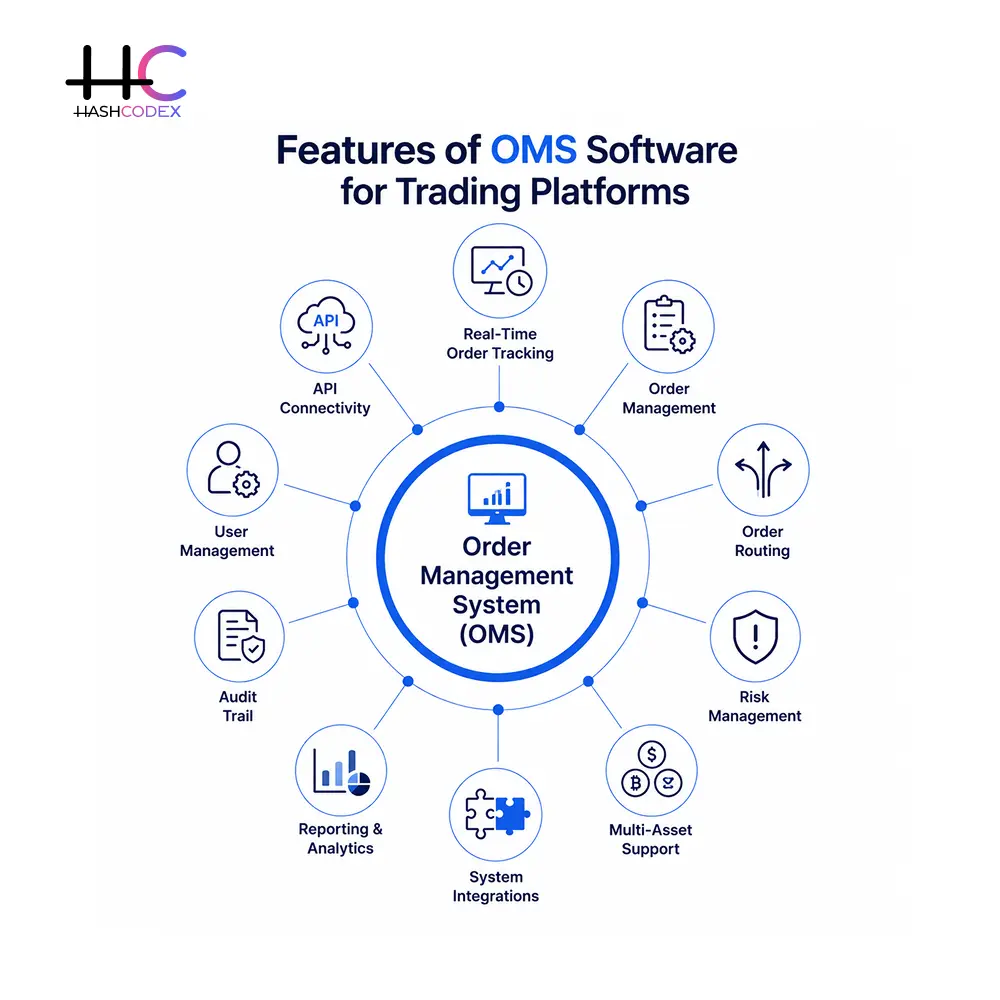
- Real-time order tracking: Track every order with live status updates from placement to execution.
- Order creation and management: Create, modify, cancel, and manage orders from one place.
- Order routing: Route orders to the right exchange, broker, or liquidity provider.
- Risk management: Apply trading rules and checks before orders are processed.
- Multi-asset support: Manage orders across stocks, bonds, currencies, commodities, and derivatives.
- EMS integration: Connect with an Execution Management System (EMS) for trade execution.
- Exchange and broker integrations: Connect with exchanges and brokers to manage order flow.
- Reporting and analytics: Generate reports and review trading activity using order data.
- Order history and audit trail: Keep a complete record of every order and its updates.
- Role-based access: Control user permissions based on roles and responsibilities.
- API support: Connect your OMS with trading platforms, market data providers, and other systems.
- Audit Trails: Maintain detailed records of order activity, user actions, and system events to support compliance and investigation.
- Partial-fill management: Track partially executed orders and maintain accurate remaining quantities, execution status, and order history throughout the lifecycle.
The right combination of features depends on how your trading platform operates. That's why many businesses choose to build a custom OMS that matches their trading workflows and business goals.
OMS Solutions for Trading Platforms
- Stock Trading Platforms: Build integrated OMS solutions that manage client orders, execution, risk checks, and trading workflows across your stock trading platform.
- Crypto Trading Platforms: Enable high-volume crypto trading with real-time order processing, smart routing, risk controls, and multi-asset order management.
- Forex Trading Platforms: Integrate powerful OMS capabilities for fast FX order processing, liquidity connectivity, execution management, and real-time risk monitoring.
- Prop Trading Platforms: Support proprietary trading with advanced order management, automated execution workflows, real-time risk controls, and high-performance infrastructure.
- Hedge Fund Trading Platforms: Develop flexible OMS solutions for complex trading strategies, portfolio order management, execution tracking, and customized workflows.
- Investment Trading Platforms: Simplify order creation, execution, compliance, monitoring, and reporting with an OMS integrated into your investment platform.
- Asset Management Platforms: Manage portfolio orders, allocations, trade execution, and transaction records through a scalable order management solution.
- Institutional Trading Platforms: Build enterprise-grade OMS capabilities with high-performance order processing, market connectivity, execution management, and advanced risk controls.
- Wealth Management Platforms: Integrate OMS functionality to manage client orders, portfolio allocations, trade execution, and advisor-driven investment workflows.
How to Build a Custom OMS for a Trading Platform?
Building a custom Order Management System is a step-by-step process. It starts with understanding your trading requirements and continues through design, development, testing, and deployment.
While every trading platform has different needs, the development process usually includes the following stages.
Step 1: Understand Your Trading Requirements
The first step is to understand how your trading platform works and what you need your OMS to handle.
This includes identifying the markets you support, asset classes, order workflows, user roles, compliance requirements, and the systems your OMS needs to connect with.
Having clear requirements from the beginning helps create an OMS that fits your business instead of making your business adjust to the software.
Step 2: Plan the OMS Design and Architecture
Once the requirements are clear, the next step is planning how the OMS will be built.
This includes deciding the system structure, choosing the right technology stack, designing the database, and planning how orders will move through the platform.
A well-planned architecture makes it easier to add new features, support more users, and connect with other trading systems in the future.
Step 3: Develop the OMS and Connect Integrations
After the planning stage, development begins. The core OMS features are built based on your requirements, including order management, tracking, reporting, and other required functionalities.
The system is also connected with exchanges, brokers, market data providers, Execution Management Systems (EMS), and other platforms your trading business uses.
Step 4: Test the System and Trading Workflows
Before launching the OMS software, the system goes through detailed testing to make sure everything works as expected.
This includes checking order flows, system integrations, performance, and security. Testing helps identify and fix issues before the OMS is used in real trading situations.
Step 5: Deploy and Improve the OMS
Once testing is complete, the OMS is deployed for actual use.
After launch, the system can be improved based on your business needs. This may include adding new features, supporting additional markets, or connecting with new trading services as your platform grows.
A well-planned development process helps create an OMS that fits your trading platform and supports your business requirements over time.
Cost of Developing an OMS for Trading Platforms
The cost of developing an Order Management System depends on your platform's complexity, required features, and third-party integrations. While every project is different, a custom OMS typically falls into the following ranges:
| System Type | Cost Range (USD) | Key Features | Best suited for |
| Basic Retail MVP | $30,000 – $60,000 | Simple order routing, basic market/limit orders, account balance checks. | Startups, small retail apps. |
| Mid-Range Multi-Asset | $60,000 – $150,000 | Multi-currency, stocks/crypto support, multiple liquidity providers, core risk modules. | Emerging brokers, fund managers. |
| Institutional / HFT-Grade | $150,000+ | Microsecond latency, FIX protocol, advanced algorithmic execution, failover clusters. | Tier-1 brokers, prop firms, hedge funds. |
The final development cost is influenced by factors such as:
- Features and functionality
- Number of third-party integrations
- Supported asset classes and markets
- Security and compliance requirements
- Customization and scalability needs
Note: These are general estimates. The actual cost depends on your specific business requirements and project scope.
Conclusion
Building the right Order Management System starts with understanding your trading requirements, workflows, and future goals. It helps you manage orders from start to finish, connect with other trading systems, and keep your trading operations organized as your business grows.
Before you start building, think about the features you need, the systems you want to connect with, and how your platform may grow in the future.
Taking time to plan these things can help you build an OMS that supports your business for years to come.
At Hashcodex, we help companies build custom OMS solutions designed around their unique trading needs. With our trading software development expertise, we work closely with businesses to create platforms that match their goals and the way they want to manage trading activities.
If you're looking for OMS software development services for your trading platform, feel free to contact us. We would be happy to understand your requirements and help you develop an Order Management System that fits your business.
Frequently Asked Questions
How long does it take to build a custom OMS?
Building a custom OMS usually takes around 3 to 9 months, depending on the features, integrations, and complexity of the trading platform.
How does an OMS trading platform benefit your business?
An OMS helps businesses manage orders, track trading activity, reduce manual work, and connect with different trading systems from one platform.
Can an OMS be integrated with existing trading platforms?
Yes, an OMS can be integrated with trading platforms, exchanges, brokers, market data providers, and other financial systems.
What is the difference between OMS and EMS?
An OMS manages the order lifecycle, while an EMS focuses on trade execution. Both systems work together to manage and complete trades.









 NDA on Request
 Free Consultation – Let’s discuss your ideas