
Imagine you have a small business. There is a good chance to grow, but you need money to do it.
So you go for a bank loan through traditional lending systems.
But then comes the
- Forms
- Checks
- Waiting for approval
For many small businesses, this waiting time becomes a problem.
On the other hand, there are people who have money and are looking for ways to earn more from it.
There is a clear gap between these two.
For businesses and entrepreneurs, this presents a promising opportunity to build platforms that connect both sides through a single digital space.
This is one of the reasons why peer to peer lending platform development is gaining attention in the fintech industry.
In this guide, we’ll explore how P2P lending platforms work, the essential features they need, the development process, costs, and key factors to consider before building one.
Let's get into it.
What Is a Peer to Peer Lending Platform, and How Does It Work?
A peer to peer lending platform is an online system that connects people who need money with people who want to invest and earn returns.
It removes the need for a bank as the direct lender and helps both sides interact through a digital platform.
The platform manages important activities such as borrower verification, loan applications, investor matching, repayments, and communication between both parties.
This creates a simplified lending experience while allowing businesses to automate lending operations.
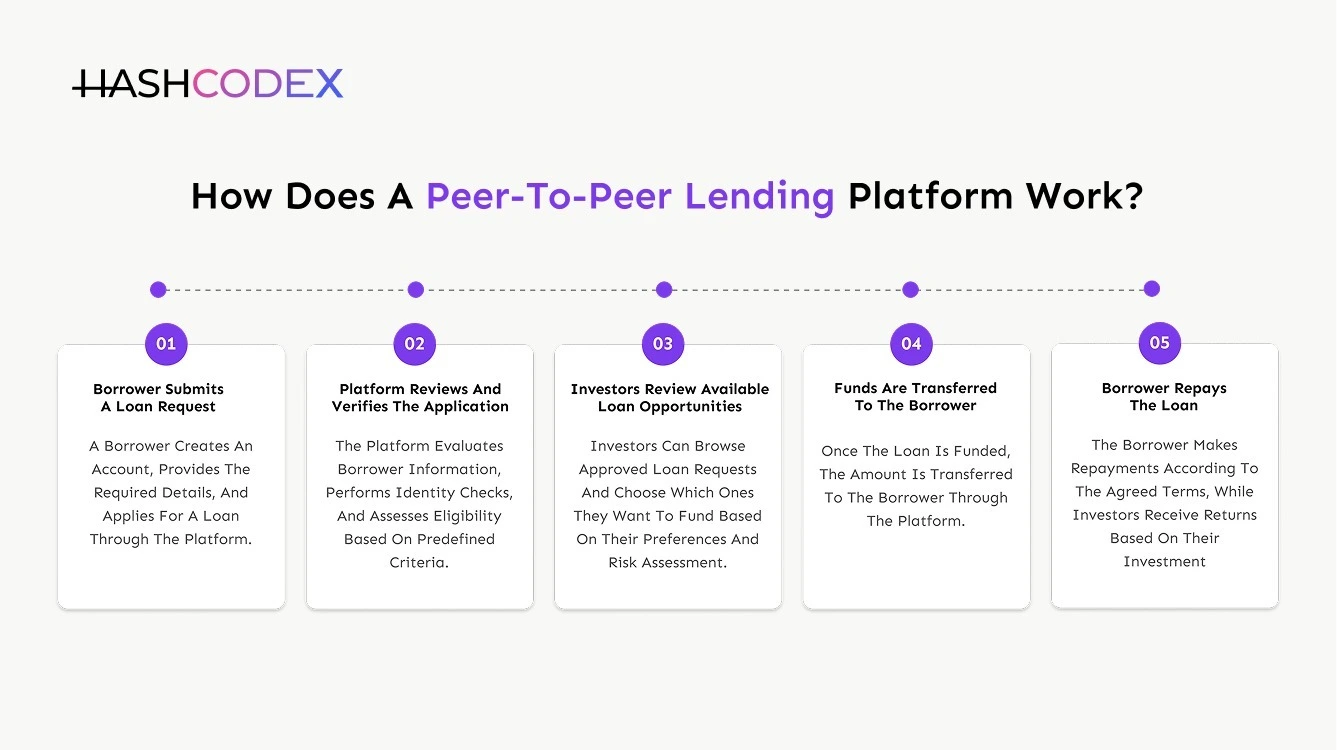
But how does this process actually work?
The image below explains how borrowers and investors interact through a P2P lending platform.
Why Investing in P2P Lending Platform Development Is a Smart Business Move?
Peer-to-peer lending platform development is gaining attention as more people prefer online ways to borrow and invest.
For businesses, this opens up a chance to build platforms that connect borrowers and investors.
A well-planned platform can generate revenue through:
- Loan origination fees
- Service charges
- Investor fees
- Premium platform services
What makes it more interesting is the kind of users it brings together.
You get individuals looking for loans, small businesses needing funds, and investors looking for returns.
When all of them use the same platform, activity keeps flowing from both sides.
Peer to Peer Lending Platform Development and Its Rising Opportunity in Fintech
Peer-to-peer lending platform development involves building a digital platform where borrowers and investors can connect, complete lending transactions, and manage loans in one place.
In recent years, digital lending has been growing steadily as more people move toward online financial services.
The global peer to peer lending market is expected to reach USD 215.18 billion in 2026 and USD 860.64 billion by 2033, with a CAGR of 21.9% during the forecast period.
This growth is happening because traditional lending often takes time and involves multiple checks, which pushes borrowers to look for faster options.
Peer to peer lending platforms help connect both sides by creating a single place where borrowing and investing can happen.
For startups and financial companies, P2P lending platform development creates opportunities to build new revenue streams while meeting changing user expectations.
Types of Peer-to-Peer Lending Platforms You Should Know
P2P lending platforms can be built for different audiences and financial needs.
While the main goal is to connect borrowers and investors, each platform type focuses on a specific lending purpose.
1. Consumer Lending Platforms
These platforms help individuals get personal loans for needs such as education, medical expenses, or debt management. Borrowers apply online, while investors choose loan opportunities based on their preferences.
2. Business Lending Platforms
Business P2P lending platforms help startups and small businesses access funding from investors. They simplify processes like loan requests, verification, and repayment tracking.
3. Real Estate Lending Platforms
These platforms connect property developers or borrowers with investors looking for real estate investment opportunities and returns.
4. Invoice Financing Platforms
Invoice financing platforms help businesses get early access to cash by allowing investors to fund unpaid invoices, improving business cash flow.
What Are the Steps to Develop a peer-to-peer lending software?
Building a peer-to-peer lending software starts with understanding the market, defining business goals, and creating a system that works for both borrowers and investors.
While the exact process may vary from one business to another, most P2P lending platform development projects follow these steps.
1. Research the Market and User Needs
The first step is understanding who will use the platform and what they expect from it.
This includes studying borrowers, investors, competitors, and current lending trends.
The insights gathered during this stage help identify market opportunities and potential challenges.
2. Define Requirements and Business Goals
Once the research is complete, the next step is defining how the platform will operate.
This includes selecting the lending model, deciding on revenue streams, and listing the features the platform needs.
Clear requirements help avoid confusion during development.
3. Plan the Platform Structure
At this stage, the overall structure of the platform is planned.
Teams define user journeys, platform workflows, loan processes, and system architecture.
This creates a roadmap that guides the entire development process.
4. Design the User Experience
The platform is then designed with the end users in mind.
The goal is to make actions like applying for a loan, tracking repayments, or funding loans easy to understand.
A well-designed interface can improve user engagement and platform adoption.
5. Develop the Platform
This is where the actual development work begins.
Developers build the frontend, backend, databases, APIs, and other core platform components.
Features such as user registration, loan management, and dashboards are also developed during this stage.
6. Integrate Essential Services
A lending platform cannot operate in isolation.
It needs to be connected with payment gateways, identity verification tools, credit assessment services, and notification systems.
These integrations support the day-to-day functioning of the platform.
7. Test the Platform
Before launch, the platform goes through multiple rounds of testing.
The goal is to identify bugs, improve performance, and ensure that all features work as intended.
Testing also helps create a better experience for borrowers and investors.
8. Launch the Platform
Once testing is complete, the platform is released to users.
The team monitors performance, user activity, and feedback during the initial launch phase.
This helps identify areas that may need improvement.
9. Maintain and Improve
Launching the platform is only the beginning.
Regular updates, security improvements, feature enhancements, and ongoing support help keep the platform relevant as user needs change.
Continuous improvement also helps businesses stay competitive in the growing peer to peer lending market.
What Are the Key Features Required in a Successful P2P Lending Platform?
A peer-to-peer lending platform should make the lending process simple for borrowers, investors, and platform administrators.
To achieve this, there are a few essential features that every platform should include:
- User registration and profile management
- Identity verification and KYC checks
- Loan application management
- Borrower and investor dashboards
- Credit assessment tools
- Loan tracking and repayment management
- Payment gateway integration
- Notifications and alerts
- Reports and analytics
These features help users manage their activities on the platform while giving businesses better control over lending operations.
The final feature set can vary depending on the platform's target audience and business goals.
Why Are Security and Regulatory Compliance Necessary for P2P Lending Platforms?
A peer-to-peer lending software handles sensitive information such as user details, financial records, loan data, and payment transactions.
Because of this, security cannot be treated as an optional feature.
Platforms should include measures such as:
- Data encryption
- Multi-factor authentication
- Access controls
- Fraud detection and monitoring
- Regular security assessments
Regulatory compliance is equally important.
Depending on the region, platforms may need to follow requirements related to identity verification, anti-money laundering (AML) checks, data protection, and lending regulations.
Failing to meet these requirements can lead to legal issues, financial penalties, and loss of user trust.
By focusing on both security and compliance, businesses can create a safer lending environment for borrowers and investors while operating within regulatory guidelines.
How Much Does Peer-to-Peer Lending Software Development Cost?
One of the most common questions businesses ask is the cost of peer-to-peer lending software development.
The cost to build a P2P lending platform depends on the features, integrations, and level of customization required.
A platform with basic lending functionality will cost less than one that includes advanced features such as credit assessment, investor management, analytics, and automation.
Other factors that affect the cost include payment gateway integration, third-party services, security requirements, regulatory compliance, and mobile application development.
In most cases, custom P2P lending software can cost anywhere from $15,000 to $100,000+, depending on the project scope and business requirements.
Conclusion
Peer-to-peer lending is slowly changing how borrowing and investing work in today’s digital world.
For businesses, this opens up a space where both borrowers and investors can be brought together in one system.
Getting the basics right makes a big difference here.
From planning the platform to handling features, security, and compliance, every part plays a role in how well it works.
This is where we at Hashcodex, as a Fintech software development company, often see businesses needing clarity on how peer to peer lending platform development should be approached in a practical way.
With the right approach, businesses can build something that supports real financial needs on both sides.
If you’re exploring this space, this could be the right time to look at how it fits into your plans.
FAQ
How to start a Peer-to-Peer lending business?
To start a peer-to-peer lending business, you need to define your business model, decide the target audience, and plan how borrowers and investors will interact. After that, the platform is developed with the required features and aligned with legal and compliance rules.
How long does it take to develop a peer-to-peer lending platform?
The time depends on the platform size and features. A basic peer-to-peer lending platform may take a few months, while a more advanced platform with integrations, security layers, and testing can take six months or more.
How do peer-to-peer lending platforms build trust between borrowers and investors?
Trust is built using identity verification, credit checks, transparent loan details, secure payment systems, and real-time repayment tracking. These steps help both borrowers and investors make informed decisions.
Is peer-to-peer lending platform development profitable for businesses?
Yes, it can be profitable through fees such as loan processing charges, service fees, and investor transaction fees. Profitability depends on user activity, platform adoption, and the overall business model.









 NDA on Request
 Free Consultation – Let’s discuss your ideas