
One day, a new prop firm launches with big plans. The traders start coming in, the business begins to grow, and everything seems to be moving in the right direction.
Then, a few months later, the firm shuts down.
So, what happened?
The answer is not always one major mistake. Sometimes, financial problems, risk management issues, technology gaps, or operational problems build up slowly until the business can no longer keep up.
The tricky part is that these warning signs are not always obvious when you are just starting out.
If you are planning to build a prop firm, what challenges should you be looking out for from the start?
In this blog, we will take a closer look at why new prop firms fail, where the pressure usually starts, and what founders can do before those problems become harder to manage.
Why Do New Prop Firms Fail? The Root Causes Behind Shutdowns
Getting your prop firm live is only the first step.
Once the business is running, there are many moving parts to keep track of. If one area is not planned properly, it can start affecting other parts of the business too.
So, what are the main prop firm failure reasons founders should know before they get started?
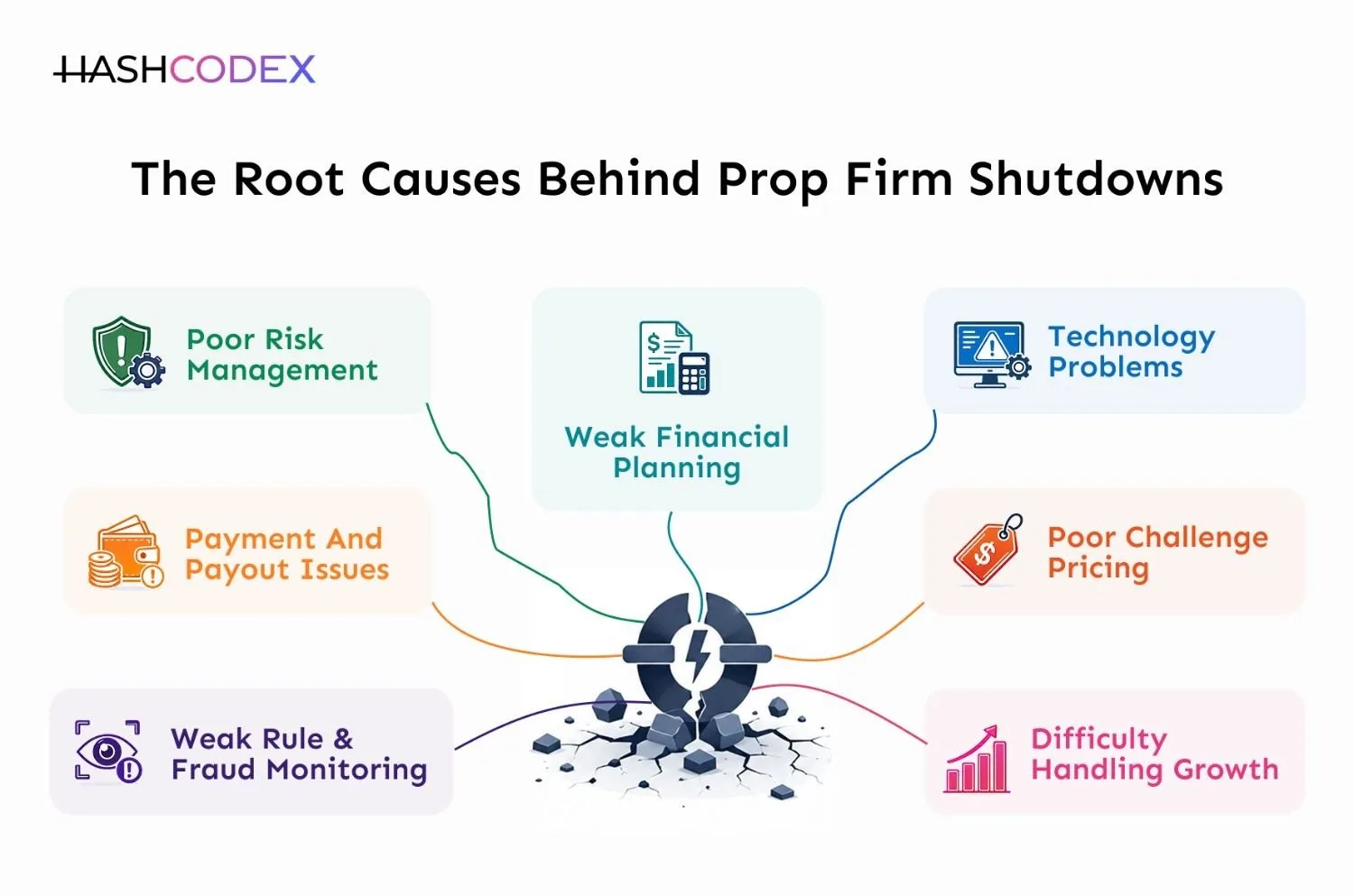
1. Poor Risk Management
Risk management is one of the most important parts of running a prop firm. The firm needs to track trader activity and understand how much risk it is taking across its accounts.
Without proper risk controls, losses or rule breaches can become harder to manage. As the trader base grows, this can put more pressure on the business.
If you want to know more about how risk management improves prop firm’s performance, then check out this blog Prop Firm Risk Management System
2. Weak Financial Planning
A prop firm needs enough money to cover its regular expenses and unexpected costs. This can include trader payouts, refunds, staff, technology, marketing, and other business expenses.
If these costs are not planned properly, the firm may run into cash flow problems even when it is getting new traders.
3. Technology Problems
Technology supports many parts of a prop firm, from account management and trading platforms to risk checks and reporting.
A system may work well during the early stages but still cause problems if different parts of the platform do not work together properly. Technical issues can then affect both the team and the trader experience.
4. Payment and Payout Issues
Payments are a key part of the prop firm business. Traders need to be able to pay for challenges, while the firm needs a clear process for refunds and payouts.
Failed payments or delayed payouts can create support issues and affect trader trust. Repeated problems can also add more work for the team.
5. Poor Challenge Pricing
Challenge pricing needs to make sense for the business. If prices are set too low, the firm may struggle to cover its costs.
At the same time, pricing that does not match what traders expect can make it harder to attract and retain customers. Founders need to consider costs, payouts, competition, and trader demand when setting prices.
6. Weak Rule and Fraud Monitoring
A prop firm needs to monitor trading activity and check whether traders are following its rules. Doing this manually can become difficult as the number of accounts grows.
Without proper checks, rule violations or suspicious activity may not be identified quickly. This can create extra risk for the business.
7. Difficulty Handling Growth
Growth sounds positive, but it also brings more work. More traders mean more accounts, trades, support requests, payments, and data to manage.
If the business is not prepared for this increase, processes that worked at launch may no longer be enough. This can create pressure across several parts of the firm at once.
How Can These Problems Lead to a Shutdown?
These risks do not always happen separately. One problem can make another problem harder to manage.
For example, technology issues can affect risk monitoring, while poor risk control can increase financial pressure. Higher costs and payment problems can then make it harder for the firm to keep up with its expenses.
That is why founders need to look at the prop firm as a whole. A firm can have a good trading challenge but still struggle if the systems behind the business cannot support it.

The Five Risk Areas That Every New Prop Firm Should Evaluate
Now that we have looked at what can go wrong, let us turn the question around.
Before you build and launch your prop firm, what should you actually check?
You do not need to look at every possible problem at once. Start with five areas that can have a big impact on how your business handles day-to-day operations and future growth.
Think of these as a quick check before you move ahead.
1. Financial risk
Can your business handle payouts, refunds, regular expenses, and a period when new signups are lower than expected?
2. Risk management
Can you keep track of trader activity and apply your rules without relying too heavily on manual checks?
3. Technology
Can your systems handle accounts, trading data, payments, and the other daily tasks your team needs to manage?
4. Operations
What happens when you have more accounts, more support requests, and more payout requests than you had at launch?
5. Growth
If your trader base grows much faster than expected, can your current setup handle it?
These five areas can give you a clearer picture of where your prop firm may need more planning before launch and help you understand how to avoid prop firm failure. They can also help you decide where the right technology or outside support could make a difference.
What Do Sustainable Prop Firms Have in Common?
Now let us take it one step further.
What do prop firms that continue operating actually do differently?
They do not treat these areas as something to think about only when a problem appears. They build their business around them from the beginning.
- They keep a close eye on their finances instead of looking at revenue alone.
- They monitor trader activity and risk as the business grows.
- They put processes in place, so their teams do not have to handle everything manually.
- They also pay attention to what is happening across the business.
The firms that last are not simply focused on getting more traders. They also think about how they will manage those traders and how the right prop firm software can support that as the business grows.
That is the mindset worth taking into your own prop firm.
Build the processes, systems, and checks around the business before you need them, rather than waiting until growth makes them necessary.
How Prop Firm Software Can Reduce These Failure Risks?
Now comes the practical part.
You know the risks. You know the areas that need attention. But managing all of them manually becomes harder as your trader base grows.
This is where prop firm software can help.
At Hashcodex, we provide a prop firm solution that brings key parts of the operation together, including trader management, challenge automation, risk monitoring, payments, reporting, and admin controls.
For example, our solution can help with:
- Trader and account management
- Challenge and rule management
- Risk monitoring
- Trading platform integrations
- Payment and payout management
- Admin dashboards and reporting
The goal is simple. Your team should not have to manage every part of the business manually or switch between different tools just to keep track of what is happening.
We also understand that every prop firm has its own business model and requirements. That is why the technology should fit the way you want to run your firm, rather than forcing you into a fixed setup.
Conclusion
There is a lot to think about before launching a prop firm.
You need a business model that makes sense, clear risk controls, manageable operating costs, reliable processes, and technology that can support the way you want to run the business.
But you do not need to solve everything at once.
Start by looking at the five areas covered in this article. Find the gaps, understand what your business will need as the trader base grows, and put the right processes in place before those gaps become problems.
If you are planning your prop firm and want help working through the technology side, book a consultation with our team.
We can discuss your business model, requirements, and what you need to get your prop firm ready for launch.











 NDA on Request
 Free Consultation – Let’s discuss your ideas