
Where did that missing payment go?
If you’re running a fintech platform, you know that a payment does not always end with a simple “successful” status. A transaction can appear correctly in your system while the bank or payment provider processing it shows something different.
In most cases, these records should match. But differences can happen. A transaction may be missing from one system, recorded twice in another, or show a different amount because of fees, adjustments, or settlement.
When this happens, your team needs to compare records across systems to understand what went wrong. Doing this for a few transactions may be manageable, but when you are dealing with hundreds or thousands of payments, manual checks can quickly become time-consuming and difficult to scale.
So, how can fintech businesses keep their transaction records accurate without relying on manual checks?
In this blog, we’ll explore how reconciliation works and how automation can help fintech businesses manage and match transactions across banks, payment service providers (PSPs), and crypto wallets.
What Is Fintech Reconciliation?
First, let's understand the basics.
Fintech reconciliation is the process of comparing transaction records from different financial systems to make sure they match, and any differences are properly explained.
For a fintech business, the same payment can be recorded in its own system and by the bank or payment provider that processes it. Reconciliation helps the business compare these records and confirm that the transaction details are correct.
For example, suppose a customer pays ₹5,000 through a fintech platform. The platform records the full ₹5,000, while the payment provider sends ₹4,900 after deducting a ₹100 processing fee.
The amounts are different, but this does not necessarily indicate an error. Reconciliation helps the business identify the ₹100 difference and confirm that it was caused by the provider’s fee.
In simple terms, reconciliation helps fintech businesses compare their transaction records with those maintained by banks, payment providers, and other financial systems they work with. This makes it easier to spot errors, explain differences, and keep financial records accurate.
How Traditional Fintech Reconciliation Works
Now, how was this handled before businesses started automating it?
For many fintech teams, reconciliation meant collecting reports and checking transactions manually.
A finance or operations team might download a bank statement, export a PSP report, and pull payment data from the company's own system. They would then work through the records to see which transactions matched and which ones needed attention.
The process usually followed a simple sequence:
Collect the records → Compare the transactions → Match the records → Find the differences → Investigate → Resolve
For a small number of transactions, this approach could be manageable. But as the number of payments grew, checking each record manually became a much bigger task.
A team dealing with thousands of payments would have to spend more time going through reports, checking transaction details, and tracing mismatches.
That is where the limitations of manual reconciliation started to show.
How Reconciliation Is Automated Across Banks, PSPs, and Crypto Wallets
If your fintech platform works with banks, PSPs, or crypto wallets, then you might be dealing with different types of transaction data. Each source records payments in its own way, so the reconciliation process needs to work with the information available from each one.
Automated reconciliation brings these records into one process and checks them against each other. But how does that actually happen? Let's break the process down into a few simple steps.
How Automated Reconciliation Works
- Collect the records: The system gathers transaction data from the different financial systems involved, such as banks, PSPs, internal systems, or crypto wallets.
- Organize the data: Records from different sources may use different formats or names. The system organizes the information so that the records can be compared.
- Match the transactions: The system checks details such as the transaction ID, amount, currency, date, and payment status to find records that belong to the same transaction.
- Flag differences: If the details do not match, the transaction is flagged so the team can take a closer look.
- Review and resolve: The team reviews the flagged transaction, finds the reason for the difference, and takes the required action.
Once this process is complete, transactions that match can be marked as reconciled, while the exceptions remain available for review.
Now that we have the basic process in place, let's see how it works when the records come from a bank, a PSP, or a crypto wallet.
Automating Bank Reconciliation
For bank reconciliation, the system compares your fintech platform's internal records with the transactions recorded by the bank.
For example, your internal system may show a ₹10,000 transfer, while the bank statement shows ₹9,950 because a ₹50 bank charge was deducted.
The system can identify the difference and connect it to the bank charge instead of treating the transaction as an unexplained mismatch.
It can also flag things such as pending transfers, failed payments, or duplicate records for your team to review.
Automating PSP Reconciliation
A PSP, or Payment Service Provider, helps businesses accept and process customer payments. A single payment can therefore appear in your platform, the PSP's records, and the final settlement report.
Automated PSP reconciliation compares these records to check whether the payment and settlement details match.
For example, a customer pays ₹2,000, but the PSP settles ₹1,940 after deducting a ₹60 fee. The system can connect the payment with the settlement and record the ₹60 difference as a fee.
This can be especially helpful when your fintech business works with multiple PSPs. Each provider may have its own report format and way of recording transaction details.
Automating Crypto Wallet Reconciliation
Crypto wallet reconciliation works in a similar way, but the system also needs to work with blockchain transaction records.
For example, your platform may record that a customer deposited 1 ETH. The system can check the related blockchain transaction, wallet address, and amount against your internal record.
It can also take network fees and transaction confirmations into account. This helps your team understand whether a difference is a real mismatch or simply a transaction that is still waiting for confirmation.
Key Benefits of Automated Fintech Reconciliation
So, what does your fintech team actually get from automating reconciliation?
The main difference is that the system can take care of much of the repeated checking, while your team can focus on the transactions that need a closer look.
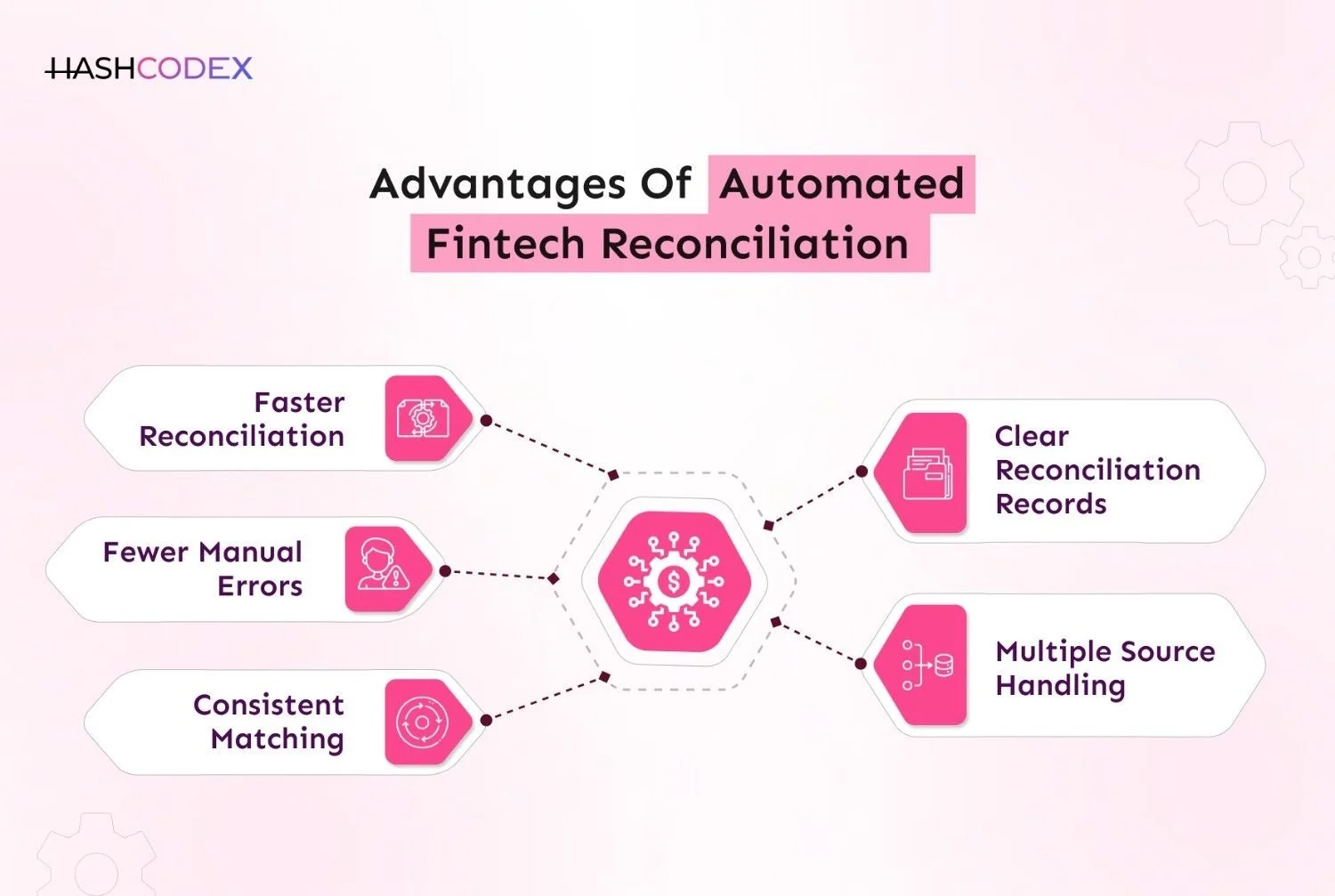
Here are some of the key benefits:
- Faster reconciliation: When transactions can be matched automatically, your team can spend less time collecting reports and checking records manually.
- Fewer manual errors: Repeatedly comparing large numbers of records can lead to small mistakes. Automated checks help reduce errors during the matching process.
- Consistent matching: The same matching rules can be applied across large numbers of transactions, rather than relying on different people to check records in different ways.
- Clearer reconciliation records: The system can keep track of which transactions matched, which ones were flagged, and which exceptions are still waiting for review.
- Easier handling of multiple sources: If your fintech platform works with several banks, PSPs, wallets, or currencies, bringing their records into the same reconciliation process makes it easier to see what has been matched and what still needs attention.
Overall, automated reconciliation helps fintech teams spend less time on repeated record checking and more time dealing with the transactions that actually need their attention.
Common Challenges in Automating Fintech Reconciliation
Automation can take care of much of the repeated work, but it does not mean every transaction will match automatically. There are still situations where the records can differ, or the system may not have enough information to make a match.
Some common challenges include:
- Different record formats: Banks, PSPs, and other financial systems may use different transaction IDs, date formats, or payment status names for their records.
- Timing differences: One system may record a payment immediately, while another may update it later when the payment is settled.
- Missing or duplicate records: A transaction may be missing from one system or appear more than once, making it harder to match the records.
- Fees and partial settlements: The amount recorded by a payment provider may be different from the original payment because of fees or a partial settlement.
- Different currencies: When a transaction is recorded and settled in different currencies, exchange rates can cause the amounts to differ.
- Failed or reversed payments: A payment may first appear as completed and later fail or get reversed, leaving different statuses across systems.
- Crypto confirmation times: A blockchain transaction may be visible before the platform considers it fully confirmed, creating a difference in timing.
These situations are why exception handling remains an important part of automated reconciliation. When the system cannot confidently match a transaction, it can flag it for the team to review instead of marking it as reconciled.
So, automation does not remove the need for human review completely. It helps separate the transactions that can be handled automatically from the ones that need someone to take a closer look.
Conclusion
When you are building or running a fintech platform, there is a lot happening behind every transaction. Reconciliation may not be the part your users see, but it still matters when you need to know that your financial records tell the right story.
As your platform works with banks, PSPs, or crypto wallets, keeping track of these records can become part of your day-to-day financial operations.
Having the right fintech development solution in place can make it easier for your team to manage transactions, identify mismatches, and know what needs their attention.
Automation can take care of the repeated checks while your team steps in when something needs a closer look. That way, reconciliation becomes less about going through every transaction and more about dealing with the ones that actually need an answer.
So, if reconciliation is something your fintech platform is likely to deal with as you grow, it is worth thinking about how you want that process to work from the start.










 NDA on Request
 Free Consultation – Let’s discuss your ideas