
Have you ever wondered why Forex CRM technology keeps changing over the years?
The reason is simple.
As the Forex industry grows, the way brokers manage traders, communication, and daily activities changes too.
A CRM system that was enough a few years ago may need new capabilities today to support modern brokerage requirements. This has led to new Forex CRM technology updates in areas like automation, analytics, integrations, and AI.
But these changes are not just about adding new features.
They are changing how brokers use CRM systems, helping them manage their operations and understand their clients better.
So, what are the latest Forex CRM technology updates in 2026?
In this blog, we will explore how Forex CRM has evolved, the latest Forex CRM updates you should know, and what we can expect in the future.
How Has Forex CRM Changed in Recent Years?
Can you imagine how different it is to manage a Forex brokerage today compared to a few years ago?
The way brokers manage clients has changed greatly over time. But this change did not happen overnight.
The journey of Forex CRM can be understood through different stages:
- Before 2000s: Manual Client Management
During the early stages of Forex trading, brokers mainly depended on manual records, spreadsheets, emails, and phone conversations to manage client details and communication.
- 2000s: The Introduction of Digital CRM Systems
As online Forex trading started growing, brokers began adopting digital systems to store customer information, manage leads, and keep track of client interactions more easily.
- 2010s: The Rise of Forex Specific CRM Platforms
With the growth of retail Forex trading, brokers needed systems built specifically for their industry. CRM platforms started connecting with trading platforms, payment solutions, and other brokerage tools.
- 2020s: The Growth of Connected Forex CRM Solutions
As brokerages expanded and trader expectations changed, CRM systems started supporting more areas such as client communication, reporting, automation, and data management.
Today, Forex CRM has come a long way from being a simple system used to store client details. It has become an important part of how brokers manage their daily activities and understand their clients better.
And this evolution has created the foundation for the latest Forex CRM technology updates we are seeing in 2026.
What Are the Latest Forex CRM Technology Updates You Should Know in 2026?
Forex CRM has changed a lot over the years, and 2026 is bringing another set of updates.
The focus is no longer just on managing client information. Today, Forex CRM solutions are becoming a key part of brokerage technology, helping businesses connect their operations, manage traders better, and build platforms that match changing market needs.
Here are some of the biggest technology updates changing Forex CRM in 2026.
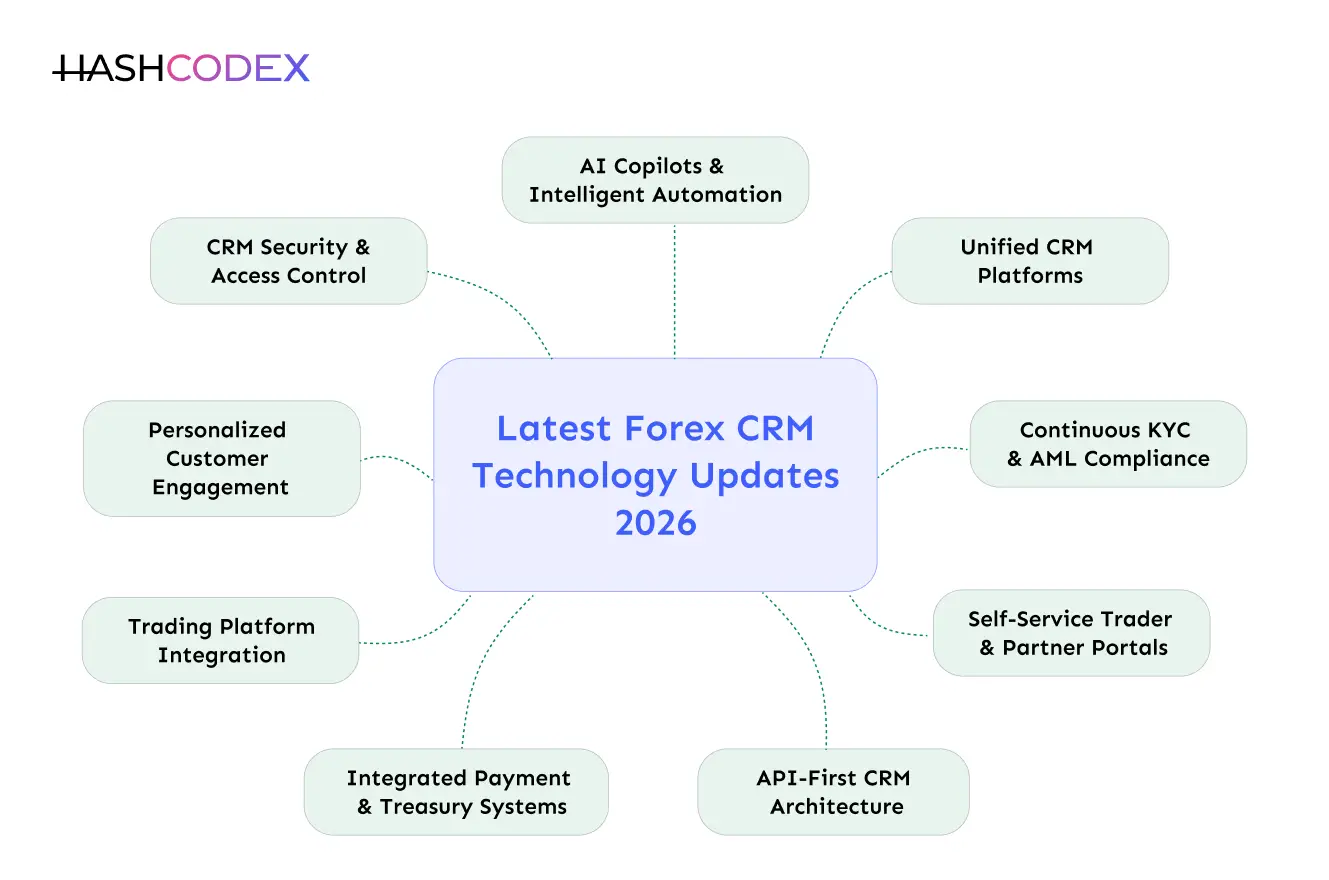
01. AI-Powered CRM & Copilots
Not long ago, automation in Forex CRM was mostly limited to repeated tasks like assigning leads, sending emails, or updating customer records.
Today, AI copilots are taking this a step further.
Instead of simply completing tasks, they can understand client activity, summarize previous conversations, recommend the next action, and even help sales or support teams prepare personalized responses.
For example, if a trader completes registration but does not make their first trade, the CRM can identify that activity and suggest the best follow-up instead of waiting for someone to notice it manually.
02. Unified Brokerage CRM
Managing a brokerage often meant switching between multiple platforms.
A sales team might check the CRM, and the finance team would use another system, while trading data and KYC information stayed somewhere else.
Today, many Forex CRM platforms connect these services into one place.
Instead of working with separate systems, brokers can access information such as:
- Trading account details
- Payment history
- KYC status
- Support tickets
- Partner information
This gives every team a more complete picture of the client without constantly moving between different platforms.
03. Continuous KYC/AML Monitoring
For many years, compliance checks mainly happened when a trader opened an account.
Once the documents were approved, the process was largely complete.
In 2026, this approach is changing.
Many CRM platforms now continue monitoring compliance throughout the customer journey. They can:
- Track document expiry dates.
- Monitor changes in customer information.
- Notify teams when additional verification is needed.
- Record every compliance activity for future audits.
This helps brokerages keep customer records up to date instead of relying only on the initial verification.
04. Self-Service Trader & Partner Portal
Partners, affiliates, and traders often need quick access to important information. Modern CRM platforms are introducing self-service portals to reduce dependency on manual support.
Earlier, they usually contacted brokerage teams whenever they needed referral reports or commission details.
Today, many CRM platforms include dedicated partner portals where they can access this information themselves.
For example, an introducing broker can log in, check new referrals, view commission reports, download marketing materials, and monitor performance without waiting for manual updates.
This saves time for both the partner and the brokerage team.
05. API-First CRM Architecture
No two brokerages follow exactly the same process.
Some may have different onboarding steps, while others use different payment providers or trading platforms.
Because of this, modern Forex CRM platforms are becoming more flexible.
Instead of relying on software providers for every small change, many systems now support API first architecture and low-code tools that allow brokerages to:
- Connect third-party services.
- Build custom workflows.
- Add new communication channels.
- Create dashboards that match their business needs.
This gives brokers more freedom to adapt their CRM as their requirements change.
06. Payment & PSP Integration
Deposits and withdrawals are an important part of the Forex customer journey, so payment integrations are becoming increasingly important in modern CRM platforms.
Instead of keeping payment information separate from customer records, brokers can connect deposit and withdrawal activity with individual client profiles. This allows teams to understand funding behaviour alongside account and engagement information.
It also creates opportunities for automation. When a client completes a successful deposit, for example, the CRM can automatically update the client status and trigger the next stage of the customer communication journey.
07. Trading Platforms and CRM Integration
Another important development is deeper integration between CRM platforms and trading systems. When trading activity is connected with customer information, account managers can gain a better understanding of where each client is in their trading journey.
This gives teams more context when communicating with traders. Instead of seeing only basic customer information, they can understand account activity and engagement within the same environment.
The result is a more connected workflow between sales, customer support, account management, and trading operations.
08. Personalized Client Engagement
Forex brokers are also moving away from sending identical messages to every customer. Modern CRM systems can use client behaviour and activity to create more relevant communication.
A newly registered lead may require a different approach from a verified client who has not deposited, while an active trader may need completely different communication from an inactive customer.
By using customer data more intelligently, CRM platforms can help brokers deliver communications tailored to individual behaviour rather than relying on one-size-fits-all campaigns.
09. CRM Security & Access Control
As more brokerage operations move into a single CRM environment, security is becoming increasingly important. Modern Forex CRM platforms handle sensitive customer, financial, trading, and compliance information, making access control and data protection essential.
Brokers are therefore paying greater attention to features such as role-based permissions, multi-factor authentication, activity monitoring, API security, and detailed audit trails. The objective is to make information accessible to the right teams while maintaining strong control over sensitive data.
Looking at these updates, one thing becomes clear. Forex CRM is no longer evolving through individual features. Many of these changes are connected, and AI is becoming a key part of that transformation.
So, before we look at what the future holds, let's understand how AI is making today's Forex CRM systems smarter.
How Is AI Building Smarter Forex CRM Systems?
If AI is becoming part of almost every Forex CRM update, what is it actually doing behind the scenes?
The answer is quite simple. Instead of just storing information, AI helps CRM systems make better use of it.
Here are a few ways AI is helping Forex CRM become smarter:
- Understanding client behavior by looking at trading activity and previous interactions.
- Helping sales teams and account managers focus on the right leads by understanding trader activity, engagement, and account progress.
- Answering common customer questions before they need to reach a support representative.
- Spotting unusual account activity and notifying teams when something needs attention.
- Suggesting the next best action based on a trader's activity and engagement.
- Organizing large amounts of information into simple reports that are easier to understand.
The goal is not to replace people or make decisions on their behalf.
Instead, AI gives brokerage teams better information at the right time, helping them spend less time searching for data and more time supporting their clients.
As AI continues to improve, its role inside Forex CRM is likely to grow even further, making these systems more capable than ever before.
Summary Checklist for Choosing a 2026 Forex CRM
When evaluating a new Forex CRM, make sure your shortlist covers these essential capabilities:
✅Native, two-way MT4, MT5, and cTrader connectivity
✅No-code or low-code workflow automation
✅Built-in omnichannel communication
✅AI-powered lead scoring and predictive client-retention tools
✅Integrated KYC, AML, and ongoing compliance workflows
✅Real-time payment and PSP integrations
✅Automated multi-tier IB and affiliate management
✅Self-service Trader and Partner portals
✅Open APIs and webhooks for third-party integrations
✅Real-time analytics and customizable reporting
✅Strong security, role-based access, and audit trails
✅ Transparent pricing without hidden setup or integration fees
What Can We Expect From Forex CRM Technology Next?
Forex CRM has already come a long way, and the next few years are expected to bring even more changes.
In fact, the global Forex CRM solution market was valued at around USD 0.51 billion in 2025 and is projected to reach USD 0.84 billion by 2033, growing at a CAGR of 6.5%.
This steady growth shows that more brokerages are continuing to invest in smarter CRM technologies.
So, what does this mean for the future?
Forex CRM systems are likely to become more connected, where different brokerage tools can work together and give brokers a clearer picture of their clients. AI will also continue to grow, helping teams understand customer behavior, handle regular tasks, and make better decisions.
Another area to watch is personalization. Instead of sending the same updates to every trader, future CRM systems may help brokers communicate with clients based on their activities, interests, and needs.
Looking ahead, for businesses building Forex CRM software, these developments show the importance of choosing technologies that can adapt to future industry needs.
This shows how the future of Forex CRM could focus on helping brokers understand their clients better, manage daily operations, and build stronger relationships.
Conclusion
The latest updates in 2026 show how technologies like AI, automation, analytics, and integrations are changing the way brokers manage their daily activities.
But this journey is still continuing.
As trader expectations continue to grow, Forex CRM technology will also continue developing to support the changing needs of the industry.
Now the question is, are you ready for what comes next in Forex CRM?
With so many changes happening in Forex CRM technology, businesses have plenty of opportunities to improve the way they manage their operations.
To make the most of these opportunities, it is important to work with a Forex CRM provider who understands the latest developments and knows how to apply them in the right way.
At Hashcodex, we help businesses develop Forex CRM solutions that align with modern technology trends and changing brokerage requirements, so they can stay updated as the industry continues to grow.








 NDA on Request
 Free Consultation – Let’s discuss your ideas